Wednesday, March 20, 2013

Time Zones and School Zones: Two Worlds Apart

It's Elementary

First grade was a stepping stone of new policies, teachers, parents and friends. Though some aspects of a fresh milestone produce excitement, not all of those stones were a shot out of a picturesque scene from the serene rock gardens of Kyoto. It took me at least two terms to pull back on comparing my own experiences of elementary school as a student, my experiences in US schools as a teacher, or even my early years in Japan on the "other side of the desk" as an English instructor. The number of unscripted, behind-the-scenes of life as an elementary school student here that my former roles couldn't provide so much as stand-ins for, are countless. I have found the hands-on-hard way that I am my own one-man stunt woman here, facing the "rocky" roads without a helmet.

Elementary school entrance ceremony: parents, students and teachers (perhaps I need to clarify that we are in the back, right hand side, and she is the 2nd row, left of center).
Walking Groups: The road less traveled by, the Japanese way

America springs ahead, falls back.  Although Japan doesn't move their clocks back during the school year, I have gone back in time.  I don't mean to say the system of education is out of date, but a little closer to the feeling of the age old joke, "in my day, we walked to school, up hill, both ways!"

We happen to live close to school here, yet thousands of miles from the yellow school bus, the car pool, the lift from Mom and Dad, or what I call the "American school zone" of transportation. Now I live in yellow hat territory. Rain or 100F degree-heat shine, typhoon or blizzard, it's a "walking group zone."  No wheeled transportation of any kind, any day -- buses, cars, bikes, scooters or skates, would be a pipe dream (the American dream?) reserved for lazy, wicked people.

A few of the parents on our block growing up divided the driving, while kids who lived a little farther out took the school bus. I remember singing songs on the way in our carpool, to the point where Mr. B told us not to talk or sing because it steamed up the windows.  It should be noted that his kids were and are musical or athletic proteges, and I picked up on that by age 8 (my deductive reasoning skills were accelerated on that thanks to the constant hum coming from their dual baby grand pianos). Fast forward thirty-some years, and now as a mom I realize that the parents were genius too, since I totally bought his theory and closed my mouth "for visibility's sake."  Fair enough, by upper elementary, I spent those quiet 5 minutes down Ritamarie Drive as the only time I devoted to cram for spelling tests.

In Japan, elementary school students walk to school in all cases, year round. City hall assigns them to the closest public school from their homes. Each kid is designated a starting point to meet their school walking group, comprised of 5-7 students, with the oldest kid leading the single line. The second oldest kid brings up the tail, and the younger tots are sandwiched in the protective cocoon by descending age from either end, not by height, as this is a hierarchy based (senpai culture): 6th grader, 4th grader, 1st grader, 2nd* grader (*ours), and 5th grader. They meet at 7:40 am, file in step and march off to school in their pack, and finally do the reverse at the end of the day on the way home, at an undisclosed time which is not the same every, or any, day.

The walking group, lined up in their age based bell curve of protection.
If for some reason you are going to be late, require an early dismissal or have a pre-arranged absence from school, policy dictates that you must contact that walking group leader to let them know in the form of hand delivered written notification, that you are not coming. To inform the school, there is a half sheet of paper that must be delivered to the teacher by the parent, also by hand. That means if your child is sick, you have to go that morning to the school to hand in the form. A phone call is never sufficient. I imagine this policy reduces absences greatly, unless the parents believe that their child's morning sniffle trumps their shot at a second cup of coffee.  But again, I am thinking from the culture of lazy, wicked parenting. (Disclaimer: I love you Mom.)

On rainy days, students carry their uniform yellow umbrella, and only then can they wear rain boots, but other than in a heavy storm deemed tropical rain front or typhoon, they must walk to school in tennis shoes that would be appropriate for gym class. Don't try slipping anything fancy in there like light up shoes, glow in the dark laces, character or logo laden anything, and don't dare close your eyes and dream about wheelies, noise makers, or anything else sneaky enough to distract children from the concentrated task of putting one foot in front of the other to reach school. After all, they are in the business of reciting their multiplication tables aloud, not whistling as they walk.

Roster for 7 of the walking groups in our neighbourhood -- color-coded ribbons hanging from backpacks designates your starting point, for further ID reinforcement.

Emergency Messaging from the Principal: Not your morning talk show

Tuning into the Ohio news, we'd learn of a chance of snow and go to bed dreaming of a snow day, or at least a delay. At the crack of dawn, I'd put my alarm clock-radio on, and just pray to the DJs to call off UA schools, often in the race for the last in the city to call off.

In extreme weather, in the case of tweaking the timing of the eye of the typhoon or during a heavy snow, we've been messaged via the emergency text system (which sends texts from the school to all parents, grades 1-6; there is a separate emergency phone chain for each class), that the walking groups would start an hour late.

In winter, they can't wear boots, as such footwear is only permitted in heavy rain, they can't wear any hat other than their yellow uniform cap, and no hoods that would cover up the regulated yellow. No scarves (I guess at this point in the rigid rule regimen, they could harm themselves), but neck warmers are okay, only for the walk to school but must be removed upon entering the building. Leg warmers are never okay, though I admit I could have used that warning in 1980. We did receive a text the day after a heavy snow to send our child to school in gloves, not mittens, yet this was not to encourage touching or throwing snow, just for added protection if they slid on the ice.

Obedient march to school in snow: no added hats, scarves, or  frivolous leg warmers.


It didn't take too many evening news headlines featuring kids dropping on playgrounds due to heat exhaustion or heat stroke to initiate a text regarding a hydration policy.  In extreme heat, it is acceptable for students to carry a thermos as long as the contents comply with the rules: iced barely tea, green tea, or water. No juice, milk, sweetened tea, sports drink or pop. (I looked over my shoulder to type that last one just now -- not just the forbidden drink -- it doubles as a bad word.)

Approved gear for the walk to school in extreme heat - thermos with strap, which complies with freeing the arms for a safe walk to school.  No drinking en route - they keep it at school for  designated, supervised drink breaks.


Only once was class-specific emergency phone chain activated, and boy, when the Mother on the list before me introduced herself as, "calling in the chain," my heart skipped a beat.  You don't live on an active earthquake plate without jumping to disaster, but the 9-1-1 was regarding the math homework for that evening.  Skill drill #13 was assigned, when it was intended to be #12, so cancel the homework before the kid gets overwhelmed by approaching new material that hasn't been covered in class.  And please call the next number on the list before that kid damages his psyche and starts sharpening pencils, or worse, goes for that lethal, unapproved scarf on your coatrack.  The final call goes back to the teacher to ensure all were contacted, and tragedy abated.

Notice we're not even to the school gate yet?

When the students arrive at school, they check their outdoor shoes and uniform umbrellas at the main entrance (a second umbrella is stored on their class veranda for sudden rains not predicted by the morning weather forecast on any given day), then head to their classrooms. They have all their gear for the day on them. There are no lockers or closets at school. Each student has a desk drawer equipped with a blue, A4-sized box that they keep supplies in, and a cubby in the back of the class to stow their larger gear: science set, math kit, gym uniform, paint set, calligraphy case, musical instruments.  They store the gear that they will use for the day at school, and it comes home nightly -- pencils to sharpen, supplies such as glue, tape, scissors and erasers requiring inventory checks for quantity and quality and potential replacement.  On any given weekday she totes more gear to school than I check in on Delta Airlines annually.

Not an off to the airport look, just any given school day.
Patrol Duty: A different take on the Fashion Police

I was on patrol duty in elementary school.  I was on outdoor assignment, and wore the Miss America style sash/belt in neon orange, held a 3 ft wooden stick with a STOP flag on the end, and was usually stuck with the corner of Reed Road spot, a full block from school. It was a cool thing to do, especially the day I stood in costume on Halloween.  I was a bag of jelly beans. I wore a clear trash bag filled with balloons, and though Miss America might have been a better costume choice, I did generate a lot of honks. None of the scene described above would be so much as caught on a movie set if the locale was in Japan.

Here, parents, not students, rotate patrol duty, and by parents, I mean Mothers.  We attend a bi-annual assembly, complete with detailed maps, instruction manual, formal schedule and even a demonstration.  You won't find it on Youtube, so I'll paint the picture as best I can based on raw experience.

The day before my scheduled morning (set to start at 7:30 am until the last walking group passes, followed up by a uniformed security guard to give the all-clear, usually around 7:55 am), the previous Mother on the grid, which is mapped out 8 months in advance, delivers "the tote," by 8:05 am, without fail.  The tote is a bright yellow bag, filled with the manual, street map to scale, schedule, rules, dress code, rain poncho, neon vest and flag.  The flag is just what you picture from the stand up comedian's stereotyped joke starring a Japanese tour guide leading a group around an overcrowded Wonder of the World. The poncho is to adhere to the no umbrella under any circumstance rule for crossing guards.  Protecting the children from harm is priority, not protecting ourselves from the elements.  We should wear non flashy clothing, easy to walk in shoes, which means no heels, open toe footwear, or boots.

The flag is for show, since the ensemble would otherwise be incomplete,  or considered "just for an emergency," somewhat like the role of a co-pilot. I do not dare hold the flag out into traffic, as I am to allow each walking group leader judge traffic and pave the way.  Bowing in bobble form at a 25 degree angle, I greet every student walking by in line one by one with an enthusiastic "good morning: Ohayo gozaimasu," all the while mentally noting the level of enthusiasm in their responses for the next survey from the school regarding general student body greetings performance. I thank the uniformed guard as s/he tips her/his hat signaling that all students have safely passed by making sure that my bow is 5 degrees deeper to up the respect factor from my end. I take tote inventory, and hand off the vest, rain gear, rule book, phone chain, and flag set to the next Mom on the list at 8:00 am.

The top half -- DO NOT USE FLAG illustration -- applies to my corner, the bottom stance is acceptable only for those in district 6, where kids walk across the street near the heavily trafficked train station.

Renrakucho and Renrakubukuro for Handouts and more Handouts

The renrakucho, "information notebook," goes from parent to kid to teacher to kid to parent each day. It's a vertical log, in traditional Japanese hand written style, of daily communication -- a place for parents and the teacher to compose questions, problems or comments. Parents and teachers sign (or signature stamp) it to insure that the information has been conveyed each day, so it acts somewhat like a non-anonymous suggestion box. The student records homework assignments, explanation of handouts sent home for the day, as well as reminders regarding the extra gear or information required for the following day. Extras can be anything from plastic clothes pins, to 5 empty paper towel rolls or a 500ml rinsed out, de-labled, de-capped water bottle, cut into even thirds. Assuming I'd spill the 500ml of liquid in the dissecting process, I just might have the 5 paper towel rolls on hand.

Over-scheduled?

Every Friday the daily schedule comes home in the renrakubukro, the "information bag." It differs from the notebook because it would be sloppy to have lose-leaf papers stuffed into a notebook.  It's a clear folder with a zipper close exclusively for daily handouts, and more secure than anything I use to carry our travel documents.  Each class has a name to spice up her "2nd Grade, Class 1" title, hers is Momotaro. The "peach boy" agenda comes in the form of a double sided, A4 sized paper, with a calendar on one side, spelling out the daily plan to determine what textbooks, notebooks and extras they need that day. Side notes explain lesson course objectives, along with any announcement of a school assembly, health checks or ceremonies.

Tune into the Peach Boy for what's up in class this week
A monthly schedule Kagayaki / Sumairu ("shining / smile") comes home for the entire 2nd grade (comprised of three classes), presenting a bird's eye view into the proposed time school ends, which varies daily, and any grade-wide announcements for the month, such as inviting parents to an open class, or preparing us to welcome the recorder into our homes and ears. Health and safety tips are included at every opportunity, usually reviewing the emphasis on hand washing and gargling after coming inside from outdoor play, the importance of traveling in pairs on weekends, and wearing masks during cold and allergy seasons.

With a Shining Smile, we're reminded to cough up some  fees.
A world away from pizza squares and tater tots

The lunch menu comes home every month, in a complex - looking Excel-like chart with 10 vertical columns on an A3 sized paper, with a breakdown of the staple (rice, bread or noodle), main dish, main ingredients divided into food groups, and caloric and protein contents. A separate handout further breaks down the ingredients, denoting each food, and its source: country, city or county location. This cryptic information came following the 3-11 quake/tsunami/nuclear disaster, in order to reassure parents that the fresh produce, rice and dairy products in school meals weren't being harvested from the disaster zone. The final touch is a box in the lower left disclosing produce which were subjected to pop - quizzes of nuclear testing in the form of cecium readings: in February, for example, the ingredients clocked 73Bq/kg, deemed well within the amount safe for human consumption. Michelin guides don't have a star on this level of detail.

Chart listing the staple dish, milk, side dishes, carbohydrates, proteins, and mineral breakdowns, with a side-note on the menu's nutritional benefits: total calories and fat grams averaged at end.


The menu is different everyday, but the entire school, including faculty and staff, eats the same menu, in the classrooms (there is no school cafeteria). Students form a head table for a serving line in class, and set their desks in clusters of 4-6 to form tables. In group rotation, they don their chef coats, hats and masks; set up, serve and clean up after themselves. They bring their daily "utensil set" to school: chopsticks, square cloth to use as a place mat, face mask for serving and distribution, cup and toothbrush. There is no packing lunch, or going home for lunch. Food is cooked on site in a school kitchen, and you can pretty much smell ramen soup or pot-sticker days from home. After clean up, they brush teeth, then scrub the floors with the rag that dangles from their chair by a laundry hook and head outside for a 20 minutes recess. Those happy cries from the playground somehow off-set the waft of the post menu-scent in the air.

The transformation to fine dining - students set the classroom, serve, eat and clean up after lunch.   No room for "Food Fight!" in this cultural blurb (she's on tray duty -- pictured in serving line, far right).
Health Newsletter

The nurse's room sends a monthly newsletter home, which offers seasonal tips on taking care to prevent colds or flu,  and reinforces study, sleeping and eating habits.  It publishes results of an athletic or nutrition test or survey conducted at school, complete with meticulous pie charts and bar graphs denoting comparative representation nationwide. It informs us when the students will have a "teeth brushing workshop," noting what 7 items to bring for that drill.  

Now so far those health reports sound like semi-normal procedures in any country, until you get to the friendly reminders and tips on how to best use an Eastern toilet (squatter) with illustrated dos and don'ts.  As protocol dictates, the role of the parent in supervising and charting progress is mapped out for our reference.
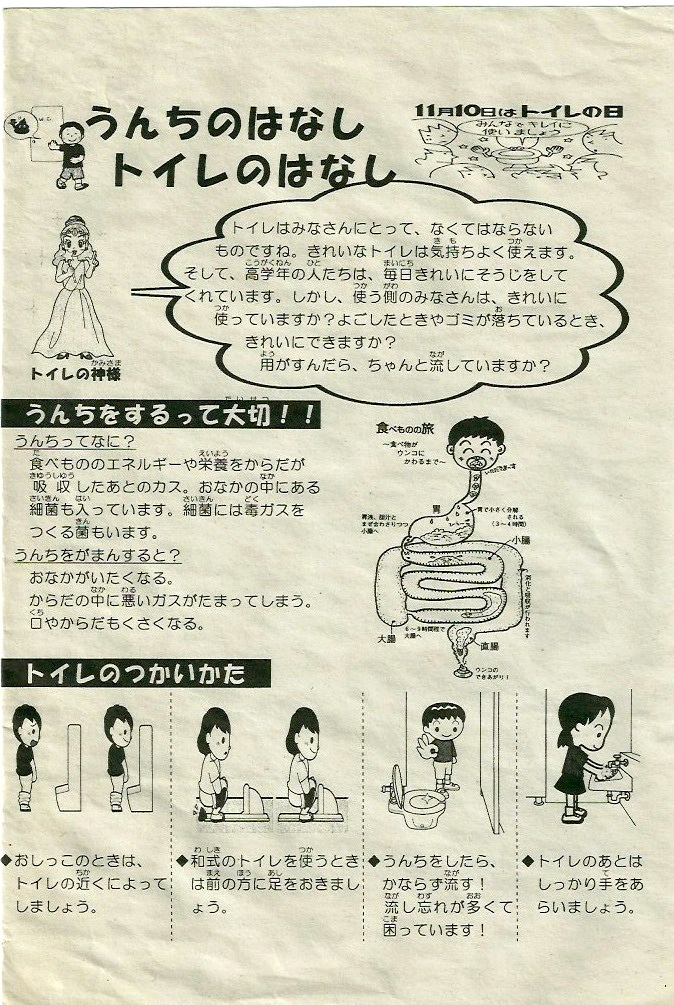


Tackling the question, "What is poo?"  Bonus lessons on toilet etiquette, flushing and hand washing included. 
Homework and homework, Notebooks and notebooks 

Homework started slowly, but consistently, and with reinforcement, from grade one, day one.  Ondoku seemed monotonous to me: the kids literally read the same chapter aloud from their language arts book every night for a week.  They rate themselves on a chart for volume, confidence, clarity, mistakes and mark the number of times read.  It's the honestly policy, which is instilled from birth, but reinforced in "moral education class."  Parents use the official signature stamp to hanko the evaluation card nightly; not to check that they did it, but to be involved in the process.  

Kids start a running reading list too, ranking the books in a double circle, single circle or triangle review scale based on if they would recommend the titles to their friends.  Math and Kanji (writing in Japanese and Chinese characters) are written and recopied into a different books from their classroom notebooks, solely reserved for the hand-recopying process. If you do the math, there are 2 notebooks for each textbook, which are added to that boxy backpack that goes to and from school every day. This 8 year old has a spine of steel.

Math Cards  

They have a series of flash cards that they go through every night in rote form: again, reading the problem and the answer aloud is the key. Volume is emphasized, probably to aid with confidence building in all these processes, which is nice when you are wondering where your kid is. At least when you hear the Japanese equivalent of, "TWELVE TIMES THIRTEEN IS..." blasting from the other room while you are doing dishes, you know she's not plugged into a violent rap music beyond her years.

I was starting to understand why all kids unabashedly shout songs in music class. Not a rap reference, but based on vocalizing homework on high. In my primary school days, it was a little "uncool," to want to belt out the chorus in music class, which is an unfortunate loss for kids, but adults in earshot might have been a little grateful (well, at least the lazy, wicked ones). 

They fly through these cards at record speed, before and after school, and again before bed.  I'm convinced this flipping skill just helps them text faster as teenagers. (Each card required individual labelling - I'm not convinced that skill helps me with much.)

Holiday Homework

I remember having a reading challenge from the public library during summer vacations growing up. Girls got a cute lady bug shaped colorful card, and the librarians rewarded us with a black circle sticker to add to the bright red wings for each book I checked out, read and returned.  Boys had a caterpillar, and worked on  filling in the "body" with every Dick and Jane they clocked.  That was the extent of my vacation academic efforts, limited to rainy days when a lightening spotting prompted the lifeguards to send us home from the community pool.

The volume and variety of homework and projects during school breaks here is relentless, and getting through it feels like moving at that public library's caterpillar pace. The school hosts explanatory meetings for parents to present homework expectations a month before a "break."  We're briefed on the overall list of assignments and general, which is pretty specific, expectations. Then on last day of school, students take home kanji and math drill books and supplemental worksheets for the vacation, a diary chart, lists of science experiments, as well as a comprehensive booklet listing art and language projects, from which to select four each.

The diary calls for logging their overall plan for the break, then a detailed chart of what they did that day, as well as a weather update in the morning and evening,  which invalidates internet searches after the fact (just a "random" discovery - e'hem).  They chart their meals, chores, exercise and grooming habits, including a separate pictorial chart where they color in various animals at the zoo to represent having brushed teeth after every meal. She's usually a panda or a monkey short in the vacation zoo cage, since twice a day is the best we can ask from our "two thirds of an apple a day keeps the dentist away" little student.

For composition, they choose 5 themes from a list of 10 to illustrate a picture diary and write a brief essay on the event pictured, and why that is a lasting memory worthy of highlighting.  They write a book report, and need to compare the moral from the protagonist to their own experience.  Her winter break report centered around a family of crows that founded a bakery to get through hard times, so she exercised some creativity relating her experience decorating cookies for Santa on that "best-seller."

Format for all projects is rigidly enforced.  The size of paper, ratio of drawing to essay, and the placement of the title, class information, must be exact.  Save your creative coloring out of the lines for the actual art, because the heading and label on one of her art projects was in the wrong place for August 2013, resulting in having it fly back home at that library's lady bug pace.  No do-overs, just do-better the next times. Summer lesson learned.

Athletic homework is school-wide too, with the number of reps for each exercise varying for grade level.  The following sheet represents muscle group strengthening: first through the motion of scrubbing floors and massaging someone's shoulders.  I am most proud she received full marks on this one, and I encourage this type of training year round. The middle section represents toe-touches and flexibility, while part three emphasises the motion of tossing a towel or ball.  As a former lifeguard, towel snapping was a ticket to place a delinquent kid on the pool deck for 15 minutes as a "time out," but now I am enlightened to view it as an educational tool. I'll forgive some ball tosses in the house an even some towel snapping that takes aim at me if it means that equal or greater efforts are put into section one.


"The Three Desired Strengths for East Elementary School Students"

Jump rope homework is beyond me, as it breaks down into the following flow chart of 12 categories of skills to master.  I'm most grateful that we are in a house and no longer rent apartments with people living on a floor below us.  That saves me from a lot of "I'm sorry" baking, despite the fact that thanks to her book report, I have a Crow The Baker patissier in the house.
Luckily they are equally trained in interpreting how to rank their progress in jump rope.  To me it looks more like the element chart, from which I remember H20, not a useless skill since parents are to "oversee hydration during holiday recess physical education."
The grand finale in the athletic homework department is a practice of morning stretches hosted on national public radio.  The week before school resumes in summer, we are called up to a local park (assigned by City hall) for morning calisthenics.  The PTA member that won rock, paper, scissors (well, I call it "losing" in cases like these)  leads the activity and sets up a portable stereo, greets the crowd and takes attendance. Students, parents and community residents show up shortly after 6 am, reinforcing the idea that it takes a village to stay in shape. The routine is only a ten or so minute workout, but the ritual is more than ten-fold, secretly getting kids from establishing a habit of oversleeping in the build up to back to school, and giving them that extra boost in the morning to dot the "i"s and cross the "t"s in their summer project portfolios.  As a good parent, I try to encourage as much review of that floor scrubbing and shoulder massaging exercise as well, just to be sure every last kink is out before she marches off with the walking group in September.
NHK morning calisthenics card is also collected when school resumes, attendance recorded by color coded stickers (differing each session, so you can't load up on blue and sleep in), awarded by the PTA member assigned to roll call. 
During "vacations," parents are not without homework.  I am the human label maker, and I stress human since we are to hand write their names, as mass produced labels do not demonstrate your love for your child to the same degree.  Assigned to assess all supplies and ensure that any faded name patches are reinforced, elastic repaired, and ailing handmade cloth totes or umbrellas replaced. Handmade items express devotion in ways that commercially produced items cannot -- I love my child so much that I follow commercials to the local tailor, and commission her to produce them by hand.


Like student projects, format is essential.  I will get "return to labeler" if I use the wrong size, detail or placement in writing her name, grade and class assignment on every item that "walks" out of our door.
Class Observation Days

Where I grew up, the day parents came to school was called an "Open House."  They attended their child's classroom during the early part of the school year, to hear the teacher's class policy and ask any questions if necessary.  It was held in the evening, probably to accommodate working parents' schedules, in a kid-free environment, which I imagine is one of the goals of success for parent-teacher communication.  

In our case, after the first couple weeks of school, the first of three required "Open Class Lessons" is held.  Parents are invited to observe a regular school day, non-rehearsed class.  The objectives include getting exposure to the teacher, the class dynamic, and meeting other parents.  Every family is represented -- it's excepted that a working parent would take off work for this priority.  There are no stickers for attendance, but in their own way, they send us signals that we are graded (see labeling chart above).  Also, by "parents," I mean, "mothers" (see Patrol section). After the lesson, students are released from school and parents stay for a group meeting with the teacher.  Note that they are released to the playground while the adult supervision remains in the classroom.  That said, I have no memory of who was watching me when my parents were at Open House, but I bet they were good memories.
Class observation day: live action of "training students to be model citizens and contribute to the greater society," one of her 2nd grade teacher's goals.  My goal is to model school supplies according to the dimensions on the chart, but we all have to start somewhere.


Kids as Custodians

"Bill the Janitor" was as an important part of our elementary school community as our classroom teacher, or the lunch line lady that would always slip an extra jello square on your tray. Bill was always cheerful, and amazing at knowing our names, or at least us messy kids' names.  There may be three TAs assigned to each class in her elementary school here (2 circulate for math, 1 floats in for kanji lessons), but nary a custodian seen anywhere on staff.

Walk into any classroom in Japan and you'll be struck by the gray rag hanging from the back of each chair by a clothes pin.  You won't be able to decide immediately which part strikes the most - the fact that each kid has a clothes pin on a ring on hand, or that the size of the zokin is off - too small for a hand towel but too thick for a hanky, or the fact that you suspect the original color was white, or, finally, why there is a student name in black marker on the corner of each rag. After lunch, students get down and get dirty with those mysterious down and dirty zokin.

Classical music takes over the loud-speakers as they scrub floors, windows, surface tops and sinks and bathrooms. East Elementary School is particularly proud of their "no talking during cleaning" policy.  They claim they are the front-runners over the other 5 primary schools in the City, and silent cleaning is more effective than if they were allowed to chat while they scour.  Also, the meditative effect is apparently good for overall student development. In fact, cleaning is such an important part of their education that, you'll recall from the Athletic homework section, they are assigned to continue to develop this specific muscle movement during their "vacations."  Again, reinforcing this facet of education is another I can "quietly" support. With Mop and Glow.

She brought her zokin home on her last day of 2nd grade.  The faded label in the upper right has her name and class, it's over a kanji test she carried home in the same backpack to illustrate the contrast in black on white, though this is a color photo.
With the proverbial zokin we've swept in and out of 2nd grade, with only a couple stains to grow on.  With each bead of the abacus we slide to the other side, we can watch her add to the amount of independence she's taking from her practices, as foreign as they seem from my State-side experiences.  But I am learning too, and much more than just the proper dimensions for the label on the class cleaning rag.  I'll support her in some of her athletic homework again this break, and train for having to chase the unicycle that the gym class curriculum introduces next term. Holding in my comparisons will be my part of the "silent training," that East Elementary School fosters as those one-wheeled rotations roll us toward 3rd grade.  Since I admit I did toss the above zokin in the trash after I took the photo, maybe I'll at least adapt the classical theme and proudly wave her off into her new school in April 2013, this time, to Mozart.


Thursday, March 22, 2012

Follow the Yellow Hat Road

A few days before my first day of the first grade, I zoomed in on the "Z" name at the bottom of the "Mrs. Jackson's Class" Roster taped to the front door of Fishinger Elementary School. Anticipation ensued, and school supplies list soon followed. I hopped in the back seat of the family wood paneled station wagon, and with one stop at Gold Circle, a detour to Northland Mall, my checklist was complete: thick Mickey Mouse pencils, Crayolas, a Holly Hobby lunchbox, a Raggedy Andy nap mat. I was measured for a shiny pair of Tom McCan school shoes, and with the final selection of a coordinated outfit from JC Penny's, that I had to "save" until the first day of school, the prep was finalized. In a day. Gearing up to enter elementary school as an Ohioan in the 1970s was relatively low maintenance (though my mom may remember it differently).

The run up to my daughter's first day at the local Japanese elementary school in the 2010s, though cliche, was a world away from my experience. In Japan, that one day of preparation from my childhood spanned into nearly two years of my motherhood. I admit that I don't know how to add bead one on the abacus I had to buy from her school supply list, but my own memory of elementary math recalls that 400 plus days vs 1 day is, according to my calculation, "no fair!" That's right, Toto San, it looks like we are not in Ohio anymore.

Initiation Process (or Hazing?)

The games began some 18 months in advance with a manila envelope from the public health center. The packet contained a detailed account of every shot, sneeze and sniffle she's had since 2005, plus a checklist citing the remaining vaccinations required before my Kindergartner's number was up to enter first grade. Since her birth, I had followed through with all of the homework-like health center round-ups. We, the birth cohorts grouped into 3-month herds, had been cattled up to public facilities in intervals to take a number, get a once-over check up, and a shot or a prick, in assembly line fashion, for what felt like everything but mad cow (vaccination pun intended).

According to our track sheet, which I didn't realize but am not surprised is public record, all but a couple of the initial immunizations and booster shots were ticked off the list. I had been passively ignoring, Nihon Noen (Japanese Encephalitis), perhaps ignorantly, perhaps ethnocentrically, assuming that since American wasn't in the name that we had a bye. However, rules are rules, and homework is homework. When entering a Japanese system, protocol comes down to less the fear of exposure to a rural mosquito spreading virus, but more on the group effort of crossing the "t"s and dotting the "i"s on the master checklist to your micro checklist.

While gradually becoming immune to earthly ills, we continued to receive friendly reminders and form letter invitations, or depending on how half full or half empty your thermos is, must-do assignments to advance into the system. One hand addressed envelope, varying from the usual tiny font for a foreign name typed mailing label, arrived from the town hall. I was cordially invited to come for a "light" interview with the superintendent of schools: "Please kindly appear with your daughter at the Board of Education at your convenience, today or tomorrow, before 4:30 pm."

Strategically, or in proud American fashion, we rocked up just before closing on a Friday. It turns out we were the first "foreign" example to grace the halls of the public schools. In contemporary town history, there exists lesser known cases in which the offspring of one Japanese parent and one foreign national stumble through. Yes, if they're out there, I know them. There is an insider eye-lock when you spot another gaijin in small town, or suburban Japan. It's a knowing look, a contextual bond. If you're in the produce section, you exchange, "can you believe how much we pay per apple?" glances, or if you happen to clamp eyes on a station platform, it's, "did you ever think you'd carry a brief case in a bike basket to catch the express train?" You may never speak, or even meet, but you communicated. Truly communicated.

Like us, those families (which I could count on one string of beads on the kid's abacus if I ever did get through the How To enclosures) were tax-paying citizens with rights to the system. Concerns from Oniisan (Big Brother) were more of the day to day variety. Can our daughter speak Japanese? Can she eat the school lunch menu? Not to omit every native's favorite Samurai sword jab, "can she use chopsticks?"

We went through the motions even after the non verbals answered all they needed. When we walked in the room, they offered a coloring book and a doll for Hana to play with while the grown ups talked "boring big people stuff." Somewhat gracefully and mostly under her breath, she launched into singing the jingle associated with the It Girl Character, Cure Sunshine, and talking to her in the local lingo. So the superhero girls-group Precure popularity boom with this age group took care of our "big dealing" session. I had been less gracefully, and to my best effort under my breath, cursing that theme song when it aired every Sunday morning from 8:30-9:00 am, but today, minutes before happy hour, I was blessing its behind the town hall scenes educational benefits.

Following through with the formality of a set agenda, they assigned me to an "essay of intent" in Japanese, 3 pages A4-sized paper, stating my reasons for enrolling my child in the local school. I doubt they looking for fundamentals such as, "human rights," or "the law," which were running through my mental outline, as much as to just make sure I had a formal hold on reading and writing the language too. Homework is homework. Well, this was more like what we used to call "in class busy work," as students, since the easy-A hand-written composition had to be completed in front of them. I took to the fountain pen with the confidence of a Precure superhero, but couldn't resist asking myself, when was my vaccination for red tape number going to be up?

We passed through the first flag marker to advance into the first grade. The Zidonis genius line continues (give me that much, it stalls at the abacus - cue the Scarecrow's, "If I Only Had a Brain").

Field Day

Closing in on 9 months before the start of the school year, an invitation for the incoming first grade students to participate in an event at the Fall Sports Day Festival arrived. I filled out the return RSVP postcard, then tackled the items included in the checklist of 9 things to bring for the 30 meter dash relay. This was to welcome the kids, as well as to warm them up to the school rituals, complete with traditional fanfare, none short of the vuvuzela invasion on the World Cup stage. I suspect a hidden agenda was to get the moms (I'd say "parents or guardians," but my quick survey of those accompanying the 91 first grade candidates came to a non scientific 100% mom count) accustomed to spending 12 hours in prep time for every 3 minutes of event time they'll face in their academic lives.

In training mode for the relay, I took the baton (a sash in Japan), and ran with my role in abiding by the uniform code, the measurements of the to-bring list, down to the appropriate measure of barely tea refreshment for both mother and child, the street shoes and the playground shoes. I studied hand crafted maps of where to check in, stand, cheer, and finally memorized the layout of the course where the kids would start, finish, and collect prizes. I didn't go as far as others by bringing my kid to run through the course, but I dutifully came through with the final request of labeling everything I or she will bring, wear, eat, drink or touch, in two languages.

In the end, everyone was a winner. At the finish line, the 6th graders presented their juniors with school issued notebooks. They labeled them on the spot at a table and marker station in impressive record time. I bet the Olympics even requires a day or two turn-around to get the champion or event names inscribed on medals.

Physician's Permission Slip

With any track and field event win, a doping test looms right around the corner. A notice of the mandatory on-site health checks and "intelligence" tests held at the school was the next invite in my mailbox. Parent-child teams were to report to the school, by now versed in the drill: labeled plastic bag totes for street shoes, indoor footwear, note-taking supplies. Future first graders had to bring specific plain white indoor shoes resembling a cross between Tretorns and ballet slippers, in order to be appropriately mobile for the rounds of health checks from classroom to classroom. These uwabaki would become their uniform indoor school shoes from April, so it wasn't a purchase-for-one-day shot, more like foreshadowing the syllabus for what was lied ahead in Fundamentals in School Supplies, 101. We were given a diagram in advance including the exact location and dimensions in which to label the shoes with our child's name. There was even a specific sized and brand marker, conveniently called a "name pen" at the top of our must-buy list for such use.

On test day at Higashi (East) Elementary School, we checked in, collected our name tags, information packets and lecture notes. Seated mother-child, mother-child, we settled into cushion-less wooden chairs, in the unheated auditorium for the next 90 minutes. The speeches from the school nurse, principal, and first grade teacher-in-chief targeted the parents: maintaining good habits at home, demonstrating a healthy lifestyle through your own actions. Sitting still beyond the keynote speaker's introduction was probably part of the kids' endurance test.

Highlights mapped out prerequisites to train your child in over the months before the spring start -- using an Eastern style toilet (squatter); introducing a certain rhythm to the tooth brushing ritual, crescendo-ing with a ue shita ue shita (up down up down) chant to complete the cycle on the two front teeth made the top of the list, followed by morphing from indoor to outdoor shoes in a single-file line without having to crouch or look down, ensuing a smooth transition from classroom to recess (one wonders if that task conflicts with mastering the squatter). There were illustrated handouts, Q&A time allotted, and of course note-taking throughout the day. I could have used a recess by page 8, yet I kept myself alert thanks to my systematic use of thematic highlighters -- pink was high on the crazy scale, blue was mild, and green was just plain weird. The sanity scale rainbow kept me awake.

Next, we shuffled in single file from classroom to classroom where doctors from local community clinics were stationed to perform a body of "tests." Examination content appeared standard, reminiscent of the once over I received growing up when a medical permission was needed to join a school sport: heart rate (confirmed Tin Man's "Heart"), pulse, height, weight, hearing and sight. Boys and girls weren't separated at any junction of the check-points, launching them into their all-for-one mind-set from the start. Portable standing screen dividers provided minimum privacy during their exam, but they were shirtless waiting in line, so it was really the thought that counted. A dentist was on call to check the teeth, as well as observe a dry run of the kid brushing on her own while gumming the jingle previously described.

Ears, nose and throat went without a hitch and then it was onto the eye chart. We had a disadvantage on this one and held up the line in American "I'm going to take my dear sweet time" fashion since the "E" chart alphabet Americans are accustomed to, was, well, not standard here, nor representative of their spoken language. As a not so 20/20 result, this is one challenge I couldn't prep her for. The standard Pacman test: A pie shaped circle, with one slice cut out. The "open" side is facing right, left, up or down, in flashing turns through a scope. The kid declares, migi, hidari, ue, shita (right, left, up, down) to indicate the direction of Pacman's mouth. With each random rotation in succession, the size Pac's size gets smaller and smaller. So if you don't know your left from your right by age 5, the school thinks your blind. Or blind dumb. Or both. Or raised by an American Mom. Or all three.

With no inspiration from me -- I was more of a Ms. Pacman kid anyway -- she was advancing from screening test to screening test like a retro arcade gamer. Assured, my focus shifted to the classroom decor. Student projects paraded zoo animals made from empty tissue boxes and paper-towel rolls, as well traffic lights constructed from milk cartons, which was a familiar one from my elementary school days, except they declare the green light to be "blue." Next, we were released with our charts filled in by the 4 doctors, and advanced to the intelligence test. The little ones were escorted by 6th grade leaders to a separate room, where they were administered a 12-page written exam, capped off with a one-on-one interview with a teacher (no Precure doll this round). Although results aren't released to parents, somehow we were granted the "blue light" to prepare for first grade, and furnished with a 66 page hand-illustrated instruction manual stating the specific items to buy, complete with a detailed rule book on how, where and to what millimeter, to label each item. I only had 9 weeks to churn out this Dissertation in Motherhood project. Where was the simplicity of Mrs. Jackson's class list now?

Label Mania

My mom strung my mittens through my winter coat to prevent me from mixing them up with classmates' gear, or sealing their fate in the lost and found crypt. That was one sentence. I could type 176 pages to describe the labeling I went through, but my fingers already feel raw from stitching and iron-on-ing names. Another mother and I devoted three straight days sitting across the kitchen table from each other plowing through the mountain of items had ordered through the school, each with its own how to and what size to label rule. We got so bored with our own child's name after awhile that we switched in intervals, like true study buddies pulling all-nighters before finals. In similar "ol' college try" fashion, it was probably considered cheating.

Science and math sets were the most challenging. Each kit is made up of a large boxed set containing hundreds of tiny items: different shapes, colors and sizes of magnets, mini flashcards, "playing" die, clocks, stop watches, beads, as well as an array of arrows and compasses, and included 380 label stickers of assorted sizes. Many magnets were flower shaped, and clearly one side was taken up by, well, the magnet. There were pinkie sized stacks of flashcards for addition, subtraction, multiplication and division, numbers 1-100. I took a break and a victory lap around the table when I got the label on a single die without covering up any of the black dots. Every single itty bitty item required tagging her name, grade level, class number, and student number within class. She was Ashley Hana Dilenschneider, grade 1, class 2, number 23, in other words, アシュリーハナデイレンシュナイダー、一年二組、二十三番.

Piano + Harmonica = Pianica

Just like it sounds, this is a piano keyboard activated with a harmonica-like attachment which somewhat resembles an accordion with a mouthpiece, but with no sign of a circus monkey gripping a tip-collecting cup. Each key required a label which at this point I don't question, but it would be alarming to start finding E-flats and F-sharps in the lost and found, let alone in my vacuum cleaner bag. Although I'm not claiming to have an in-house Mozart prodigy, the Pianica produces a halfway decent sound. I disturbed the neighborhood in 5th grade with my forced-purchase of an unlabeled Yamaha Recorder for music class. In this context it's fitting to draw that comparison, but I doubt I ever practiced, which may be linked to the chilling sounds I set off toot for toot. Alas, the E and the F letter keys were more reflective of my instrumental effort grades rather than musical notes.

Alarm Buzzer

This oval shaped, bright yellow safety item dangles from a built in leather stitched hook on their backpacks, adjacent to a color coded ribbon denoting which group they walk home with after school, which differs from the ribbon color denoting which group that they walk to school with. I failed the alarm attachment test faster than I bombed the Pacman eye exam, my first and 100th attempt at folding origami, my one shot at the abacus, and please don't start me on my try on the unicycle, since at least I have until 2nd grade to get that one "rolling." Unintentionally, I sounded the alarm on day one of attaching it. Note that it wasn't day one of school, but the first day of the recommended "prep in advance" run-through before the school year started. When bloody murder sounded through the neighborhood, a cop doing rounds on his motorbike swung by to detonate it. Instead of being embarrassed (I dropped that feeling 15 years due to over-use), I quickly switched to relief that it was boorishly announced within a 2 km radius that I was doing my parenting homework. And Homework is Homework. If only I still had that old Yamaha Recorder, I could accompany her to and from school, serving as live a replacement for the buzzer. However, that notion would risk jump-starting her book of embarrassing moments, a chapter which I claim to have closed, before even giving her the chance to reach the starting blocks.

And More School Supplies

From the list of items to prepare before the first day of school, we were "free" to purchase some requirements -- pencil case, pencils, erasers, notebooks and seat cushions that became cone-head hats for disaster prevention (I would insert an airplane "your can be used as a floatation device" joke here, but they used those things more in 2011 than I did magnet labels) at our store of choice, but not without a "restrictions apply" clause. First, the store of our choice could be selected from one of the two recommended venues. Second, the items could not appear flashy in color or with commercial characters as to not distract the 6-7 year olds from the learning process. As an exception, the material for the cloth tote bags for chopsticks, masks, lunch place mats, towels (to hang on the chair to scrub the classroom floor, to hang on hook to dry hands after washing), gym clothes cloth tote, indoor shoes cloth tote, craft supplies cloth tote, and cloth "chair leg booties" for when they move the classroom seats to the dusty outdoor grounds for events, had no such color, pattern or character regulation.*

*Providing they were hand made in a display of a mother's pure love and support of her child's education, and within the regulated dimensions, with a one-pull drawstring with no tie or bow, labeled with a single thread color of my daughter's liking, representative of her individualism.

Public schools in Japan don't dictate complete uniforms until junior high. Therefore, they have 6 years of *limited* freedom to choose their daily outfits until they are formally strapped in. Yet, with choices come rules: Neck warmers en route to school? Yes. Leg warmers? No. Rain boots? Yes. Snow boots? No. I don't know if this policy saves them from later regretting fashion photo-uploads on social networking sites, or if it is to thicken their skin while promoting the ability to ganman, or, withstand the harsh seasonal elements. Culturally, I'm guessing it's the latter, but I sure could have benefited from the former. If only someone would have put a carton of milk quart Stop Light on my Xanadu leg warmers and Mork From Ork Moonboot choices. On second thought, 17 winters without central heat, and no early childhood education in ganman, I'd give my thousand sticker labels for that warmth now.

Nevertheless, elementary pupils do have a line of formal Uniform Accessories:

Gym Clothes
: Summer wear consists of a white shirt and blue shorts straight out of the circa polyester line my generation modeled from the former Agler Davidson on Henderson Road. Navy blue uniform swim suits and white swim caps, each ID-ing the kids in bold black marker creating trackable bobbing buoys. All public schools have outdoor pools and require a 6 week swim program in their curriculum.

The have an additional 2 weeks during "summer vacation." The report card parents send the kids with to their lesson requires recording their temperature daily, circling an icon best representative of the child's mood that day, listing their breakfast menu, and finally the number of hours of slumber they clocked in the previous night. I'd give myself a grump face icon for my end of the assignment, but instead, I choose to grin and bear it, "in a display of a mother's pure love and support of her child's education."

Following the summer swim school session, they have morning calisthenics at 6 am led by the live national public radio broadcast with a PTA - volunteer - assist daily for one week before school resumes. Freedom of clothing choice for the wake up call disguises the hidden agenda of making sure the children don't get used to the poison vacation lifestyle that yours truly had growing up with Scooby Doo catered by Cap'n Crunch.

Winter Gym Clothes
gear simply adds a coordinating blue zip-up jersey and matching pants to the look, although they don't get much use, in harmony with the idea of "proving your toughness to withstand the elements." Colors or styles rarely vary nationwide, though the unique school emblem sets them apart from other kids, or in the least keeps the rice on the tables of the the local Ma and Pa school uniform store fronts. The name plate spanning across the chest of the shirts is 5 by 7 inches, so there is no secret as to who "drops the ball" on any play. Year round, they wear the red side of their red/white reversable hats. Half flip to the white hat side when they into divide teams for assorted scrimmages. The colors depict the Japanese flag, which makes more sense and perhaps is more within the law for this age group than the US cultural equivalent of "shirts and skins," despite having played rounds of that game at the public school health check.

Commute to School by the seasons: 1. Solid yellow hat for winter, mesh yellow hat for summer. No, they don't change clocks for daylight savings time, just hats. No memo or emergency phone chain is activated to remind us, rather, they leave it to the Equinox on the calendar to denote the big switch. 2. Two yellow umbrellas. Even though there are fierce rainy season and a typhoon seasons, kids don't carry both in during these heavy downpours. What with all the "handmade from love" draw-string totes in an array of sizes, how would they ever spare a hand? Rather, one is to carry from home for when rain is predicted from the morning (I give the meteorologists a 99% accuracy rate), the other is to keep at school in the event of sudden rain (so the meteorologists' 1% margin of error covered).

Boxy Backpacks: They serve as a mobile desk, and have the added charm of making students look like astronauts (accessorized with previously introduced neon buzzer and multi colored ribbons). Kids bring all the necessary texts depending on their changing class schedule each day, as opposed to storing them in a school desk or cubby at school. Unlike the K-Mart Blue Light Special, prices vary from About $200-$1,200, a figure which renders them sturdy enough considering they carry the same リュックサック (backpack) all six years. Since about the millennium, リュックサックcolors may vary as much as price. Tradition formally dictated red for girls, black for boys. Women's lib has since advanced, allowing 6 year olds more personal expression to cut loose for this commitment.

School Lunch Uniform: This sounds misleading, since the student body doesn't have a costume change to eat. The daily lunch menu is cooked on-site in a kitchen, but there is no school cafeteria. Instead, they eat lunch in their classrooms. The kids set, serve and clear the daily meal for their class. They rotate serving groups monthly, and the "lunch ladies" (boys and girls teamed in a group of 4-6) wear white cotton chef caps, white lab coats, white masks, and the complete ensemble folds neatly into a white tote bag with a one-pull drawstring. Each student brings a white surgical mask to wear during the set up, chopstick set, toothbrush and cup in a cloth bag each day. Students in the serving rotation require 2 masks to ensure having a spare to serve seconds mid-way through lunch period. *White denotes international symbol of cleanliness in food handling, though I believe they look like they are prepped to perform an emergency root canal.

Not to be excluded, parents are administered 2 types of uniforms: 1. "Event pass" ID badges to wear around our necks for when we visit the school, as well as a matching banner to fasten to the front basket of our bikes for when we pedal* around the neighborhood or to school. *Driving to the school is not allowed, which is in line with our modeling the ideal "uphill, both ways" hardship in commuting-to-school life. After all, our presence in the neighborhood is expected to be of the safety and greeting patrol duty, day or night, weekday or weekend, rain or shine, sleet or snow. 2. We rotate the morning crossing guard ensemble consisting of a neon vest, yellow poncho for rain (umbrella of any color strictly prohibited, ganman enforced), and neon flag pole. As if I didn't stick out enough (here I activated the Cowardly Lion's "Nerve").

Entrance Ceremony

Finally, the gate to Oz, or in this case, the entrance to the first grade along the Yellow Hat Road, comes into view. We chose the right path at the fork, in this case, chopstick in the road, and the Scarecrow, in this case, first grade teacher-in-chief, pointed us the way to the induction ceremony in the gymnasium at the elementary school. Time came to mount that horse of changing colors to the black tie affair. The principal, superintendent and local politicians wear tails (but not the kind donned by guest star Winnie the Pooh who spoke on traffic safety). Parents and incoming 1st graders wear suits, but thankfully not matching to each other or matching to Pooh Bear. We were to carry bags for our shoes and tote our fanciest slippers for the formal occasion.

The hand off from home to school at the starting line has a bigger milestone feel than even the way we celebrate the graduation victory finish in the States. After almost 2 decades in the field of education in Japan, I have come to embrace the ceremonial entrance along side of them, now with my non-cynical, sincere Glinda the Good Witch smile. Their connection to the school, their class, their group within the class, is a proud part of student identity. I would equate it to the zealous loyalty an Ohioan has toward Buckeyes Sports, yet without the tension or risk of losing (or rioting). Following the two hour ceremony of speeches, the classroom teachers give a roll call for the 91 incoming students. We were instructed to rehearse our children for this. They hear their name. They stand. They reply, "HAI!" to confirm their enthusiastic attendance. They take their seats with perfect posture for the remaining of the 90 names and responses.

After the 6 year olds complete their sitting still test (and the fidgeting parents fared well too), one professional photo snap commemorates the teachers, staff, students and families as a group for the last time. They are now released from us and deemed independent first-graders. The principal, or Wizard, of Higashi Elementary School, gives us one final deep bow with his pledge to "take them in and care for them for the next six years in earnest." Off she went to meet with her classmates and teacher for the first time as a unit. No, Toto, we are not in Ohio anymore. And with that, I clicked my indoor ruby slippers and reminded myself, "there's no place like Parenthood" in Japan.

Sunday, October 9, 2011

The After Shock

On March 11, Japan's coast moved 8 feet, shifting the earth's axis. NASA claimed the 9 magnitude quake shortened the day by 1.8 microseconds. I don't have scientific research to back my claim, but from March 12, the days felt 1.8 hours longer. Exhilarated to be alive and grateful to count my blessings, adrenaline was running on over-drive. I rose long before the Rising Sun. Next, my daughter woke. We all made contact: Bob was okay, and would probably make it home somehow (despite grounded train lines) within 24 hours. At least our axis, that family side in the big picture of our own little earth, felt centered. I set myself in motion, all sights set on shifting the axis back to its conventional setting, launching into a normal "day in the weekend life" of mother and child.

Normalcy would be a long time coming.

We had plans to go on a day ski trip up north with another family from kindergarten. Nobody on the east side of the country was going through with plans they made for March 12, although I'm sure everybody had some form of to-do pencilled in that square of the no frills wall calendar. Transportation heading north was crippled, ski lifts toppled, and it turned out the site, along with a list of hundreds of other entertainment venues, never reopened that season. For the day, I wasn't glued to disaster footage on TV, nor focused on the unfolding nuclear crisis. Unintentionally, I isolated myself in our suddenly choked off environment, and attempted to create make-shift fun for a 6-year old who had a full of frills countdown Hello Kitty calendar to her first ski lesson. The quake knocked that calendar from the fridge magnet, shuffling it around the floor by then, so she wasn't concentrating on it anymore either, yet that didn't quench my strong desire to fix something on that chilly Saturday.

We made breakfast, loaded the car, and headed out. Destination: movie theater? I'm almost embarrassed typing that now. I am aware of how absurd and frivolous the notion is, but everything from seismic plates to mindsets was shaken up. We were out of place in our own lives. Aftershocks kept coming, from quick jolts to long trembles, though we were shaky anyway. We felt like we'd just gotten off a long, choppy boat ride, so it was easy to lose track of which were real tremors, and which were what became dubbed as "地震酔い, earthquake sickness."March 11, before 2:46pm at any rate, marked the opening weekend of the latest Disney movie, Tangled. Shobu and Hanyu are the two theaters in our area, centered in sprawling city in itself style shopping malls. As we approached the Shobu parking lot, we greeted the first eerie reality of the day after. Empty. In Japan, it's typically a one car in, one car out of the parking lot policy. It was deserted, the entire shopping mecca closed. The flashy, bustling, crowd-pleasing mall with more than 300 shops, restaurants and arcades vacated. I flashed back to a scene in National Lampoon's Vacation. But this was no comedy. It was the innocent attempt of trying to bring my child to a kids' movie, that suddenly turned into feeling like we were starring in a suspense thriller. We drove on to Hanyu, the next mall, only to discover the same "horror" scene replayed.

By now, though still only mid-morning, we've driven enough distance looking for "escape" entertainment that we need to fill up on gas. The roads were abandoned, and it felt as strange as it did comforting that the one pump stop we stumbled on was attended. Little did I realize that would be my last gas-up opportunity for nearly a month.

We stopped at a 7-11 to pick up some snacks to head to a park. The lights were dim, the shelves bare, and the concrete reality -- unlike the road side concrete damage lining the sidewalks -- was piecing together. Arriving at that park we found comfort near another mom standing on the sidelines trying to give her kids the same "run around break" I was. I wasn't completely conscience of it yet, but that hallow, jet-lagged sense began overtaking my bones. It didn't matter, and it couldn't be a priority for months. Hana latched on to the 2 little girls as they dove into a game of tag -- up and down a hill, rolling from the top to the bottom, making up new rules along the way. I joined in once in awhile, just to fake "losing" long enough to keep their play fresh. I chatted with the other mom. We talked about the moment, its impact, and questioned what was to come. I mentioned the picked over convenience store, asking her if she found the same. She concurred: It was ominous, noting that locals must be stocking up for the big one with our area as the epicenter. Preparing for the big one? That wasn't the big one? Damage, lack of transport, electricity being down were contributing forces (I hesitate to use the axis of evil metaphor here), generating a demand in daily goods, and preventing any re-stocking on shelves. Yet I hadn't stopped to register her big-one reasoning until she candidly articulated it. With that, the innocent kids' game of freeze tag brought me to a stand still.

The next day gas stations had mile long lines ebbing the road. Eggs, milk, bread, toilet paper, bottled water, batteries, instant noodles, candles -- those overlooked items you take for granted -- were a part of our re-written recent history. Soon after, SOLD OUT signs replaced gas price lists at stations, and hand written apologies from store managers replaced goods on emptied grocery shelves. A few more days pass, and those hand scrawled signs were replaced with typed notices, indicating this was not a temporary situation. Paralyzed transportation shut down the in-roads, and the dire need in the hardest hit areas further north got any priority of remaining goods and services anywhere in the country. My exhaustion wasn't jet-lag, and it wasn't just a lack of sleep from the aftermath of events. We were in the midst of adjusting to living with a condition. Despite the relief of the 3 of us reuniting, semi-grounded and in good health, there was no returning to normal. We were breaking ground, learning along the way, how to pave a new normal.

The international media was adjusting its zoom lens on a potential "action" shot, an inevitable lava pool set to erupt in our path. Other networks were one step ahead, putting the final touches on a still life canvas of Japan. Over the next few days, the battle cry of foreign embassies rang out in procession. Non essential nationals should evacuate the Tohoku/Kanto regionn. The crisis surrounding the disabled Fukushima nuclear power plant was more than a mushroom cloud of unknown. France, Germany, and Ireland followed suit, with Canada and the US finally waving the red flag at the end of the pack. The image of the Tepco jumpsuit took center stage, with round-the-clock press conference updates from the sacrificial workers at the Dai Ichi plant, and representatives from the Tokyo Electric Power Company.

Lunch time, March 17. The phone rings. One of my closest friends, a "non essential" Irish expat, but essential to me, is on the other end of the line calling from her Tokyo home. I think we've spoken on March 17 for at least the past 15 years we've been connected in Japan. 2011 marked the first in our history that it wasn't a "Happy St. Patrick's Day" social call. Conflicted, she was in the midst of scrambling to get to Ireland that night. She'd cart two young boys across Tokyo to get to the airport with extremely limited, over-crowded transportation options. Her boys' schools, including the school where she worked, were all closing doors due to the triple crisis anyway, so she was going to shift her summer travel plans to March, yet this time without the usual vacation spirit. "Triple crisis" was one of the many merging catch-phrases, which in happier times was describing another patty on the burger. Language was changing as fast as life.

We, too, were at a crossroads (a sticky place to be when you're getting low on gas). We weren't exactly in Japan on short term contracts from the States, or even on the business trip formula that had a start, an end, complete with a one-way return ticket. We established careers at Japanese universities, and we have a daughter in the local school system. In spite of our blue passports, we are long-term, tax-paying, established-residents of a red passport nation. Our lives here would go on. But for now, the country was in mourning. Ceremonies were cancelled. There would be no traditional March graduations. Pomp and circumstance were inappropriate. Money for the banquets and flowers that go hand in hand with the celebrations were transferred into Red Cross donation accounts. And in place of graduation caps flying up in the air, flags would lower to half mast. Even cherry blossom season - the thousand-plus years old custom of festivals and parties, down to the ubiquitous portable karaoke machines and mobile Asahi beer kegs at all the parks and riverbanks in bloom, would be off for 2011. The display of cheer surrounding the sakura, (cherry blossoms) was replaced by chrysanthemum bouquets as grieving symbols at shrines. In the same way my fellow expat friends dropped the idea of annual green beer gatherings and leprechaun parades in Harajuku (Tokyo), nobody in Japan was focused on pink blossoms, celebrations or tradition.

But it was still March 17. It wasn't just post-disaster, mid-crisis, St. Patrick's day, or even just another Thursday. It was my husband's birthday. Traditionally, the non-surprise (he came to expect the doorbell to ring the dinner hour since his late 20s) was pizza, his favorite, the American classic. Japanese pizza, however, is the cultural opposite of his strict Pepperoni and "no funny business" (his words) pie order. To paint a deep-dish picture, octopus, mayonnaise, and broccoli, to name a few are hot selling toppings here. Therefore, his rigid pepperoni and cheese standard is a special order, and not special just because it would call for birthday candles for his "party." Instead, the take-out menu features a set list of pizza orders, complete with fancy titles and cutsie graphics. The only choices that come with the ordering experience are size (S, M, L) and crust (crispy vs. regular). Prices vary from roughly $20 (S) to $40 (L), and titles are equally as fancy as the photo and price would indicate: Teriyaki Chicken Deluxe, Pizza Purukogi, Tuna Mayo, Bomber Quarter, and Busters Quarter.

Although Japanese customer service is second to none, the drawback is that its consistency is so stringent that it causes a kind of a chaos that shakes the Richter scale to off the line-by-line manual they are trained to follow. Special orders are a foreign language. Thus, after years of dress rehearsals, we have adjusted to playing out their script, their way:

Pizza-La, may I take your order? (It's not a hint toward pseudo American style in the store name - that's pronounced LA, like singing La la la, not L.A. as in Southern California.)
I'd like a large, "Busters Quarter," regular crust, hold the potato, shoulder bacon, corn, sliced tomato, mayonnaise, teriyaki chicken, shrimp, squid, onion, and black pepper.

(That's the Japanese way of following the how-to menu, and leaving off everything to come down to ordering a plain-ol' pepperoni & cheese, thick crust.)

I see, that's, a large, "Busters Quarter," regular crust, with no potato, no shoulder bacon, no corn, no sliced tomato, no mayonnaise, no teriyaki chicken, no shrimp, no squid, no onion, and no black pepper.
Is that correct?
Yes, that's correct.
That will be $37.90 (After all we are paying for the whole Busters Quarter), and we'll have it to you within 30 minutes.

The usual script ends there.
Except under the circumstances, there is an add-on:

Very sorry. We have no mozzarella cheese. Or pepperoni-salami. Or crust.
What do you have?
We have some sliced cheddar. Mini wiener hot dogs. And I have a tortilla.
Okay. Turn that into a pizza, we'll take it.
That will be $37.90 (after all, we did order the Busters Quarter), and we'll have it to you within 30 minutes.
Okay.

Add on number 2:

Very Sorry. There's a gas shortage, so the mopeds are grounded, and our deliverers are on pedal bikes. Please understand we can't guarantee delivery time.
Okay.


The unusual script ends there.

We weren't leaving the country, but while we were waiting for our mini-hot dog-flat-burrito birthday pizza, we'd come to the decision that we'd at least escape the stress of the Kanto region for a few days, and instinctively made a call to a Japanese family we've been in contact with even before moving to Japan. The Hayashis were the host family to a college buddy of mine when she was an exchange student in a Japanese high school as a teen. We met the family at her Chicago wedding years later, and they have since become the closest comfort zone and "home-away-from-home-and-away-from-disaster-zone in our lives. It felt like the best "running to Mama away from Mommy" we could do to nurture our family spirit.

They live in the Kansai region, a little over 300 miles from our home, in the opposite direction of the epicenter and eventual nuclear meltdown site (the buzz word quickly moved from crisis to meltdown). We arranged to leave the next day, and with some evacuation plan laid, we had the rest of that evening to pack our essentials and embrace the small joy of someone turning a healthy 42 years-old. The most reckless party-behavior we engaged in over the next two hours was lighting a candle to compliment our "Happy Birthday" song. Not only were candles were a "hot" commodity, but they also served a greater emergency kit and blackout source dual purpose now. We gave it one choppy verse, and we sang fast.

Tickets in hand, we boarded an overbooked bullet train fist thing in the morning. The journey under normal conditions should be roughly 4 hours door-to-door. Yet with damaged infrastructure, a dwindling electrical supply, mass crowds and mass confusion, we clocked more than double that. We embraced the Hayashis upon arriving almost 9 hours later, as if it hadn't been over 7 years since we'd last visited, although nobody could pretend that the circumstances were the same as the previous trip. It was a few refreshing days of being away from the immediate zone, but certainly not a sejour from a problem that would be resolved in our absence. Rather, after an extended weekend of spending time with "family," breaking from mass media frenzy, and from the stress of the unknowns and un-understoods, we would return to the Kanto region to a new round of what ifs and what nexts.

Our daily newspaper now features a map of the Kanto region highlighting the daily cesium amount in the air, and how many microseverts per minute are being released in our area. Confusion over the new nuclear related vocabulary continued to mount, a lesson in words I never dreamed would enter my bilingual world. Knowing how to calculate the surface deposits of cecium in kiloecquerels per square meter in more than one language was never on my lofty list of goals, let alone a desirable boon as a resume-builder. Outdoors, expressways closed and were blocked with crime scene tape and manned by uniformed guards. The sound of low flying choppers overhead hummed through the neighborhood, making home feel like war zone. Dumping sites for debris, divided like paper and plastic on a recycled disposal day--into a pile for concrete blocks from roads and side walks, and another for neighborhood home roof tiles, popped up where cars formally parked. Even the subtle scenes of kids playing outside and futons airing out on balconies, continued to disappear.

A great deal of mis-information was oozing from the rumor mills surrounding the Fukushima plant. But the fact remained, the nuclear power plant was disabled, and scheduled rolling blackouts were kicking in. Tepco jumpsuits took over the familiar TV news anchors' crisp suited look, as they set the scene to warm us up to chilling announcement of cutting off our heat and shutting down the lights. We were glued to the TV to get the flash on the neighborhood assignments, streaming in writing across the bottom of the screen. Which train lines were running as well as their respective time tables were reduced and changed daily. The world-record-on-time Japanese transportation network they pride themselves on here was upstaged by a wait-and-see non precise process. However, pride was being redefined, and contributing to relief efforts was now the sole source of pride for the nation in desperate need.

Every neighborhood across the Kanto plain was divided into any number from 1 to 6 zones, and the time frame that you were to lose power changed daily. The blocks were 2 hours at a time, 2 times a day. Without complaint, people disconnected from their social networks, cable networks, heating, lighting and refrigeration, and re-connected with their neighbors. Community bonds firmed, and everyone worked in tandem: passing frozen goods across the zone boarders, dividing coveted goods such as batteries or lighters, and even hot baths. Splitting my time between the office and home due to different "zones" became one working strategy. I was following the flow of electricity while racing the clock between zone 2 and 4, while traffic lights were shutting down in my near gas-less wake. I daydreamed I was the star of the next Mission Impossible action thriller. Fortunately, hope and the nation's unity were powerful enough forces that the Mission would be Possible.

Without electricity or dependable transportation, many schools were either called off, running on limited hours around the blackout schedule, or with a come at your own risk (and dress warmly) clause. Hana continued to attend kindergarten during the hours it was up and running, if for no other reason to have some form of play, albeit restrained. Newsletters came home: "kids were under stress, uncharacteristic crying as well as "wetting" accidents were on the rise." The scheduled school day, however, meant eliminating the schedule. Planned field trips, end of school year parties, even the daily bus service was off. There was no gas supply, and festivities for a country in mourning could wait. Yet teaching the 5 to 7 year old crowd they "could wait" for their agenda was a hard-fast crash course that their Disney Princess and Toy Story kickers took in stride. Fortunately, I was still riding on that lucky juice of a half tank of gas from the day after the quake, so I loaded a cooler of juice boxes and took up driving some of the neighborhoods kids back and forth. As they road in an oddly hushed state, I was convinced the giggling was much more animated on their regular bus route, when days were "regular." Though the region called for a larger dose of patchwork to repair the quake damage, my imported care package stash of gooey Easter candy could provide some after-school boosts to keep them glued into some form of kid-like fun.

Back home, with 2 unfamiliar knocks on the door, the lady next door entered the entrance way, quickly kicking off her outdoor slippers and announcing herself. She cares for an aging husband full-time, and I rarely see her in the comings and goings of day to day life. Yet, day to day life was over on March 10, and though she barged in like the "busy body" neighborhood lady is portrayed in fiction, I was happy to see her welcomed her warmly. She received a shipment of a 4-pack of quail eggs from a relative on the west side of the country, and was eager to share. She reached out with one thumbed-sized egg with delicate handling, as if it was a fresh catch from the nest, ready to hatch. She popped out as quickly as she "broke" in, barely accepting the bow of a thank you. I looked down at the bite sized spotted gem for an extended half minute before I moved on. I held back for a minute from my usual sarcastic mindset surrounding food delicacies in Japan, which would have been immediately wondering how with this, with a cup of only available powered milk, well, what a sorry pancake I could make. Instead, I was transfixed in bigger meaning behind the catch of that single egg: at how, with that hand-off, she was reaching out with much more than a silly little quail offspring.

Stocking up on fresh perishables had been a non-option during those early weeks, yet I had a relationship as a regular at a Ma and Pa fresh produce shop in the city. Not expecting to load up on goods, I stopped in on a social call. They were grounded, although their store shelves toppled in disarray. The Ma had been waiting for me, and disappeared at first glance, re-emerging with a stash containing a quart of milk, a block of tofu and 10-pack of eggs. Attached was a post-it note with キャサリン (Kathryn) displayed in bold and beautiful Japanese lettering. When supplies were dwindling and among their damage they couldn't remain open for business, she put some staples to the side with me in mind, and calligraphy brush in hand.

During the ride home from that interaction, I could tune out the low flying choppers of the Self Defense Force. I didn't wonder what their mission was that day - whether or not they were transporting delegates to survey the damage, or transport medicine to the victims. For just 3 miles, I let the joy and the gift of the moment sink in. I loaded a CD in the stereo, opting not of the American Armed Forces radio network 24/7 up-to-date disaster information. I road in calm, without monitoring how much gas I had left, I just let go. I pulled in the car port, and greeted neighbors that were outside talking, exchanging water they were putting aside for the scheduled blackout 2 hours later. I approached as Santa with the big red sack. They accepted my offer without hesitation, ducking into their homes and back with containers. We were pouring milk into thermoses, dividing eggs, and scooping bite-sized chunks of tofu into mini tupperware, right in the middle of the street. Maybe we were more like kids on Beggar's Night, trading and exchanging our Halloween loot. I lost the memory of how I prepared that first round of fresh dairy post-quake, but the post it note is a keep sake representing a memory that will stay with me forever.

We were able to feed our bellies, next was trying to feed the tank. One Mobil gas station in the neighboring town started to open for limited hours, 12-2pm or until supplies ran out, limiting each customer to a flat $20 cash in advance rate. I joined the line, which turned out to be 90 minutes of inching up one at a time. (Others behind me didn't make it in the lot that day, they'd line up the next day.) Cars filed toward the entrance in neutral, savoring the limited supplies they had, while volunteers pushed as we slowly inched up closer to the pump. The receipt was pre-printed, with an eloquently worded tag line apologizing for not offering usual services such as windshield cleaning, checking oil, or cleaning out ash trays. The attendants appeared as drained as the pumps, handing the "note" to the customer, saving themselves from further depleting their "only human" energy levels with explanations.

A cold week later, kerosene was rationed back, and I returned to that trusty Mobil station with our orange tanks in the trunk.

During the cold months, kerosene carrying trucks circle the neighborhoods on a regular rotation (Thursdays and Sundays for us), blaring a peppy tune like a mid-summer ice cream truck. The pep was out of step as much as the trucks were out of gas. News of the few stations that acquired enough supplies to sell to non commercial customers on a bring-your-own-tank basis rippled fast. Again, it was a bumper to bumper approaching the station. The difference this time was cars collecting kerosene were unable to enter the lot. They still had 2 hour lines to get in for a tank of gas, so if you were there to get kerosene, Mobil arranged a deal with the 7-11 across the street to use their parking lot. 7-11 had been lonely since they sold out of staples 10 days prior, so they must have welcomed the action. They welcomed it like turkey on Thanksgiving, really. They were handing out bowls of oden, which is a hodge podge kind of soup, a dish popular in winter, while you were waiting for your turn to cross the street to get your tanks filled. When my bowl was empty and my "number was up," 2 men followed me across the street and carried my load after I filled up as far as the traffic light. When the light turned green, they passed my tanks along the human conveyer belt of heavy lifting hands to volley it back to my mini Honda in the 7-11 lot. It was a Norman Rockwell type beauty, like the Boy Scout walking the "little old lady" across the street. When the light turned red, the volunteer transporters retreated in quick step to the closest side of the road and stood at attention until the next green light.

Following kerosene, other necessities slowly re-emerged, and grocery stores introduce new policies. A bell would ring at 10am and 4pm. Customers lined up for a 1 per family per day supply of eggs, fermented beans, or a quart of milk. Store lighting was dim or off, refrigerator and freezer sections were rationed for energy. Background music, such "frivolous luxuries," shut off. There was little we could do to help the affected areas with their survival, but pinching where we could, and reaching out to each other to share what we had, became a pro-active recovery tactic. Escalators and elevators remain off, but train stations re-opened with limited service. Productivity in the workforce, consumerism, all of the key factors that make advanced nations tick remained off-kilter, but despite the lights going dim and the peppy music going silent, people seemed to welcome the idea of heading off to work, of getting involved in volunteer disaster relief efforts, of doing anything that contributes to rebuilding a country that a few weeks prior may have even been considered an over-developed nation.

Seasons changed the annual tropical rain front set in and lifted, as we braced for the oppressive heat. Summers in Japan see (and feel) many days over 100 degrees, with humidity factors as relentless as the still on-going aftershocks. The threat of more rolling blackouts was in the thick, wet air. The jumpsuits reappeared as the government regulated power use for companies, public facilities and schools, requiring cut backs of 15-25% power usage. The daily weather report initiated a "peak power use" forecast for the following day, based on the prediction of when A/C use would be in highest demand. Households were gently warned to refrain from any "extras" during that time: using the microwave, vacuum, washing machine, or iron -- any of that domestic glamour that could wait.

Air conditioning thermostats were regulated to 28 degrees Celsius (82 degrees Fahrenheit), which is not an ideal cool setting. Hand fans returned in style, and retailers scrambled to create new clothing lines, professional sweat-free, breathable looks. New tricks and trinkets came on the market, and any item that stimulated the economy while cooling down the body was a justified purchase.

The Cool Biz campaign started years ago, when the Kyoto Protocol kick-jumped companies into saving energy in order to reduce the impact of global warming. The unwritten suit and tie dress code during the warm months at work places eased. The image of then Prime Minister Koizumi modeling a Hawaiian shirt at a press conference is still strong. Yet, summer 2011 brought the birth of Super Cool Biz, which really sounds like the Prime Minister (already a position change once since 3/11 from this writing) should don a cape. Honestly, we need to embrace the fantasy of a superhero sweeping the country from disaster and rubble.

The movie theater would re-open with limited (day of only) scheduling, fewer screens available, in order to save power and to maintain safety checks. There were no guarantees that they could even maintain the "day of" listings, since a strong aftershock would shut down the system, offering no refunds. I did get to take my daughter to see Disney's Tangled, a month before Tokyo Disneyland recovered enough to open the entire park. On film, Rapunzel was saved. I couldn't help but look at the heroine's tower, less as a dungeon-like trap, but more as a protective fortress from a tidal wave. Either way, it was a happy ending, and a great flash of hope in our day too.

In the peak of the August heat, we did make a brief trip back to Ohio. For the three of us, it was the summer recess period from school and teaching, and we would temporarily leave a country that had no "recess" from rebuilding. We would take a break to visit our State-side families, while surviving families were still living in non air-conditioned evacuation centers: former high schools and public gymnasium floors. However, boarding a plane didn't dismiss us from our experience. We flew through a brief electrical storm, and turbulence kicked in, shaking the cabin somewhat, rattling the bottles from the attendants' carts slightly. Tears rolled down my cheeks. I was half conscience of it, but it was that lingering "earthquake sickness."

Seven months have passed since the day, and I will be carrying the memory of March 11 for a lifetime. I am not a hoarder, but I saved the キャサリン (Kathryn) post-it note, the receipts from the Mobil gas station, and now the Tangled movie ticket stubs. The keepsakes feel like the inspirational notes, or simple reminders that people leave around for themselves when they need a pep talk. A quail egg here, a quart of milk there, a tank of kerosene here, and a cinema memory there, to me all added up to a personalized four leaf clover. I'm happy to drop the memory of the moment of 2:46pm, 3/11/2011, but I welcome the idea of hoarding the lessons learned and experiences lived in the aftermath since that instant, to follow me for life.

Wednesday, March 23, 2011

The Earth Shakes, the Heart Firms

2:30 p.m. The second Friday of the month, every month. The regular faculty meeting at the university where I work as an associate professor of English in rural Saitama, Japan, begins with Japanese-style timed precision.

I am the only foreign national among forty-seven faculty members. We assemble in the large formal conference room on the top floor of the university, take our routine table, pulling up to the ritualistic cup green tea placed at each seat. We rifle through the agenda and handouts while waiting at attention for the vice president to call the meeting to order.

Opening greetings, followed by sixteen minutes of what I used to know as order. In an instant, the most fixed routine in my life became the most broken day of my life.

2:46 p.m. A sway, a steady sway. The dean has the floor as the teachers begin to shift their focus from his words to eye one another, as if asking in a glance, “do you feel some…” Sway turns to jolt and momentum builds. No words are spoken, as I follow instinct and the lead of the others and dive under the desk.

Tea is spilling, scalding at first. I’m shaking. I’m wet, and shivering. I clutch the hand of the faculty member closest to me, (Mr.) Sakamoto Sensei, gripping out of the desperation for human contact. He has one leg trying to prop the door open behind us as protocol calls for securing an emergency exit.

The power goes out; my chills intensify. The only noises in the room are hushed yelps of shock, the sound of tea cups clattering, wall hangings crashing down and glass shattering around us. We’re thrusting back and forth under the tables, rocking as if we’re on board that ill-fated ship.

Seventeen years ago, I picked up from a high school post among the cornfields in central Ohio, and moved to a school in the center of the rice fields in Japan on a teaching exchange program between Ohio State and Saitama Prefecture. I have since felt hundreds of tremors over these years, including the Great Hanshin (Kobe) quake in 1995.

Typically, they play out a familiar script. A sway, or a light jolt, and remain steady-paced until they fade away. “Oh, huh. Earthquake,” was the extent of my usual reaction, until March 11, 2011.

2:47 PM. This is not the way I want to go. This cannot be the end. I am not going to die here. Not like this. Not today.

I am not with my family!
My husband?
My DAUGHTER!
Is she panicked? Is she screaming? Who is holding her? I want her. I have an intense need to cocoon her in a tight, protective hug.

2:48 PM. The shaking is strengthening as my heart is weakening. My thoughts shift, “What was my last communication with Bob? How did we leave each other this morning?”

I’m reminded of the text he sent me from the train on his morning commute. He was sandwiched in with a rush hour, Tokyo bound crowd, unable to type, but managed to put a series of pictorial icons together which, in communication among couples, only I knew to read, “I’m glad I married you, and I love our family.” It was silly and sweet, and the pictures gave me a giggle. I opened it mid-morning and responded, “Best. Text. Ever,” which was intended to match his cheekiness because there was no actual text.

We were in three different places when the quake hit. My husband also teaches at a university, and he was on a research trip in Tokyo that day--over 30 miles from where I was--but fortunately in the opposite direction of the epicenter. Our six year old is in a Japanese kindergarten, three miles from where I work, and like any other “normal” day, I dropped her up and need to pick her up by car.

2:49 p.m. I have to get to her, hold her. I’m overcome with a feeling of power that nothing can stop me. I knew my husband was going to be OK. He isn't alone, meeting in a library with a member of his doctoral cohort, and I was confidant they’d know what to do. I also knew that he would be torn up inside not being able to contact us, which was unnerving. I was fraught for the three of us to be holding each other, to be rocking under cover in each other’s arms.

My mind doesn’t wander to a “bucket list.” I’ve been blessed by being surrounded by loving family and friends all my life, which has been full of fortune, adventure, and even touches of humor. I have no “but I didn’t get to…I still want to…” going through my mind. Only a basic need for the three of us to physically come together.

2:52 p.m. I voice it, crying, “I don’t want to die. Not now. Not like this.” My closest colleague and friend, taking cover under the table in front of me, calls back, “I’m scared to death too.” It’s his way of comforting me. He practices--even preaches--Zen and is the calmest person I know under any circumstance. This is his way of reassuring me that I wasn’t alone, and even though culturally I was the only one in the room, who was showing my emotion with inconsolable tears, they all feel the same, rather express emotions differently. Culture, country and language were not barriers. We all had to be family on that day.

2:55 p.m. Shaking subsides. We eye one another, as if slowly coming to, in semi-disbelief that it could be over. The vice president takes welcome command and releases us, instructing us to, “take a moment in our offices,” and we’ll reconvene in 10 minutes.

2:56 p.m. Many of us remain outside the conference room door. We’re in a semi-circle, not saying anything specific, but being near one another. Teachers are checking their cell phones. The power is still out, phone signals are gone, but Internet access one phone provides information on the quake: 9 magnitude, Miyagi Prefecture.”

2:57 p.m. Speechless, our faces drop. We’re stunned. Certainly we were the center of the trauma. The realization that the epicenter was approximately 150 miles north on the coast registered with us that there’s a truer disaster area, and tsunamis are inevitable.

2:59 p.m. I dash to my office, ignoring the collapsed wall-to-wall bookshelves, the desktop that rolled off my desk and into the window, the picture frames and coffee mugs smashed to the floor. I try to call my husband on my cell. No signal. I pick up my office phone to dial the kindergarten. No power, no phone line. I scurry back upstairs and find teachers coming together in awe of the rubble they found in their offices. We’re still shaken up, we are dominated by a feeling of fear, panic still heightened, and we are physically nauseated by the rocking feeling.

3:05 p.m. We reassemble in the fourth room floor, in the dark and cold, despite the dropping temperatures, the windows are wide open, serve as an emergency exits.

3:07 p.m. Another jolt. An aftershock? We shake, we’re back under the tables. Sirens, a fire alarm. It feels almost as strong as the first, but not as long. More sirens, followed by evacuation orders from a citywide public broadcast. I had been anxious to exit the building during the initial quake, but was morbidly reminded that we were on the top floor. If the university collapses, the higher we were the better.

3:10 p.m. The building evacuates. Students, faculty and staff are coming together in the campus courtyard. Hard hats are being distributed, preparedness and order is impressive, but my mission is to get to the parking lot and peel out to get my daughter. Timidly, I ask a colleague if I can get in a car. Knowing, he just nods and waves me off with empathetic concern.

I was the first out of the lot, and I don’t stall to question my judgment. Driving through torn roads, I see smoke coming from the surrounding farmhouses. “Surely the result of gas heaters jolting,” I said to myself. Local residents line the rural streets, staring, wandering and seeking out each other and answers.

Bumper-to-bumper under dangerous conditions, I listen to the broadcasts: “Stay close in line with other cars. Do not use the emergency break. Ride with your foot over, but not touching the gas pedal, and pull over to the side of the road, onto the grass or into the rice field, if an emergency or fire truck comes through.”

3:30 p.m. Still trying to get through to Bob; phone lines are down. I pull into the kindergarten lot. I pick my daughter up, embracing her like a solider home from war hugs his wife.

Ashley Hana, unlike Bob and me, was born in Japan and has had earthquake drills every other week since she started school. She followed protocol. Each six-year-old is assigned to a four-year-old in the way we used to have “buddy check” growing up. She was holding a little boy, “Gara Chan,” during the quake. It turns out that being in a big girl role made her a strong girl when she needed it most.

We edged along the slow-moving flow for the four-mile drive home. She was going over her what-to-do-during-a-disaster chant and wondering what state of chaos our house is in. I’m faking my Mama’s Just Fine Face, still reliving the hour, and feeling crippled by the communication line to our other unit member being out.

Cell phone lines still clogged, I send a text. I know it’s not going through, but hoping it’s in queue for when service resumes. Yes, it’s a series of icons, but not sent in the jovial mood Bob used to send me off on my day a chunk of hours earlier on that same day. I hurriedly use pictures to represent that I have Hana and we are home safe.

3:55 p.m. We make it inside. Hana Chan (she goes by her Japanese middle name here) puts on her Miffy bike helmet, and helps me assess the damage and clean up. It’s a healthy distraction for her: recovering and accounting for her Barbie and princess doll collection strewn about from the toppled dollhouse.

Announcements blare through our neighborhood. “Wear helmets. Change from slippers to shoes to protect yourself from broken glass and fallen items. If you see an elderly person in the streets, and please take him in.” The preparedness is comforting, but not my focus. I am overcome with the relief that we are together, but the unsettling feeling of not being able to hear Bob’s voice, to tell him that we are OK is insurmountable.

4:37 p.m. The power back on, I am able to use my land line. I jump for the phone, and dial the wife of the friend Bob is with. She lives in Tokyo, and informs me that the impact and damage was less than it was in Saitama, where we are. She’s able to exchange an email with her husband, Paul and Bob are together, and they are fine.

4:40 p.m. I turn on the TV and see footage for the first time. I’m sickened. I start resetting timers on heaters, the bath and toilet functions--everything electric in the house.

Hana’s hungry and asks about dinner. I go through the motions and start the dinner shift. I’m jumpy. There’s broken glass, I’m reluctant to use the gas range. I pour a bath once I detect the hot water has resumed.

5:30 p.m. After shocks continue, some stronger than others, as Hana calls them off one at a time, counting them off the way kids count off landmarks on road trips. We sit down to dinner. Saying Grace gives me pause, as every word of every prayer I’ve ever learned takes on a deeper meaning.

6:38 p.m. My cell phone rings for the first time. Bob’s voice on the other end. We’re quickly cut off due to the overloaded tower signal, but we had 17 seconds to know we we’re all in tact and grateful. There are no trains running at the time, as they were wandering the city streets of Tokyo with the millions of Tokyoites evacuated from office buildings.

7:53 p.m. Bob gets through again. He got a hot meal at a restaurant with Paul. They didn’t know what they were going to do from there. Paul lived quite a distance away within Tokyo, so they want to scout out a hotel together, although perhaps hundreds of thousands are hoping to do the same.

We go to bed assured that Bob was not alone. We hope he finds a room, or a way to shelter rather than waiting on a train station platform.

9:00 p.m. – 1:00 a.m. I lie awake while aftershocks shake the bed constantly. Next to me, Hana is sound asleep, still in her helmet. I stay in bed as it’s the most peace I can find by just being next to her warmth and smell, much the same way new parents lose sleep because they would rather marvel at their miracle’s slumber.

2:00 a.m. I get up and head downstairs to the couch. I turn on the TV, and I’m sucked into the public service announcements on screen, the reports, the updates, the footage and the predictions for the future. I hope for answers.

4:00 a.m. I check the Internet and I have a series of emails and Facebook messages, checking in on me. I’m comforted that loved ones are reaching out, but at the same time, I’m lonely and starving for adult conversation and physical contact.

4:30 a.m. I am able to see my parents via Skype, and I articulate my experience for the first time. She is my Mother. She asks if I want to come home. The idea of a car, train and airplane were too much to fathom, but wanting to hug her? Yes, I dream of that.

7:13 a.m. My cell phone rings, and I hear Bob’s voice. Trains still hadn’t resumed service, however, the subway was open to limited areas late last night. He and Paul rode as far as they could go, then walked an hour at 11:00 p.m. to reach Paul’s house. He was just coming to, from the same aftershock shaken night I had, having put Paul’s ten-year-old daughter out of her room.

We lose the connection again. Cell phone towers are clogged by everyone trying to reach their loved ones in the disaster stricken area.

3:00 p.m. Trains resume service, but only to the border of Tokyo and Saitama--not quite as far as we live. Trains beyond that are promised, but few, far between, and packed beyond belief. Bob boards a train around 5:00 p.m. and arranges for a friend to pick him up by car from a station he can reach. It’s a 90-minute drive.

5:30 p.m. He calls en route. Bob is with Tony, heading north on congested roads. There are no train options for all the eager commuters taking to the streets.

Knowing that he is on his way, and that the journey is coming to the end, I allow myself to respond to my fatigue. I’m exhausted from having ventured out into uncertainty, attempting to provide a healthy play venue for my child. We only found closures everywhere. Finally, Hana and I go through the established motions of a nightly routine.

9:00 p.m. Hana and I collapse into bed. I’m out solid for a good two hours, interrupted only once by feeling Bob enter the room. I’m half asleep, a needy, jet-lagged feel of sleep. Aftershocks continue through the night, but all three of us are in the same house, in the same bed, aware of each other’s physical presence, finally resting our hearts.

7:00 a.m. I am already downstairs, starting the day. I hear my family wake, stir and come down the stairs. Reunion. A new day, a new chapter. With beaming enthusiasm, Bob exclaims, “family hugs!” There are no cell phone icons to depict that joy, that relief, that reminder of our greatest gifts.


*A version of this blog post originally was published in The Anchora, the Delta Gamma magazine, Spring 2011.

Thursday, December 16, 2010

Ready or Not, Here Kids Come!

My yellow and orange Fisher Price shopping cart is still in my parents' basement in Ohio. At one time I even had a plastic steak, a chunk of Swiss cheese, an egg, and a slice of tomato in the set. There was probably more food that came with it initially, and although as a preschooler I doubt I was subscribing to a menu that reads like an "Atkins" fad diet, that's what I remember pushing through Kroger's on weekend grocery store trips with my Mom. She was that cool. She let me toss that cart in the back of the wood panel station wagon, and scamper with it behind her from the produce section to the dairy aisle, despite the fact that the grocery store supplied carts with seats for children. The fact that Kroger's stocked carts for kids serves as a form of an invitation, or a green light, that you may pass go with your child into this facility. There are high chair restaurants. There are white tablecloth restaurants. In the States, there is a division, and it's a red light, or a green light, with little to no room in the middle for a blinking "Caution: enter with child at your own risk," yellow light. However, in Japan, incidentally the land of rules, there are no such signals defining entrance laws. Nor is there such choice. If you have a child, she's coming with you. Wherever you go. Whenever you go. With crayons. A snack. And a sippy cup.

Sure, a trip to the market, the bank or the post office, although double the time and half the accomplishment with children in tow, can be legally (in this imaginary law book) completed in most any country that provides modern civic services. Those State-side mothers with a willing and available relative nearby, or a babysitter in want of spending money, may choose to "drop the kids off," (in quotations since it's already a distant memory in my phraseology book) during essential errands. Yet in Japan, babysitter is not only a non option, it is not even a word in the Japanese language. Like the fantasy, a reference to my early teen babysitting days, in the peak of the Saturday night line up of Love Boat and Fantasy Island, babysitter (bebiishittaa) is a borrowed word from the fiction section of the guide to American English, and the most basic dictionary definition of the concept in Japanese requires 4 lines of explanation.

I'm not going to pretend that I've lived my 6 years of motherhood in hardship, or that I actually want to hop a chopper to Fantasy Island. I have traveled throughout SE Asia, and although my backpack may feel heavier as the days footing through banana plantations, rice fields and monkey farms go by, hardship illustrates itself in one glimpse of a graceful Malaysian woman, a baby strapped to her back, a newborn wrapped around her front, a bucket of water in one hand, a pail of grains in the other, and a basket of fruit balancing on her head as she crosses a rapid stream. Now she is not crying about a toddler tugging on her pant leg wanting to go to the potty in a post office, or a preschooler protesting because there are only root beer flavored Dumdums remaining in the picked-over candy basket at the bank. Nonetheless, Japan is not one of the countries in the developing nation status column within Asia. Rather, Japan and America tend to be lumped together as comparable in categories such as economic status, technological advancement, achievement in education, and today, the ins and outs, or the tag along withs, of child-rearing.

It would be a shorter list to name which public venues do not supply a play room. I think everywhere I have been in Japan, since 2005 when baby friendly things signaled my radar, I can attest for a corner furnished with a minimum of a crib, box of toys, rack of stuffed animals and picture-book shelf. At least in what would be cultural fuzzy yellow zone facilities to me, whether or not they are geared for kids, at least there is a provision to make it easier for the escorts of the under 3-foot crowd. Airports, car dealerships, real estate offices, city halls, hospitals, hair salons, office building lobbies - they tend push the pedal into the green zone with extended recreational set ups including play houses, slides, swings and hula hoops. These recreation within reality stations are at-your-own-risk, and certainly solely under the parent's supervision. So when your number is up for whatever the transaction, the kid comes with you. Yes, even in the examination room during a delicate dental procedure, or strapped in the chair next to you at traffic school, both examples from personal experience. While a patient in high-tech practices would usually watch an examination chair-side screen of the open mouth and tooth drilling, my monitor quickly switched over from my pearly whites, while Miffy and Friends took over my screen. "The Cute Little Bunny" and friends suddenly served as (what would have been administered as standard in my home town), my Novocaine trade-off. On a different day in the life, after an afternoon at the police station renewing my driver's license, I can confidently claim to have the only American kindergartner that has walked the black bold line wearing simulated "beer goggles" to test her faculties if she were over the blood alcohol limit. Perhaps the chuckle the latter experience gave me was a form of pain relief medication for the former.

I don't hear that collective groan when a child enters a yellow zone. Parents or not, adults seem to perceive children as members of society, and perhaps all they've ever known is a bell curve of ages everywhere they've been. But when I was the only child left at home as a teenager as my older siblings moved away to college, my parents included me in their running weekly dinner date with close family friends (with a teen my age). "Mr. Ed" would ask for "smoking" without fail. None of us were smokers, but it usually guaranteed seats in a non kids section, which was presumably his way of avoiding unruly children spoiling his dinner. Come to think of it, before I moved to Japan, I did notice that on the whole, Asian children seemed so well-behaved, cordial and patient. Now I understand why. At least here, they are basically in the real world from birth, and I am the late bloomer building patience by relearning the process of going through grown up transactions in what I formerly assumed non kid-friendly green zones. This real world experience at an age before they can even count on their little hands results in children knowing that even though there is an available pop-up book selection while Mom spends the day filling out paperwork at the Bureau of Immigration, it's not a place to initiate a game of hide and seek with an unattended briefcase. There was a "cry room" in every church service I attended growing up. Though open-air temples and shrines dominate this region, there is no separation of child and adult. Kids don't need to be told when they've been sponged into the learning process naturally. Catholic Priest or Buddhist Monk speaks at ceremony, you listen. Teeter totter or swing at the park, you play.

After my Florida-based sister had a couple of little ones, she was ready to get out and get some exercise, and maybe even socialize with someone in her age bracket. She joined a gym with a nursery room, where the parents leave their children with the attendants and go workout. Granted, she was pulled from Pilates' peace if her kids got too fussy, but nevertheless, the concept was based on a possibility. I sought out an exercise class in my city. The sessions were held at a public center, in an auditorium, and combined yoga with aerobics. There were probably about 40 ladies in the group with me. All of their pre-school children were there too, in the same large room. The class was conducted as if the kids were not there. The instructor went about selecting her songs for the different stages of the 90 minute session, as the class rolled out their yoga mats or towels, actively joining in. Babies were napping in strollers off to the side, toddlers wandered throughout the rows of workout moms with the comfort toys they toted along from home. Once in a while a kid would get fussy, and the closest mom would just roll a toy that got loose toward the kid. A baby would cry, and any mom would just give the buggy a push back and forth and rock the kid back into a calm state. It was a physical and mental workout to take it all in. My American brain just thought: Lawsuit City. But that's not the culture here. Nobody was concerned about a child sliding under a back bend, or a stroller finding a downhill slope in the auditorium. It was just one, big, happy, flexible and on the way to sweaty, extended family. I not only learned how to take a new look at tolerance levels, I mastered how to change a diaper mid tummy crunch.

My parents have jumped planes out of Ohio to head to Florida or California, to stay with their grand kids while my siblings took an anniversary trip, or a just to give their married children the chance to take a getaway vacation. The coasts provide nice tourist destinations, especially outbound of Port Columbus during the gray months, so they get to see blue skies and soak up sun rays while flexing their grandparent muscles. But the point is, it is not an act of neglect in American culture to leave your children behind, with their blood relatives or a familiar nanny, for a brief sejour. However, when we took our first getaway after we had our baby, a solo flight was unthinkable: We packed our bags, diapers and a Baby Bjorn and headed to Saipan for a long weekend island tour. It's not that my parents' would have been unwilling if we called on them in a pinch, but we would shock the local culture by going anywhere without are child, especially when boarding an airplane, let alone if dusting off the passport was on the agenda. The All Nippon Airlines flight out of Tokyo was smooth, as Saipan is a short hop popular with Japanese tourists. In flight, the attendants were cart-loaded with as much kid toy and snack giveaways as they were duty free bottles of whisky and perfume for the "big kids." We were not alone as a couple traveling with a baby to a resort that included French restaurants with silver service, and a beach front bar, elegant suites with a turn down bed service complete with chocolate mints on the pillows. The add on is that the restaurant had a stash of hidden booster seats, the swim up bar stocked loaner toddler floaties, and the rooms had Hello Kitty plugs to cover the electrical outlets, as well as tasteful corner protectors on the Indonesian wood coffee table for clumsy crawlers. An American family taking the equivalent Caribbean hop from the States might not come across the same Toys R Us-style exclusive, romantic vacation setting.

Upon return, friends from Ohio were in Tokyo on business, and I was eager to show them the insider take on the sights for a day. I headed in with rush hour crunch city-bound train to meet them, with an 11 week old strapped to my front. I held her above my head during the latter stops, as more and more salarymen are physically crunched onto the train with baton assisted train platform employees. It's a typical scene - a commuter needs his briefcase shoved into the train by a third uniformed party wielding a weapon-like stick. So, a mother gently lifting her baby overhead is the protective way to avoid an unthinkable squish. Again, there is no "for shame" looks from observers, as the briefcase and the infant are in the same boat. We're all in this together and we're all equals in this (over)population. Although a college student stood on my feet most of the way, I successfully avoided the imprint that stepping into unfit mother territory would have made, and we safely made it to our destination.

The-do-it-myself walking tour included a stroll through the winding streets of old Edo, with its friendly mix of modern chaos with traditional architecture, followed by a stop at Japanese pub to cap off our time together, relax and catch up on recent years. Bar stool table for 3 with a pull up stroller. There is no "carding" IDs at the door, and the drinking crowd is quite well-behaved here. It was no surprise to the patrons that there was a baby in a bar, nor was it a shock, fortunately for me, that the newborn claimed the only "spit up" in the joint during our time inside. It was all quite civilized. It's just a cultural difference: a watering hole in the US would without question be a red light to bring kids, and if a parent runs that light, the traffic STOP signal would quickly turn to flashing sirens, with social services on board. Yet while a baby who is not exactly nursing a beer, but nevertheless is in a bar in Japan, doesn't attract looks, save the adoring cooing as if she were in a park. Rather, just being with her parent is what makes this acceptable. The assumption is that the company, not the venue, serves as the green light. It's all very warranted. And without call for a breathalyzer.

On trips back to the States, friends and family often ask, "How do dates work?" The inference is that my husband and I would go to an establishment, in the evening, as a couple. The short answer is, dates don't work. They aren't broken, there is simply no fixing what doesn't exist. Without a bebiishittaa, there is no da-to post child. I guess it's not an accident that "date" is, like its vital component, "babysitter," a borrowed word from American English. I wonder if this culture could consider borrowing the babysitter, and not just the word? Rather than the American instinct to see a child enter a non child friendly venue - a candle-lit restaurant, or a dance hall perhaps - and sigh in "my night is ruined" exasperation, the act is oddly accepted, and more expected in Japan. Instead it's the romantic parent-couple on a date without their children that would invite disapproving looks of, "did you abandon your child?" In 2006, I tried to import the custom when we had tickets to a Billy Joel concert at the Tokyo Dome. With the help of an American friend in Japan, who has a daughter the same age as ours, we pulled it off. But I'm convinced that coordinating the 2 hour outing took more time, planning, and energy than it did for Joel to create 16 platinum albums.

Granted, there are day care, pre-school and kindergarten facilities for young children in Japan. However, none of the above resembles a play room with a rolling time line, with or without a talking dinosaur or guest clowns. Instead, they are run on a tight school-day format, with a structured "class" schedule. And when school's out, the kid's out. System rules dictate that the parents' working hours (which workplaces certify with a grand stamp featuring raised seal as proof) serve as the perimeters of the drop off and pick up times. The bylaws gently remind us in their nuanced-laden language that frivolous detours such as picking up milk, stopping home to change, gassing up at the pump, or any other child neglect-like activity en route is strictly prohibited. So like it or not for the parents or other co-errand running customers in society, kids go everywhere moms go.

It's not unusual for American working parents to have a framed family photo on their sturdy oak desks at the work place. Maybe a school aged child's artwork is professionally framed on the wall, or even a calendar with some recent vacation snapshots on each month drapes the back of the office door. These are the display-model children caught on film, clean and pressed. I have a bi-cultural, or you could call it a two-faced, office. The American mom professional has it furnished with a conference table, 6 chairs and a whiteboard for student counseling. By the window sits my desk, swivel chair and computer station. The scene is rounded out with framed Monet, Renoir and Degas on the walls, impressive dictionaries, encyclopedia sets, literary works and various hard back texts line the bookshelves.

Meanwhile, my dual personality side, the kid-in-tow nutty professor living-in-Japan, has a closet with no hangers or umbrellas, rather a stash of indoor racket games, a pogo stick and romper stomps. A life sized play car is strategically covered with a batik cloth in the corner. Colored construction paper stacks and crayons fill my file cabinet, while puzzles and children's books line my bottom desk drawer. Flip the white board around and uncover stick figures in colorful dresses, tulip gardens and rainbows sketched from top to bottom by a five year old's hand. Open the video cabinet under the TV, and you are greeted by Sing Along with Barney and Dora the Explorer DVDs. Alas, if kindergarten has a day off, but the university is in session, my students and I have the benefit of a teaching assistant that works for gumdrops. Yet it is no surprise, instead it's simply the cycle of life, education and play growing up in Japan. These 18 to 22 year-old students grew up in the same kids come along environment, so it's no wonder they are fantastic with children (even when their grades don't depend on it). When I was an elementary school student, I always liked the children's educational program and theme song of the same title, "Kids are People Too." I suppose their was a hidden message in their for adults to respect us little ones. However, motherhood in Japan has taught me an even greater lesson: Kids are Grown Ups Too. Now I'd also like to keep the cliched American fantasy of "Being a Kid Again" alive, although I'll admit I probably won't go as far as reviving my retro Fisher Price shopping cart to do my groceries, even as a shameless mom in her 40s. Yet I'd like to keep spinning the cycle of acceptance, and assume that this idea that kids and grown ups are on some level created as equals, could be an educational program with a catchy jingle that both American and Japanese "Grown Ups" could sing along to, karaoke style.