I will never buy a pack of tissues or a washcloth again.
"Sorry to have kept you waiting." Bow. Tissue hand off. "Sorry to have inconvenienced you." Double bow. Towel hand off. Welcome to the pay scale of I'm sorries in Japan. Small mess up equals tissue pack. Big mess up upgrades the whoops! gesture to a white towel with a standard assembly line red bow wrapping. Neither of these "mistakes" by service representatives, mind you, are even what I would consider as my personal best effort. The customer service is so gold star in Japan, that their self-proclaimed worst trumps my self-proclaimed-worth-a-brag-best any day. I say this with at least an ounce of unleaded credibility since I did put some years in the food service industry State-side. On that note, anyone ever sitting at my station who didn't get a timely refill of coffee, a tissue pack is on the way. And if I brought you the wrong salad dressing on the side? I'll drop a towel in the mail.
During a recent trip back to my parents' house, I was beating jet-lag while relaxing in front of the TV with my Mom. Commenting on a commercial, she noted, "I don't understand why the post office needs to advertise. It's not like we have choices." The same rings true in Japan. They don't need to go out of their way to please me -- it's not like I have rivals to turn to. Nevertheless, I must have a room full of kickbacks (them kicking their backs in humiliation) from the Japan post. A purple ceramic replica of a retro mailbox I turned into a Christmas ornament. A plastic utensil and chopstick set with matching cup that my daughter now takes to kindergarten. Countless towels that I started using as disposable dust rags since it felt indulgent dedicating an entire linen closet to them. Every tear of sadness over Buckeye losses or joy from last minute victories over the last 15 years was wiped dry with a postal tissue. And finally, a plastic "Hello Kitty" coin bank I use to stash the thousands of yen I save on towels and tissues.
To wit, I must provide an unending challenge with my off the usual playbook tasks. I mail things in a non standard package, or to an obscure place, or make a postal order in US dollars that gives the innocent intern a year equivalent in training in one hour or less. They think that I am the victim when clearly I am requesting that they jump through barbed wire hoops for me in their cumbersome uniforms, and without the chance to limber or study up. And being made to wait? When they excuse themselves to work on my task, it's not a case of the cliche American sitcom scene highlighting an employee dashing to the water cooler to gab about the annoying, demanding customer. Rather, while I am waiting for the transaction to take place, which usually involves the representative consulting at least one other, followed by two assistants checking manuals, and another associate running to the man in back behind the big desk for some kind of authoritative nod. All the while, I am seated on a roomy vinyl chair, (which feels like a massage chair since the whole room is buzzing with productivity centered on my request) at a table, with a fresh cup of green tea. I hardly think "going postal" was coined in this environment at all, unless the phrase is an undercover code for High Tea at the Waldorf. In fact, all this waiting they think I'm bothered to do is most likely a matter of waiting for them to dig out a new I'm sorry gift from the crypt to ease my "troubles."
Once again Mom had a point, and I agree with her on this one. It's not as if I have ample mailing options outside of the post office, nor do I get that cut-throat feel that their work ethic is even slightly competition-based. Besides, any delivery service (postal, furniture, electric equipment, Sanrio Hello Kitty products) in Japan welcomes you to call for redelivery if you were out when a package arrived, furthermore, you can choose the day (even same day delivery) down to the hour of your convenience as a matter of customer right. It just has a genuine warm-fuzzy feeling about it. Besides, with Hello Kitty logo kick backs, how can anything feel impersonal? It's hard not to compare this royal treatment to the more than one time I've hung up the phone from dealing with US customer service practically in tears, wondering where my kick back tissues were during those times, while wishing there was a "press # for Japanese" option on the switchboard.
The standard white towel gift classifies as I'm sorry to ease a momentary disappointment. The I value you towels represent a slight upgrade. They involve colors, patterns and everything cute, just to maintain lifetime satisfaction. I've received happy patterned towel sets from book publishers, the hospital I chose for child birth, my insurance company, no less than three banks, and most recently, a used car dealer. The salesman handed me the large meticulously wrapped box with a Harrods by Hallmark logo on it, which apparently must mean, "when you care to thank, or apologize in advance for the very best." My American brain would wonder what I was set up for. Did he program a coolant explosion for when I pull out of the lot? Then I'd be grateful that I had these little dancing animal patterned towels with ribbons and flowers to comfort me? Well, I dropped the sceptic line of questioning 77 trees worth of tissues ago, which might have been in the late nineties. Again, Harrods has us back sipping high tea at the Waldorf as a matter of transaction course.
Electronic stores are equally as huggy feely with their apologetic handouts, but the gift items tend to be less of the cuddly category and more from the battery operated family. The key word is "family," since there is so much love conveyed in the service industry (mainly me just loving my personal 100% rate of customer satisfaction). I had no problem with the application process taking up what the representative thought to be too much time to get a cell phone. I had to make a trip back the next day based on my schedule. Somehow this sent the store a message that they should load the phone with a $50 value memory chip as an extra. Granted, he would probably have to make 10 more slip ups to justify giving me a semester worth of tutorial to get as functional as I would need to be in order to need high level memory. With low level cell-phone function ability, I don't know what I would begin to store with the multimillion mega bits, unless of course I could upload a room full of white towels.
Thus far, I've spent most of my time on the receiving end during my shopping experiences. When I'm actually on the gift purchasing side of the check out counter, the price tag blow is lessened by the free art exhibition that comes in watching the salesperson gift-wrap. One birthday growing up, I asked for 2 record albums. My brothers went in together and bought them for me. The went as far as wrapping them together in their hunter green bath towels. I was impressed. I got the thrill of opening, and the towels were clean. Standards here are a notch higher, and I'm not referring to an upgrade in my taste of music from those Men and Work and Blondie album requests, rather the concept of gift wrap. My daughter turned 5 recently, and wanted a Mell bath time doll. The store wrapped this up as if it were a toy intended for the young Princess Aiko, potentially the heiress in line for the Chrysanthemum throne. The standard gift wrap that comes with purchase is an art form. The Land of Origami. They don't use scissors in the process, it's all done with large sheets of paper that they fold into varying angles and sizes of triangles. I wrapped as a seasonal part time job over the holidays in high school, and with all of the fancy slicing machines and bow builders we used, I never came up with this clean and pressed look. Origami. I can't follow the fold A to B directions for one sheet. I'm grateful that my family is healthy, since I could never fold a paper crane, let alone one thousand cranes as the legend goes to wish someone well. Certainly my daughter will get a dose of culture shock of she visits Uncle Bill and Uncle Frank over the holidays. She'll be left to assume that Malia and Sasha get their Christmas gifts wrapped in Barack and Michelle's bath towels.
Between the errands to the post office, electronic depots and toy stores, eventually I'll need to fuel up the car. Stopping at the gas station is a treat, where even what is labeled "self serve" is would be more appropriately considered, "overflowing full service with a smile." Everybody with an employee name tag pitches in. They bow approaching the door, tap lightly on the glass, open the door and bow. Next, they proceed to ask, in a manner in which they feel they are invading my space, if I want "regular or super," and if I'll be paying with "cash or debit card." When the transaction is complete, the uniformed attendants, men in colorful jumpsuits and women in coordination jackets and mini skirts, dash out into traffic and halt oncoming so I can get on my way, with my fresh tank of friendly fun filled gas. I pull away from the station to the tune of Billy Joel's Uptown Girl in my head (only a slight upgrade from that Blondie's Heart of Glass request), vaguely recalling the pop video where Christie Brinkley turned heads, if not stopped traffic, at car service station of sorts. It's the closest I've come to being a super model even if only in my head. But as a customer in Japan? I'm convinced that 5 star and super star treatment are one in the same.
With a full tank in the Honda, the only thing left on the to do list is to refuel the tummy. Restaurant service is no exception to the 5 bell service standard. I'm not still day dreaming that I'm a rock star, or even play one on an MTV Video when I can state for the record I have never been unsatisfied leaving a restaurant in Japan. Even, or should I say especially, the service at McDonald's deserves Michelin consideration. Wait staffs at every scale of eatery follow a peppy, pre-programed script. When you order from the table, the server is repeating what you say while inputting it into a handheld computer, sending it to the kitchen instantly. When the party's order is complete, he or she repeats the order to confirm. When the food comes from the kitchen, there is a final cross check to ensure that that everything came out as ordered.
When all the hot plates and steaming bowls of food are attractively arranged at the table, the server scrams to let you enjoy your meal, only returning when paged. Yes, paged. Each table is equipped with a numbered, one touch push button bell which signals the staff when you want something, making it the customer's decision if they "left any room for dessert today," as opposed to the potentially invasive 5 minute rotation of questioning from US servers checking on their stations. Although it may sound degrading to "ring a bell for help," as if I'm snapping at my mother for a second helping, a habit that fortunately I have not adapted on my trips back to the States. But fortunately both sides maintain mutual manner of respect, which frankly, would be an aspect that my mother wouldn't mind at all.
Service in the States varies in both quality and strategy. I've heard expats claim that the Japanese service industry tends to follow a robotic script which could be considered superficial or insincere, whereas the American side prides itself on individuality with a personal touch when it comes to customer relations. Granted, I am proud of that national trait too. Working for tips, Americans are often chatty with customers, carefully building a 10 minute, empathetic relationship. I admit, I've made it work for me too, by reading up on local sports heroes and being up to date on big games scores in order to connect with the cocktail hour clientele. There is no tipping custom in Japan. It's their national pride to just do a job well. I "served" my time, and I tip well, but honestly, I am paying for consistency, not looking to have a deep exchange with whomever is waiting on me.
Yet, now that I've had some distance from it, and having spent some time on both sides of the menu, I realize I don't miss the trivial conversations. Maybe I'm the one who appears insincere, but when it comes to ordering a steak rare-medium, I prioritize knowing that the order gets to the kitchen, rather than hearing that the server's middle child Jimmy is doing better with his tutor in Algebra this week. That's nice chit chat, and although I wish Jimmy and others well, generally, customers are not going to start sending their servers kids' graduation gifts, nor are they looking to add shop attendants to their greeting card lists. I've "served" my time, and tip well (even when that rare-medium steak comes out as cold as this sounds), but honestly, in the end I am paying for consistency, and not asking to have a deep exchange with whomever is waiting on me, so a little "superficial" treatment if the service is outstanding goes a long way. Keep in mind, I have a sizable collection of heartfelt towels and tissue packs to show for it.
The cost of living is reputed to be high in Japan, and the consumer industry is no exception. Things are expensive. Luckily, it's easy to justify most purchases for the customer service experience. If that in itself isn't worth the money, then the fanfare attitude that accompanies shopping at least makes you feel like you have a cheering squad pepping you up while you part with your cash. The kid's meals at McDonald's is a Happy Set, boutiques advertise a "Happy Price," discount stores offer a "Special Price," and seasonal promotions come with a "Smile Price" tag. These are all large placards, usually pink, accessorized with hearts, inked in bold English lettering. It's a peppy time at the store, and when prices smile and sales are happy, how can you feel dissatisfied, let alone feel taken on a splurge?
I recall one winter vacation in Krabi, Thailand. We shared a tuktuk ride with an older British couple that have spent their past 40 Christmas holidays touring her islands. We were discussing the friendliness of the Thai people. The gentleman commented on the bargaining culture, "even if they're ripping you off, they're doing it with a smile on their faces so it's fine with me." It sounded like an absurd way of accepting being overcharged. But it stuck with me, since I've grown to share his sentiment. Bringing it back to first world, fixed-price customer service, I value a friendly smile, simply a good feeling, even if just for a minute. So maybe it's robotic, impersonal or expensive. I walk away having been given consistent and fair treatment, along with an occasional, even if superficial, goody bag for my "troubles?" If that's the case, allow me to freely quote the British sage who was my friend for a day, "it's fine with me." In fact, it's more than fine. It's smiley, it's special. It's happy with me. No fries with that, thank you. I'll take the towels, and meet you at the Waldorf.
Saturday, March 20, 2010


Monday, February 15, 2010
Slipper Slip Up
Clean undies. Mom always said to wear clean underwear "just in case." The supposition was that she would feel ashamed on some level if I got into an accident, was life-flighted to the hospital, and the medical staff found me in dirty dungarees. I'd like to believe that if I were in an accident rendering me in the ER, that she would have a bigger worry than the state of my undies. Nevertheless, with her greatest fear in mind, I pretty much developed basic hygiene habits, which featured laundering and changing underwear daily, from an early age. I make my Mom proud. She is so easy to please, a trait that has come in handy as a much needed confidence tool over my trials and tribulations living overseas. However, since relocating to Japan, Mom's rule of thumb has been slightly altered, say a few fingers over to the pinkie. The importance of the quality of my socks has trumped the condition of my underwear in every case. I spend so much time taking off and putting on shoes in front of others, each time changing into and out of strange or borrowed slippers, that I would never consider donning non darned socks again.
Covered in any Travel Japan Etiquette guide is the gentle reminder to remove shoes upon entry into a Japanese home. The front door to any house, condominium or apartment in Japan opens into the genkan. It's a traditional entryway that's somewhat of a combination of an indoor front porch and a mud room. The main function is to remove shoes and any dirt tracked in before "stepping up" the home. Shoes do not step up, they do not pass go, and if they do, you go directly to jail. Slippers will be lined up on that step with the heels pointed toward the door so that the guest need only, now try to follow the word use here, "slip" in and resume pace.
There is an awkward moment here, designed for foreigners, that no amount of years in Japan can cure. It's the feeling of being watched as if the host is wondering if you'll get all or none of the following steps of the process right. First, pin point the exact location in that genkan pit to take off your shoes, then execute your acrobatic slip into those guest slippers. Finally, now launched in your slippers, face the split second decision of whether you 1) just scoot scoot forward into the home, or, 2)once up out of the pit, do you squat down and turn to point your own street shoes in the other direction suitable to leaving. All the while you wonder if you should leave that to the host, as if depending on the nature of the relationship, are you creating a rank or power issue? Besides, "wear clean underwear," Mom always warned decisions could be tricky. Alas, the act of removing and lining up your outdoor shoes, slipping into slippers as you step up into the house is a not simply tradition or ritual, but it's also serves as a comprehensive nerve inducing act for veteran as well as first time foreign guests. Things get more complicated regarding the degree of difficulty if you are supposed to pick up your street shoes and place them on a shoe shelf or in a shoe locker on your own, but we'll cover that later. Up to now we've barely got our foot in the door, so let's try to just to work on getting into the house without losing technical points first.
To present a concrete, tile, stone but not straw mat example, we'll take my home. Upon entering the front door, you will immediately be standing in a recessed area of the floor, which is tiled and has somewhat of a stone walkway feel (that would be if there were front yards, and if front walkways led from the door, through the yard, to what would be, if there were, driveways in Japan). On the left, there are 3 built-in waist-high (my waist) cupboards with 4 shelves each designated to house shoes. The lower level is deep enough for boots, as rain boots are an essential accessory to any Japanese wardrobe. Most Japanese keep a shoe rack for guests just as matter of factly that you'd have an umbrella stand in the foyer in any home (also a matter of fact due to Japan's typhoon and rainy seasons), although the umbrella stand would be on the door side of the genkan, and the slipper rack would be in the hallway part of the house, as soon as you "step up" from the genkan to enter the home.
Thanks to the genkan, my shoes have a bigger closet than my clothes. You might even say they have their own room. This is not a statement linking me to Imelda Marcos, or some hot at the moment Jimmy Choo clad Hollywood fashionista. In actuality, I own fewer pairs of shoes than ever before, based solely on the unavailability of size 9 medium women's shoes in this country (size 8 is as far as they go, and all shoes big and small come in a EEE width), further complicated by the unwillingness of most dot com companies to mail overseas. As a result, I tend to load up on shoes an my annual trip back to the States in August. This goes for our-topic-of-the-day, socks, too. The standard "off the rack" set of 3 size 9-11 pairs of socks doesn't exist on this side of the Pacific. Now that the airlines are charging per bag, I get every inch to the yen out of my check in luggage by stuffing my elusive size 9 shoes with size 9-11 socks. Oh, I've tried the Japanese "large" size, only to find my big toe nail popping out to greet me after one wear. I can't risk having to spontaneously visit a home, school or business requiring the shoe to slipper change while sporting the footwork for a hobo Halloween costume. My mother would be so ashamed. Putting those fears behind us both, I justify a suitcase devoted to my over-sized and under-pampered feet every year. Come to think of it, the Macy's shoe department encourages me to open a charge card with them each time I visit. I assumed it was for employee bonus points for landing the sale, but they probably were plain curious to see if I'd open an account in the name Kathryn Marcos.
Once up from the genkan and into the home, although it's harder to slip up the slipper ritual, you're not out of the carpeted woods yet. Rest assured, after a few rounds, it gets to be has habitual as Sunday Mass. Sit, Kneel, Stand, Sit starts to feel like Shoe off, Slipper on, Slipper off, Stocking feet. Slippers are worn on flooring, but slipped off to cross carpeting, and as a law, removed to enter a tatami (straw mat) room. The latter is not as hard to remember as it seems, since tatami rooms are always elevated a few inches, which serves as a silent whistle of a reminder. Unfortunately, the step up increases the likelihood of tripping ten-fold, but I would rather fall on my face and track a bloody nose across a host's tatami room than be caught dead, or, worse, alive standing on tatami wearing slippers. Good socks. If you're covered there, you can feel good about at least that one thing. The only other margin of error in a home is the bathroom. Indoor slippers are removed when you enter the WC, and there are designated toilet slippers provided as soon as you step in. I use these as a guest, and I keep a pair in our restrooms for guests as well to maintain my (in)consistency. Call it the white lie of cheating if you will, since we don't actually use them at home. Instead, they are tucked in the back of the room and pulled out for when visitors come just like you would pull out the fancy guest soaps or frilly guest towels. It's just one more obstacle in the whole act of answering nature's call that simply doesn't feel natural. I like to justify it as meeting them halfway on that one.
Indoor slippers, guest slippers and toilet slippers. We're covering this one inside to out. On to outdoor slippers. Since everything I do here feels backwards, are start with "backyard" outdoor slippers. There will always be slippers placed ready for launch in the veranda area for hanging laundry, which personally I have found to be the only acceptable case for wearing Crocs. Now that I think of it, a clothes dryer on the veranda would eliminate the need for another breed of slippers in and around the home, but I digress in another self indulgent fantasy (size 9 shoes, please). In addition, if there is another exit stoop for entering the back "yard" for gardening (in our case off of the living room), this calls for a second pair of rear end of the house outdoor fashionably challenged Rubbermaid slippers. Back-tracking to the front of the house, you'll undoubtedly find a sturdy plastic pair of slippers, that most likely have an open toe and slightly elevated heel in the genkan of a Japanese home. These are placed on call for a quick step down and jaunt out the front door. The most common uses of this glorified flip flop are for going out to the gate to sign for a package or pick up the mail, or to pop the door open from the genkan for a guest (there are no socks or indoor slippers worn on that 4 by 4 tiled area).
My favorite use of outdoor slippers (by observation since I don't keep a pair -- I tend to favor the klutzy style semi-slip on real shoe when needed), is convenient store sightings. It's not uncommon, nor unacceptable, to see a grown, otherwise presentable, man in these itty bitty 3 sizes to small open-toe-plastic-slippers-with-heels in a 7-11 after dark. He is not a cross dresser just busting out from the daily business suit ritual, rather, he's just picking up milk, bread, eggs, smokes or beers like most people on any given innocent evening in a convenience store. Sometimes those little numbers even clickity clack when they walk, which makes it all the more entertaining to me. It should seem normal to me by now, but I still see them as successful business men in their Armani suits in wearing Major Margaret Houlihan slippers in public, yet thankfully, without her matching fluffy pink boa.
I've witnessed this business man in heeled slippers on convenience store hops here for years now. On the other side of the pond, the fashion world tends to turn its eyes toward the streets of New York to predict what to expect in fashion trends from haute couture to the discount racks. A typical scene, or at least a replayed CNN file photo, is the working woman clad in a smart business suit, walking briskly through the heart of Manhattan wearing Nike cross-training shoes with her heels in hand en route to the office. The understanding is that she arrives at work, changes in to her real world shoes, does her real world job, and wheels and deals with real world people. Japan practices the reverse. Commuters show off their duds. Chic employees in Japan dress to the nines (I didn't need that self-inflicted elusive shoe size reminder) at home, head to the genkan, and put on dapper footwear. They're off on their commutes -- walking, biking, busing, hopping on trains, in cars or cabs all the way to the office. Once they arrive, well, what do you know? They are greeted by another genkan. Off with the shoes (often Choos) and on with the indoor work slippers for another tip toe-y day at the office.
Not sneaking, but swish swishing doesn't slow staffers or even trip them off task on their all out sprint across the office floor. That skit-skit-skeet noise from the slipper clad dart up from the desk to answer that phone, tend to a client, or confer with a coworker must ring in their ears like a welcome hum of productivity - a comforting lullaby signifying that accomplishment is in the making. The only time I could picture employees running across a US office would be if there was a rush to the break room for an employee's birthday sheet cake due to a limited supply of plastic forks, let alone only 4 decorative frosted roses on each corner to fight over. Not exactly in line with that footwear fashion bar set by NYC working women, even if I had my New Balance kickers on in the office, my several decades old history of competitive running would never pick up the pace fast enough for me in a Japanese office. I couldn't keep up with my Japanese colleagues, notwithstanding the fact that the standard issued indoor slipper is made of vinyl, is one size fits none, and only covers 3/4 of the foot. My New Balance logo has been culturally downgraded to No Balance.
The Olympic Office Dash training starts early. At every level of schooling in Japan, students are trained to walk to school (getting a ride from a parent is unheard of, and bicycles are only approved for those who live a specified distance from school), which calls for sturdy outdoor shoes. Upon entering the school genkan, they change from their outdoor shoes to their indoor shoes. These indoor sneaks remind me of a delicate version of the most simple white Keds from my youth. They are uniform, labeled, and are kept in each student's personal shoe cubby. Once up from the genkan and inside the school, they only take off their indoor shoes for gym class (which requires another indoor shoe, toted in a separate cloth bag with draw strings), or to use the restrooms, where they change to another variety of vinyl, one size fits none bathroom slippers.
For visitors and guests to the building, who wouldn't have a personalized shoe slot in the genkan, there are "guest lockers" to stow shoes, and guest slippers available, which would have the school name inscribed on them. The school name in gold lettering is not intended as a protection from theft, like those monogrammed pencils that many American teachers have on their desks, reading, "Property of Mrs. Briss," for example. Thank you, Mrs. Briss. I still have it. Contrary, the name represents pride in the school, and issued in either a shade of public facility brown or public facility green. Those public facility bathroom slippers are always yellow, perhaps to serve as the neon flashing light reminder NOT TO EXIT THE TOILET WITH THE SLIPPERS STILL ON. One wrong move embarrasses everyone, and once that mis-step occurs, you might as well monogram I committed the cardinal slipper sin on all your footwear.
A lesser offense in right or wrong is just not managing stairs. There is no "right or left" to the bureaucratic pair, rending it impossible to manage stairs without painfully cramming your toes in the slippers just to maintain balance while doing flights within the building. There is there is no "left foot right foot" to those slippers which would provide some aspect of grounding, and thus maneuvering steps makes you feel like "wrong foot wrong foot." You are better off as a visitor to the school when the occasion calls for a larger ceremony, which means there would not be an ample guest slipper supply for everyone. The pre-visit message sent home would indicate, "bring slippers and plastic bag." In this case, once you enter the genkan, you change into your BYO indoor slippers, and carry your outdoor shoes with you in the plastic bag. The socio-subtleties continue. Depending on your status in the process of the ceremony (attending an open house while humbly applying for your child to get in the school, or gratefully attending your child's graduation in the auditorium), you would bring your best indoor slippers, that special occasion pair which look new and have some kind of decorative touch such as lace, bows, or a hoity toity visible brand name. The bag would not be a recycled grocery store bag, which would otherwise be accepted, rather a sturdy Harrods of London or Fauchon Tea shopping bag. These tend to be the 2 reoccurring status symbol themes I've confirmed for having your slippers in tow at a school. I'm still waiting to be able to take a victory lap for the balancing act, but to date, I've yet to experience any slippers I've had in tow actually stay on my toes.
Shoe shelves and cubbies are common at schools, but other facilities step up the storage to "shoe lockers." When you enter a Japanese restaurant, bath house, or shrine, for example, you're greeted by rows of small wooden lockers, each with a coin slot and key. You put your shoes in, take the guest slippers out, insert a one hundred yen coin, take the key, and carry on. The key often has some kind of rubber band or safety pin to string it around your wrist or clip to your clothes, a reminder of the way my Mom strung my mittens through the sleeves of my winter coat. Not losing the key is taken care of for you here, and fumbling in the slippers for long isn't usually a problem in these cases since in a restaurant or shrine, once you actually reach the tatami from the flooring, you have to remove the slippers and you're down to your socks anyway. In a bath house, once you reach the water, well, you take off your socks too, so this might be the only occasion where you could get use out of that shabby old pair with holes that you wouldn't want to be "caught in." When you return to the shoe lockers, simply reverse the process. The reward from all of your effort comes back to you in the form of that one hundred yen coin. Some would call it a missed marketing opportunity. The shoe locker and slipper use is refundable. If only I could get back the money I've spent on too small, now hole-ly, socks over the years in the same way.
Doctor visits and hospitals. The last thing you want to deal with is the extra effort of changing your shoes and performing the slipper shuffle when you're not feeling well. But a visit to the doctor denotes visitor status which leads to visitor slippers. Usually, when you enter the clinic, the genkan is furnished with ample shoe shelves for patients, and a slipper sterilizing cabinet. This device looks like a mid sized refrigerator with a transparent door. Unlike a fridge, however, it's brightly lit even with the door closed, and, well, it's warm. The shelves of slippers are caged behind the glass appearing somewhat like the Crown Jewels on display. Open the cabinet, and a vending machine type function ejects a pair of slippers, now sterilized, at the bottom. On the way out, you insert the slippers on the top shelf and the well lit cabinet sucks in the pair with your sick day germs through the process. It is an elaborate, admittedly neat at least for the first time, process. Yet an American part of me thinks it would save a lot of steps to just have a door mat to give an old college scrub scrub off the treads before entry. But I can't argue with a tradition that's been around far longer than the existence of my country. You know what they say, "When in Rome, do as the sick Japanese do."
The only hospital visit that really was worth fussing over in my experience was in the hospital to give birth. I entered the hospital on the first floor, and was escorted to my room on the second. The building was carpeted. When I got to my room I was administered a pink robe and a matching pink pair of slippers to wear within the hospital. I stayed in my room until the internal "it's time!" alarm, at which point I walked down the hall to the delivery room. The delivery room had its own genkan, with shelves of delivery room slippers. Oh, my. That was taking labor one step too far at that moment. I had to stop, crouch down, remove my indoor hospital slippers, and change into the hospital delivery room slippers. Next, I paced 8 steps to the delivery table, kicked the slippers off (holding back the temptation to kick them into the midwives at that point), and liftd myself onto the bed. Eighteen minutes later our daughter was born, and the most painful part of the process in memory was swapping slippers.
Clearly, slippers are a serious business. In fact, after all, I wonder if the average Japanese owns more slippers for every occasion too numerous to count, than Imelda Marcos owns shoes? As always, Mom was right. Clean undergarments as a rule. That includes keeping my socks in good shape. And while I'm at it, I'll pass down that sound advice from my mother to her granddaughter. Keep yourself and your socks in shape. You're in for years of training to graduate up the scale of the various steps of the sport of changing footweaer. Changing shoes to slippers (beginner) to judging when you switch from slippers to stocking feet (advanced beginner) to managing your own shoe lockers, indoor shoes, and outdoor shoe totes (intermediate). And one day, like you're mother, you may need to be in as tip top shape as your socks are presentable and enter the advanced level: indoor hosptial slipper to delivery room slipper. This advice is not to be read as pressure to give me a grandchild anytime soon, but it's never a bad idea to have those darned socks on call.
Covered in any Travel Japan Etiquette guide is the gentle reminder to remove shoes upon entry into a Japanese home. The front door to any house, condominium or apartment in Japan opens into the genkan. It's a traditional entryway that's somewhat of a combination of an indoor front porch and a mud room. The main function is to remove shoes and any dirt tracked in before "stepping up" the home. Shoes do not step up, they do not pass go, and if they do, you go directly to jail. Slippers will be lined up on that step with the heels pointed toward the door so that the guest need only, now try to follow the word use here, "slip" in and resume pace.
There is an awkward moment here, designed for foreigners, that no amount of years in Japan can cure. It's the feeling of being watched as if the host is wondering if you'll get all or none of the following steps of the process right. First, pin point the exact location in that genkan pit to take off your shoes, then execute your acrobatic slip into those guest slippers. Finally, now launched in your slippers, face the split second decision of whether you 1) just scoot scoot forward into the home, or, 2)once up out of the pit, do you squat down and turn to point your own street shoes in the other direction suitable to leaving. All the while you wonder if you should leave that to the host, as if depending on the nature of the relationship, are you creating a rank or power issue? Besides, "wear clean underwear," Mom always warned decisions could be tricky. Alas, the act of removing and lining up your outdoor shoes, slipping into slippers as you step up into the house is a not simply tradition or ritual, but it's also serves as a comprehensive nerve inducing act for veteran as well as first time foreign guests. Things get more complicated regarding the degree of difficulty if you are supposed to pick up your street shoes and place them on a shoe shelf or in a shoe locker on your own, but we'll cover that later. Up to now we've barely got our foot in the door, so let's try to just to work on getting into the house without losing technical points first.
To present a concrete, tile, stone but not straw mat example, we'll take my home. Upon entering the front door, you will immediately be standing in a recessed area of the floor, which is tiled and has somewhat of a stone walkway feel (that would be if there were front yards, and if front walkways led from the door, through the yard, to what would be, if there were, driveways in Japan). On the left, there are 3 built-in waist-high (my waist) cupboards with 4 shelves each designated to house shoes. The lower level is deep enough for boots, as rain boots are an essential accessory to any Japanese wardrobe. Most Japanese keep a shoe rack for guests just as matter of factly that you'd have an umbrella stand in the foyer in any home (also a matter of fact due to Japan's typhoon and rainy seasons), although the umbrella stand would be on the door side of the genkan, and the slipper rack would be in the hallway part of the house, as soon as you "step up" from the genkan to enter the home.
Thanks to the genkan, my shoes have a bigger closet than my clothes. You might even say they have their own room. This is not a statement linking me to Imelda Marcos, or some hot at the moment Jimmy Choo clad Hollywood fashionista. In actuality, I own fewer pairs of shoes than ever before, based solely on the unavailability of size 9 medium women's shoes in this country (size 8 is as far as they go, and all shoes big and small come in a EEE width), further complicated by the unwillingness of most dot com companies to mail overseas. As a result, I tend to load up on shoes an my annual trip back to the States in August. This goes for our-topic-of-the-day, socks, too. The standard "off the rack" set of 3 size 9-11 pairs of socks doesn't exist on this side of the Pacific. Now that the airlines are charging per bag, I get every inch to the yen out of my check in luggage by stuffing my elusive size 9 shoes with size 9-11 socks. Oh, I've tried the Japanese "large" size, only to find my big toe nail popping out to greet me after one wear. I can't risk having to spontaneously visit a home, school or business requiring the shoe to slipper change while sporting the footwork for a hobo Halloween costume. My mother would be so ashamed. Putting those fears behind us both, I justify a suitcase devoted to my over-sized and under-pampered feet every year. Come to think of it, the Macy's shoe department encourages me to open a charge card with them each time I visit. I assumed it was for employee bonus points for landing the sale, but they probably were plain curious to see if I'd open an account in the name Kathryn Marcos.
Once up from the genkan and into the home, although it's harder to slip up the slipper ritual, you're not out of the carpeted woods yet. Rest assured, after a few rounds, it gets to be has habitual as Sunday Mass. Sit, Kneel, Stand, Sit starts to feel like Shoe off, Slipper on, Slipper off, Stocking feet. Slippers are worn on flooring, but slipped off to cross carpeting, and as a law, removed to enter a tatami (straw mat) room. The latter is not as hard to remember as it seems, since tatami rooms are always elevated a few inches, which serves as a silent whistle of a reminder. Unfortunately, the step up increases the likelihood of tripping ten-fold, but I would rather fall on my face and track a bloody nose across a host's tatami room than be caught dead, or, worse, alive standing on tatami wearing slippers. Good socks. If you're covered there, you can feel good about at least that one thing. The only other margin of error in a home is the bathroom. Indoor slippers are removed when you enter the WC, and there are designated toilet slippers provided as soon as you step in. I use these as a guest, and I keep a pair in our restrooms for guests as well to maintain my (in)consistency. Call it the white lie of cheating if you will, since we don't actually use them at home. Instead, they are tucked in the back of the room and pulled out for when visitors come just like you would pull out the fancy guest soaps or frilly guest towels. It's just one more obstacle in the whole act of answering nature's call that simply doesn't feel natural. I like to justify it as meeting them halfway on that one.
Indoor slippers, guest slippers and toilet slippers. We're covering this one inside to out. On to outdoor slippers. Since everything I do here feels backwards, are start with "backyard" outdoor slippers. There will always be slippers placed ready for launch in the veranda area for hanging laundry, which personally I have found to be the only acceptable case for wearing Crocs. Now that I think of it, a clothes dryer on the veranda would eliminate the need for another breed of slippers in and around the home, but I digress in another self indulgent fantasy (size 9 shoes, please). In addition, if there is another exit stoop for entering the back "yard" for gardening (in our case off of the living room), this calls for a second pair of rear end of the house outdoor fashionably challenged Rubbermaid slippers. Back-tracking to the front of the house, you'll undoubtedly find a sturdy plastic pair of slippers, that most likely have an open toe and slightly elevated heel in the genkan of a Japanese home. These are placed on call for a quick step down and jaunt out the front door. The most common uses of this glorified flip flop are for going out to the gate to sign for a package or pick up the mail, or to pop the door open from the genkan for a guest (there are no socks or indoor slippers worn on that 4 by 4 tiled area).
My favorite use of outdoor slippers (by observation since I don't keep a pair -- I tend to favor the klutzy style semi-slip on real shoe when needed), is convenient store sightings. It's not uncommon, nor unacceptable, to see a grown, otherwise presentable, man in these itty bitty 3 sizes to small open-toe-plastic-slippers-with-heels in a 7-11 after dark. He is not a cross dresser just busting out from the daily business suit ritual, rather, he's just picking up milk, bread, eggs, smokes or beers like most people on any given innocent evening in a convenience store. Sometimes those little numbers even clickity clack when they walk, which makes it all the more entertaining to me. It should seem normal to me by now, but I still see them as successful business men in their Armani suits in wearing Major Margaret Houlihan slippers in public, yet thankfully, without her matching fluffy pink boa.
I've witnessed this business man in heeled slippers on convenience store hops here for years now. On the other side of the pond, the fashion world tends to turn its eyes toward the streets of New York to predict what to expect in fashion trends from haute couture to the discount racks. A typical scene, or at least a replayed CNN file photo, is the working woman clad in a smart business suit, walking briskly through the heart of Manhattan wearing Nike cross-training shoes with her heels in hand en route to the office. The understanding is that she arrives at work, changes in to her real world shoes, does her real world job, and wheels and deals with real world people. Japan practices the reverse. Commuters show off their duds. Chic employees in Japan dress to the nines (I didn't need that self-inflicted elusive shoe size reminder) at home, head to the genkan, and put on dapper footwear. They're off on their commutes -- walking, biking, busing, hopping on trains, in cars or cabs all the way to the office. Once they arrive, well, what do you know? They are greeted by another genkan. Off with the shoes (often Choos) and on with the indoor work slippers for another tip toe-y day at the office.
Not sneaking, but swish swishing doesn't slow staffers or even trip them off task on their all out sprint across the office floor. That skit-skit-skeet noise from the slipper clad dart up from the desk to answer that phone, tend to a client, or confer with a coworker must ring in their ears like a welcome hum of productivity - a comforting lullaby signifying that accomplishment is in the making. The only time I could picture employees running across a US office would be if there was a rush to the break room for an employee's birthday sheet cake due to a limited supply of plastic forks, let alone only 4 decorative frosted roses on each corner to fight over. Not exactly in line with that footwear fashion bar set by NYC working women, even if I had my New Balance kickers on in the office, my several decades old history of competitive running would never pick up the pace fast enough for me in a Japanese office. I couldn't keep up with my Japanese colleagues, notwithstanding the fact that the standard issued indoor slipper is made of vinyl, is one size fits none, and only covers 3/4 of the foot. My New Balance logo has been culturally downgraded to No Balance.
The Olympic Office Dash training starts early. At every level of schooling in Japan, students are trained to walk to school (getting a ride from a parent is unheard of, and bicycles are only approved for those who live a specified distance from school), which calls for sturdy outdoor shoes. Upon entering the school genkan, they change from their outdoor shoes to their indoor shoes. These indoor sneaks remind me of a delicate version of the most simple white Keds from my youth. They are uniform, labeled, and are kept in each student's personal shoe cubby. Once up from the genkan and inside the school, they only take off their indoor shoes for gym class (which requires another indoor shoe, toted in a separate cloth bag with draw strings), or to use the restrooms, where they change to another variety of vinyl, one size fits none bathroom slippers.
For visitors and guests to the building, who wouldn't have a personalized shoe slot in the genkan, there are "guest lockers" to stow shoes, and guest slippers available, which would have the school name inscribed on them. The school name in gold lettering is not intended as a protection from theft, like those monogrammed pencils that many American teachers have on their desks, reading, "Property of Mrs. Briss," for example. Thank you, Mrs. Briss. I still have it. Contrary, the name represents pride in the school, and issued in either a shade of public facility brown or public facility green. Those public facility bathroom slippers are always yellow, perhaps to serve as the neon flashing light reminder NOT TO EXIT THE TOILET WITH THE SLIPPERS STILL ON. One wrong move embarrasses everyone, and once that mis-step occurs, you might as well monogram I committed the cardinal slipper sin on all your footwear.
A lesser offense in right or wrong is just not managing stairs. There is no "right or left" to the bureaucratic pair, rending it impossible to manage stairs without painfully cramming your toes in the slippers just to maintain balance while doing flights within the building. There is there is no "left foot right foot" to those slippers which would provide some aspect of grounding, and thus maneuvering steps makes you feel like "wrong foot wrong foot." You are better off as a visitor to the school when the occasion calls for a larger ceremony, which means there would not be an ample guest slipper supply for everyone. The pre-visit message sent home would indicate, "bring slippers and plastic bag." In this case, once you enter the genkan, you change into your BYO indoor slippers, and carry your outdoor shoes with you in the plastic bag. The socio-subtleties continue. Depending on your status in the process of the ceremony (attending an open house while humbly applying for your child to get in the school, or gratefully attending your child's graduation in the auditorium), you would bring your best indoor slippers, that special occasion pair which look new and have some kind of decorative touch such as lace, bows, or a hoity toity visible brand name. The bag would not be a recycled grocery store bag, which would otherwise be accepted, rather a sturdy Harrods of London or Fauchon Tea shopping bag. These tend to be the 2 reoccurring status symbol themes I've confirmed for having your slippers in tow at a school. I'm still waiting to be able to take a victory lap for the balancing act, but to date, I've yet to experience any slippers I've had in tow actually stay on my toes.
Shoe shelves and cubbies are common at schools, but other facilities step up the storage to "shoe lockers." When you enter a Japanese restaurant, bath house, or shrine, for example, you're greeted by rows of small wooden lockers, each with a coin slot and key. You put your shoes in, take the guest slippers out, insert a one hundred yen coin, take the key, and carry on. The key often has some kind of rubber band or safety pin to string it around your wrist or clip to your clothes, a reminder of the way my Mom strung my mittens through the sleeves of my winter coat. Not losing the key is taken care of for you here, and fumbling in the slippers for long isn't usually a problem in these cases since in a restaurant or shrine, once you actually reach the tatami from the flooring, you have to remove the slippers and you're down to your socks anyway. In a bath house, once you reach the water, well, you take off your socks too, so this might be the only occasion where you could get use out of that shabby old pair with holes that you wouldn't want to be "caught in." When you return to the shoe lockers, simply reverse the process. The reward from all of your effort comes back to you in the form of that one hundred yen coin. Some would call it a missed marketing opportunity. The shoe locker and slipper use is refundable. If only I could get back the money I've spent on too small, now hole-ly, socks over the years in the same way.
Doctor visits and hospitals. The last thing you want to deal with is the extra effort of changing your shoes and performing the slipper shuffle when you're not feeling well. But a visit to the doctor denotes visitor status which leads to visitor slippers. Usually, when you enter the clinic, the genkan is furnished with ample shoe shelves for patients, and a slipper sterilizing cabinet. This device looks like a mid sized refrigerator with a transparent door. Unlike a fridge, however, it's brightly lit even with the door closed, and, well, it's warm. The shelves of slippers are caged behind the glass appearing somewhat like the Crown Jewels on display. Open the cabinet, and a vending machine type function ejects a pair of slippers, now sterilized, at the bottom. On the way out, you insert the slippers on the top shelf and the well lit cabinet sucks in the pair with your sick day germs through the process. It is an elaborate, admittedly neat at least for the first time, process. Yet an American part of me thinks it would save a lot of steps to just have a door mat to give an old college scrub scrub off the treads before entry. But I can't argue with a tradition that's been around far longer than the existence of my country. You know what they say, "When in Rome, do as the sick Japanese do."
The only hospital visit that really was worth fussing over in my experience was in the hospital to give birth. I entered the hospital on the first floor, and was escorted to my room on the second. The building was carpeted. When I got to my room I was administered a pink robe and a matching pink pair of slippers to wear within the hospital. I stayed in my room until the internal "it's time!" alarm, at which point I walked down the hall to the delivery room. The delivery room had its own genkan, with shelves of delivery room slippers. Oh, my. That was taking labor one step too far at that moment. I had to stop, crouch down, remove my indoor hospital slippers, and change into the hospital delivery room slippers. Next, I paced 8 steps to the delivery table, kicked the slippers off (holding back the temptation to kick them into the midwives at that point), and liftd myself onto the bed. Eighteen minutes later our daughter was born, and the most painful part of the process in memory was swapping slippers.
Clearly, slippers are a serious business. In fact, after all, I wonder if the average Japanese owns more slippers for every occasion too numerous to count, than Imelda Marcos owns shoes? As always, Mom was right. Clean undergarments as a rule. That includes keeping my socks in good shape. And while I'm at it, I'll pass down that sound advice from my mother to her granddaughter. Keep yourself and your socks in shape. You're in for years of training to graduate up the scale of the various steps of the sport of changing footweaer. Changing shoes to slippers (beginner) to judging when you switch from slippers to stocking feet (advanced beginner) to managing your own shoe lockers, indoor shoes, and outdoor shoe totes (intermediate). And one day, like you're mother, you may need to be in as tip top shape as your socks are presentable and enter the advanced level: indoor hosptial slipper to delivery room slipper. This advice is not to be read as pressure to give me a grandchild anytime soon, but it's never a bad idea to have those darned socks on call.
Friday, January 29, 2010
And I thought Boy Scouts were Prepared
I carried more gear to pre school for my kid on any given school day than I checked on to the plane on my initial flight to Japan. You would think that a 25 year old relocating to a 4 season climate would haul more than a 3 year old starting pre school, but once again, Japan pointed and laughed at my not so common sense. Thanks to catching wind that it was competitive to get a slot in the public preschool system, which unfortunately was not the wind that brings Mary Poppins, I dug my geta clog heels down and started campaigning early.
Before I even knew if I'd be potentially enrolling a girl or a boy, I made phone calls, visited the city hall, the target school, and one backup school in the private circuit in case there wasn't an opening for him. Or her. Or them - for all I knew at that stage. My zeal was absolutely more of a direct result of my American in Japan paranoid side of bumbling around and getting it all wrong than it was my Japanese kyoikumama paranoid side of failing to pave a clear path to the Ivy League from the womb.
Flash forward to the birth of a baby girl. After a generous maternity and child-rearing leave from my post at the university, it was time to start step one of more than I can count in any language flights of stairs to get my daughter into the system. I headed to the city hall, took a number, and finally picked up the 3 inch thick application packet for entrance in to the schools. Loaded down with the instructional guidelines, I crunched my way through the falling leaves in the parking lot to make my way to the car. I consulted the calendar on my cell phone and book marked the strict application deadline -- November 30 for an April 1 school start. Turning the key to the car, I voiced a rhetorical, "What in the world takes 4 plus months for the application process for a spring start? We haven't even had our first snow yet!"
I had visions of having to provide an elaborate reading list that my just-graduated-from-the-toddler-milestone prefers. Fortunately (and/or unfortunately?), it turns out that the application kit has less to do with the child's skills than it does of the home environment and family background. Filling in the details of my husband and me was just a good warm-up. Next I found myself drudging up from memory the birth dates and colleges attended by my and my spouse's parents and siblings, as well as their occupations. If parents were working, we needed to submit an official certificate from the employer detailing our job title, the date work commenced, the average amount of hours required per work week, as well as the length and method of commute. (Later I floundered through the related "draw the map" part of the forms, with my chicken like scrawls illustrating the distance from work to home, and home to school. I wished my kid was old enough to excuse its amateur look by claiming, "oh, I let her draw that!")
If grandparents live in the household, a common arrangement in Japanese families, you must submit information on their states of health as well as their general role in the child's daily life. All of this, we are led to believe, is for the purpose of providing necessary details for the school to better set a nurturing environment for the kids. Page 23. Grandma and Grandpa live in America. (Luckily I did not have to draw a picture to their house. The Great Lakes always end up looking like asparagus when I attempt to scrawl the Midwest). Grandma and Grandpa are healthy (maybe from eating all that asparagus). Grandma and Grandpa are Santa and Mrs. Claus. It's a big role. The kid has a healthy home life. Siblings' dates of birth? Thanks for the reminder. My sister's birthday is coming up. Let's see. She graduated from Northwestern, and I'm pretty sure she fared well on her SATs in high school. Call her. She doesn't speak Japanese, but during your fact check, please wish her a happy birthday anyway from me. That's right, there is truth to the rumor that they are thorough over here. But what I was about to learn is that they can probably pop tents around the preparation motto the Boy Scouts of America hail as well.
If you pass the screening process, in mid-winter you are greeted with an invitation to the appointed school for an "interview." Thankfully, the interview was less of a skills test for the toddler and more of a straight forward, albeit a 3 inch thick, explanation of what the parent needs to prepare before entering the school (did I say "thankfully?"). We entered the Principal's office through the back door, off the school playground, promptly removing our shoes. I sat across the table from her, and there was a little play corner set up for the accompanying child candidate. Luckily, she gravitated to the toys and picture books and didn't help herself to the teacher's supply kit and write on the walls. The Sensei was warm, in an all business way, which made me feel like she balanced the Mrs. Cunningham welcome with the Catholic school teacher strictness. It helped ease the tone that it happened to be nap time at the school, and even though there were concrete walls between the slumbering children and us, she carried on her dictating with grace in a whisper. Somehow she had the notion that she could have confidence in my ability to fulfill all the necessary preparations she was firing off, page after page, calendar after calendar, and schedule after schedule, in her sweetly hushed way. Maybe it was a test. The kid played attentively and didn't interrupt our session, nor did she create a commotion that would wake her future schoolmates. Perhaps we both passed? I walked away from that meeting asking myself, "How in the world is a measly 4 months going to be enough to prepare for this process? The cherry blossoms will be blooming any minute!"
Two and three quarters of the thickness of the instruction packet was the list of items to have ready. This was not the kind of list that would come to my parents' door in the form of the neighborhood news in time for back to school shopping -- crayola crayons, safety scissors, thick lined paper. Rather, this was a detailed account of what we needed to make by hand, and other than the required set of kiddy chopsticks, there wasn't much that the likes of a Wal Mart could save me from. Enter, guardian angel. Yes, thankfully I had a Nakamura san as my wild Karuta card. Every bumbling American trying to survive abroad needs one. She is that one of a kind, willing, and been-there-done-that retired mother of 2 from the system that remembers the drill as if it were 2 and not 20 years ago. We sat over pot after pot of green tea, which helped me come back from sheet what do I do white, and plowed through the material. She even dropped by the school to plow through the nuances within the mapped instructions, to ask questions and to politely demand to see hands on examples of the required materials. I had a native ally up my kimono sleeve, which made me feel like my American handicap was reduced to XYZ. (XYZ is a non numerical cop out -- this is where I would insert knowledgeable golf stat reference. I just know that the higher the handicap of a player, the poorer the player, and I don't know how low to go without losing effect here.)
In first grade, I had a Raggedy Andy nap mat, which, given the choice, I elected over Raggedy Anne. That much I remember. My parents did not weave it. They bought it, in a store, with currency, and I am confident that they truly loved me. Yet I had to prepare a futon, with fitted hand made sheets with two blanket options: one for summer and one for winter, each requiring different specified hand stitched dimensions. The futon and the seasonal blankie went into a futon bag (also handmade), which is a large fitted cloth duffel which was to match the hand made sheets to the given dimensions, all representing my thimble thumbed love for my child. The rule was to bring the futon bag (and more to come) every Monday, and back home every Friday for weekend laundering and fluffing. That Raggedy Andy mat stayed at school all year. And I still love my parents. (Just recalling all that labor makes me long to spread it out and take a snooze right now.)
Also in the category of hand made demands, two other cloth bags, of varying but specific dimensions, were required. The slightly larger of the 2 was a "pajama bag," and the other, a "book bag." Japan prides itself in preparing youngsters to be good citizens and in turn contribute to society. I quickly learned that this life training can start before potty training is even complete. At the same time, I wondered how I missed the sign up for the crash course for first time mothers of preschoolers. The tie in here is that the PJ bag was to put kids on the path to learning that there is an appropriate dress for every activity. They actually had a complete costume change for nap time. After lunch, they'd set up their own futons, put them away when they woke, and change out of their pajamas, putting them back into their PJ bags, and access their drawers to choose fresh clothes for the rest of the day. The book bag was for Thursdays. The book bag was to match the PJ bag fabric, but it didn't have to be the same as the futon bag, which had to be the same as the sheets. On Thursdays, they could "check out" a book from the school library, carry the book home in its bag, and then they returned it on Monday, of course, in the personalized book bag. I love my child enough to go to the fabric supply store with Nakamura san, and choose the appropriate materials to match her 3 year old tastes for at least the 3 hand made bags and the 3 sets of seasonal sheets. Nakamura san took the needle from there, and from that day, I realized that I just might love Nakamura san almost as much as I love my daughter. In the least, I think I needed Namamura san as much as my daughter needed me.
She also filled in all the excess trimmings. She stitched on the loops for the hand towel for the towel rack by the rest room, which was sent home daily for washing, as well as the swim season towel, of a different pattern and size. What did I do? I ironed on and labeled the name patches for every little item until the room filled with enough steam to perma starch my shirt. That's love. I labeled. I got away with buying the swim bag, (and order the uniformed swim suit which, even for the girls, was only the bloomer-like bottoms!), as well as the "mud play" bag, (hey, even if you have a rainy season, you've got to embrace someway of enjoying the outdoors -- mud it is!) since those called for more of the semi-waterproof bag, as opposed to the cuddly cloth hand stitched variety. We were also off the hook on the back pack. That we were permitted to rely on manufacturing and purchase. I don't know how I could have survived the guilt of having Nakamura san whip up something that required multiple zippers. Why does a 3 year old need a backpack if the book bag is a separate bag anyway? Well, it was to host part of the remainder of the list of 57 things to bring to and from school on a daily basis, which I'll get into later. What struck me is that I was teaching 260 university students a week at the time and never equalled this school supply load.
Everybody loves snack time, so I'll continue from there. Morning snack time required the first of three towels per day, of a specific dimension. The second was for lunch, and the third for afternoon snack. The kids put them under a faucet briefly and wrung them so that they could wipe their mouths and hands as they ate. Because these were wet and dirty in the end, they went into a daily vinyl bag that each kid had, labeled, and hung on one of the 2 hooks at their cubby hole (the other was for the backpack). If you are keeping count, we are up to 5 towels a day, everyday. Lunch was slightly different. They had a hot lunch provided for the main dish and soup, but the kids brought their own rice. Rice rules were rigid. The rice could be spread in the tin, or formed into 2 balls with salt or a pickled plum, but with no other additives to spice it up (no smiley faces made out of seaweed or secret favorite filler ingredients stashed in the center of the rice ball) and finally placed in a specific dimension of a small oval aluminum container made for this purpose.
I had a Holly Hobby lunch box and thermos in elementary school and loved it. As I am writing this I am hoping that my parents still have it somewhere. Maybe the rules will loosen up one day and I could sneak my daughter an off sized item in her school supplies so she could enjoy a retro hand-me-down from Mom. She chose Anpanman, an extremely popular bread superhero in Japan and I could safely say arguably the most popular of all the bread heroes worldwide. The rice tin had to have an elastic cloth strap, also with an Anpanman logo label. The tin was obviously to be washed daily, but the strap could go through the laundry weekly. That was the honor system. The rice container went into a matching Anpanman bag with a draw string. There are 2 more small bags with draw strings in the line up. One is for the chopstick set. They required a spoon, fork and chopstick set, and each item was labeled. I can't believe I still have my eyesight after trying to carve a name on baby sticks, but I made it through. Labeling the toothbrush, which we brought every Monday, and home for "inspection" on Fridays, was a snap after my chopstick drills, even considering that waterproofing was part of the process. (If you take inspection lightly, you will get a post it note requesting you to change it when the bristles wear down. Like any American, I dreaded the "note sent home" from the teacher.) The remaining bag was for the gargle cup. In Japanese tradition, they gargle to prevent colds after every time they come in from outside. They also used this cup after lunch when they brush their teeth, and it came home to be washed everyday. I was able to get away with allowing Hana to bring her Hello Kitty cup, even though it threw off the color pattern of the Anpanman lunch set. I guess nobody could deny the friendship of an honorable carb superhero and a cult worshipped kitten. I did, however, question why we couldn't just combine all of the above in one draw string bag, but I suppose it's a life lesson for the kids that their is an appropriate dress for you personal effects just as their is your personal clothes.
Besides the 2 hooks at the cubby hole and 2 drawers for seasonal changes of clothes, each of the 57 items in the back pack and duffles had a specific drop off point in the morning. We would enter the classroom together, removing shoes at the entrance. The futons went in the closet, the cup and toothbrush went into a basket on a small table. In a separate basket went the rice tin. Underneath the table, there was a basket for the book bag. In the hallway, there were 3 racks with hooks. The first was for the coat. Next was the bag (depending on the weather or the season), was for the swim or mud play set. Down the hall a bit were the restrooms, where a rack was to hang the hand towel. Each kid had a sticker with a cute character on it representing their personalized hook. It was more pleasant to be Pikachu than a social security number I suppose, and until every kid could read names in Japanese, it was a pleasant ID system.
Delivering all of the above in the morning, and then reversing the drill and picking them all up in the afternoon doesn't sound that tedious. However, it did dictate my shoe choice for the 3 years she was enrolled at that school. I will never master the amazing slip on and slip off when entering and exiting rooms as the natives do. But it keeps me on my toes, so to speak, bare or not. We lived a few minutes walk to the school, but with all that gear, I drove her to school. I marveled at the moms who were transporting their kids by bike -- the child on the back seat and the futon in the front basket, and sometimes they'd be maneuvering with one hand as the other was holding up and umbrella. (And on those days, they'd have the added baggage of the mud play kit!) I have fond memories of walking to the corner of our street to wait for the bus to Our Lady of Bethlehem for preschool. I don't think I carried anything. I did wear shoes that said "Right" and "Left," so perhaps I think I had my walking cheat sheet and that was enough. I can't compare my daughter's daily supply load to my own preschool experience at all. Indeed, it parallels more the experience I have at the airport when I have to tip the luggage caddy when I check in as a family of three traveling overseas. Come to think of it, I better get back to Nakamura san, and tip her for a lifetime, and lifeline, of help for my daughter's over sized load, and never under loved load.
Before I even knew if I'd be potentially enrolling a girl or a boy, I made phone calls, visited the city hall, the target school, and one backup school in the private circuit in case there wasn't an opening for him. Or her. Or them - for all I knew at that stage. My zeal was absolutely more of a direct result of my American in Japan paranoid side of bumbling around and getting it all wrong than it was my Japanese kyoikumama paranoid side of failing to pave a clear path to the Ivy League from the womb.
Flash forward to the birth of a baby girl. After a generous maternity and child-rearing leave from my post at the university, it was time to start step one of more than I can count in any language flights of stairs to get my daughter into the system. I headed to the city hall, took a number, and finally picked up the 3 inch thick application packet for entrance in to the schools. Loaded down with the instructional guidelines, I crunched my way through the falling leaves in the parking lot to make my way to the car. I consulted the calendar on my cell phone and book marked the strict application deadline -- November 30 for an April 1 school start. Turning the key to the car, I voiced a rhetorical, "What in the world takes 4 plus months for the application process for a spring start? We haven't even had our first snow yet!"
I had visions of having to provide an elaborate reading list that my just-graduated-from-the-toddler-milestone prefers. Fortunately (and/or unfortunately?), it turns out that the application kit has less to do with the child's skills than it does of the home environment and family background. Filling in the details of my husband and me was just a good warm-up. Next I found myself drudging up from memory the birth dates and colleges attended by my and my spouse's parents and siblings, as well as their occupations. If parents were working, we needed to submit an official certificate from the employer detailing our job title, the date work commenced, the average amount of hours required per work week, as well as the length and method of commute. (Later I floundered through the related "draw the map" part of the forms, with my chicken like scrawls illustrating the distance from work to home, and home to school. I wished my kid was old enough to excuse its amateur look by claiming, "oh, I let her draw that!")
If grandparents live in the household, a common arrangement in Japanese families, you must submit information on their states of health as well as their general role in the child's daily life. All of this, we are led to believe, is for the purpose of providing necessary details for the school to better set a nurturing environment for the kids. Page 23. Grandma and Grandpa live in America. (Luckily I did not have to draw a picture to their house. The Great Lakes always end up looking like asparagus when I attempt to scrawl the Midwest). Grandma and Grandpa are healthy (maybe from eating all that asparagus). Grandma and Grandpa are Santa and Mrs. Claus. It's a big role. The kid has a healthy home life. Siblings' dates of birth? Thanks for the reminder. My sister's birthday is coming up. Let's see. She graduated from Northwestern, and I'm pretty sure she fared well on her SATs in high school. Call her. She doesn't speak Japanese, but during your fact check, please wish her a happy birthday anyway from me. That's right, there is truth to the rumor that they are thorough over here. But what I was about to learn is that they can probably pop tents around the preparation motto the Boy Scouts of America hail as well.
If you pass the screening process, in mid-winter you are greeted with an invitation to the appointed school for an "interview." Thankfully, the interview was less of a skills test for the toddler and more of a straight forward, albeit a 3 inch thick, explanation of what the parent needs to prepare before entering the school (did I say "thankfully?"). We entered the Principal's office through the back door, off the school playground, promptly removing our shoes. I sat across the table from her, and there was a little play corner set up for the accompanying child candidate. Luckily, she gravitated to the toys and picture books and didn't help herself to the teacher's supply kit and write on the walls. The Sensei was warm, in an all business way, which made me feel like she balanced the Mrs. Cunningham welcome with the Catholic school teacher strictness. It helped ease the tone that it happened to be nap time at the school, and even though there were concrete walls between the slumbering children and us, she carried on her dictating with grace in a whisper. Somehow she had the notion that she could have confidence in my ability to fulfill all the necessary preparations she was firing off, page after page, calendar after calendar, and schedule after schedule, in her sweetly hushed way. Maybe it was a test. The kid played attentively and didn't interrupt our session, nor did she create a commotion that would wake her future schoolmates. Perhaps we both passed? I walked away from that meeting asking myself, "How in the world is a measly 4 months going to be enough to prepare for this process? The cherry blossoms will be blooming any minute!"
Two and three quarters of the thickness of the instruction packet was the list of items to have ready. This was not the kind of list that would come to my parents' door in the form of the neighborhood news in time for back to school shopping -- crayola crayons, safety scissors, thick lined paper. Rather, this was a detailed account of what we needed to make by hand, and other than the required set of kiddy chopsticks, there wasn't much that the likes of a Wal Mart could save me from. Enter, guardian angel. Yes, thankfully I had a Nakamura san as my wild Karuta card. Every bumbling American trying to survive abroad needs one. She is that one of a kind, willing, and been-there-done-that retired mother of 2 from the system that remembers the drill as if it were 2 and not 20 years ago. We sat over pot after pot of green tea, which helped me come back from sheet what do I do white, and plowed through the material. She even dropped by the school to plow through the nuances within the mapped instructions, to ask questions and to politely demand to see hands on examples of the required materials. I had a native ally up my kimono sleeve, which made me feel like my American handicap was reduced to XYZ. (XYZ is a non numerical cop out -- this is where I would insert knowledgeable golf stat reference. I just know that the higher the handicap of a player, the poorer the player, and I don't know how low to go without losing effect here.)
In first grade, I had a Raggedy Andy nap mat, which, given the choice, I elected over Raggedy Anne. That much I remember. My parents did not weave it. They bought it, in a store, with currency, and I am confident that they truly loved me. Yet I had to prepare a futon, with fitted hand made sheets with two blanket options: one for summer and one for winter, each requiring different specified hand stitched dimensions. The futon and the seasonal blankie went into a futon bag (also handmade), which is a large fitted cloth duffel which was to match the hand made sheets to the given dimensions, all representing my thimble thumbed love for my child. The rule was to bring the futon bag (and more to come) every Monday, and back home every Friday for weekend laundering and fluffing. That Raggedy Andy mat stayed at school all year. And I still love my parents. (Just recalling all that labor makes me long to spread it out and take a snooze right now.)
Also in the category of hand made demands, two other cloth bags, of varying but specific dimensions, were required. The slightly larger of the 2 was a "pajama bag," and the other, a "book bag." Japan prides itself in preparing youngsters to be good citizens and in turn contribute to society. I quickly learned that this life training can start before potty training is even complete. At the same time, I wondered how I missed the sign up for the crash course for first time mothers of preschoolers. The tie in here is that the PJ bag was to put kids on the path to learning that there is an appropriate dress for every activity. They actually had a complete costume change for nap time. After lunch, they'd set up their own futons, put them away when they woke, and change out of their pajamas, putting them back into their PJ bags, and access their drawers to choose fresh clothes for the rest of the day. The book bag was for Thursdays. The book bag was to match the PJ bag fabric, but it didn't have to be the same as the futon bag, which had to be the same as the sheets. On Thursdays, they could "check out" a book from the school library, carry the book home in its bag, and then they returned it on Monday, of course, in the personalized book bag. I love my child enough to go to the fabric supply store with Nakamura san, and choose the appropriate materials to match her 3 year old tastes for at least the 3 hand made bags and the 3 sets of seasonal sheets. Nakamura san took the needle from there, and from that day, I realized that I just might love Nakamura san almost as much as I love my daughter. In the least, I think I needed Namamura san as much as my daughter needed me.
She also filled in all the excess trimmings. She stitched on the loops for the hand towel for the towel rack by the rest room, which was sent home daily for washing, as well as the swim season towel, of a different pattern and size. What did I do? I ironed on and labeled the name patches for every little item until the room filled with enough steam to perma starch my shirt. That's love. I labeled. I got away with buying the swim bag, (and order the uniformed swim suit which, even for the girls, was only the bloomer-like bottoms!), as well as the "mud play" bag, (hey, even if you have a rainy season, you've got to embrace someway of enjoying the outdoors -- mud it is!) since those called for more of the semi-waterproof bag, as opposed to the cuddly cloth hand stitched variety. We were also off the hook on the back pack. That we were permitted to rely on manufacturing and purchase. I don't know how I could have survived the guilt of having Nakamura san whip up something that required multiple zippers. Why does a 3 year old need a backpack if the book bag is a separate bag anyway? Well, it was to host part of the remainder of the list of 57 things to bring to and from school on a daily basis, which I'll get into later. What struck me is that I was teaching 260 university students a week at the time and never equalled this school supply load.
Everybody loves snack time, so I'll continue from there. Morning snack time required the first of three towels per day, of a specific dimension. The second was for lunch, and the third for afternoon snack. The kids put them under a faucet briefly and wrung them so that they could wipe their mouths and hands as they ate. Because these were wet and dirty in the end, they went into a daily vinyl bag that each kid had, labeled, and hung on one of the 2 hooks at their cubby hole (the other was for the backpack). If you are keeping count, we are up to 5 towels a day, everyday. Lunch was slightly different. They had a hot lunch provided for the main dish and soup, but the kids brought their own rice. Rice rules were rigid. The rice could be spread in the tin, or formed into 2 balls with salt or a pickled plum, but with no other additives to spice it up (no smiley faces made out of seaweed or secret favorite filler ingredients stashed in the center of the rice ball) and finally placed in a specific dimension of a small oval aluminum container made for this purpose.
I had a Holly Hobby lunch box and thermos in elementary school and loved it. As I am writing this I am hoping that my parents still have it somewhere. Maybe the rules will loosen up one day and I could sneak my daughter an off sized item in her school supplies so she could enjoy a retro hand-me-down from Mom. She chose Anpanman, an extremely popular bread superhero in Japan and I could safely say arguably the most popular of all the bread heroes worldwide. The rice tin had to have an elastic cloth strap, also with an Anpanman logo label. The tin was obviously to be washed daily, but the strap could go through the laundry weekly. That was the honor system. The rice container went into a matching Anpanman bag with a draw string. There are 2 more small bags with draw strings in the line up. One is for the chopstick set. They required a spoon, fork and chopstick set, and each item was labeled. I can't believe I still have my eyesight after trying to carve a name on baby sticks, but I made it through. Labeling the toothbrush, which we brought every Monday, and home for "inspection" on Fridays, was a snap after my chopstick drills, even considering that waterproofing was part of the process. (If you take inspection lightly, you will get a post it note requesting you to change it when the bristles wear down. Like any American, I dreaded the "note sent home" from the teacher.) The remaining bag was for the gargle cup. In Japanese tradition, they gargle to prevent colds after every time they come in from outside. They also used this cup after lunch when they brush their teeth, and it came home to be washed everyday. I was able to get away with allowing Hana to bring her Hello Kitty cup, even though it threw off the color pattern of the Anpanman lunch set. I guess nobody could deny the friendship of an honorable carb superhero and a cult worshipped kitten. I did, however, question why we couldn't just combine all of the above in one draw string bag, but I suppose it's a life lesson for the kids that their is an appropriate dress for you personal effects just as their is your personal clothes.
Besides the 2 hooks at the cubby hole and 2 drawers for seasonal changes of clothes, each of the 57 items in the back pack and duffles had a specific drop off point in the morning. We would enter the classroom together, removing shoes at the entrance. The futons went in the closet, the cup and toothbrush went into a basket on a small table. In a separate basket went the rice tin. Underneath the table, there was a basket for the book bag. In the hallway, there were 3 racks with hooks. The first was for the coat. Next was the bag (depending on the weather or the season), was for the swim or mud play set. Down the hall a bit were the restrooms, where a rack was to hang the hand towel. Each kid had a sticker with a cute character on it representing their personalized hook. It was more pleasant to be Pikachu than a social security number I suppose, and until every kid could read names in Japanese, it was a pleasant ID system.
Delivering all of the above in the morning, and then reversing the drill and picking them all up in the afternoon doesn't sound that tedious. However, it did dictate my shoe choice for the 3 years she was enrolled at that school. I will never master the amazing slip on and slip off when entering and exiting rooms as the natives do. But it keeps me on my toes, so to speak, bare or not. We lived a few minutes walk to the school, but with all that gear, I drove her to school. I marveled at the moms who were transporting their kids by bike -- the child on the back seat and the futon in the front basket, and sometimes they'd be maneuvering with one hand as the other was holding up and umbrella. (And on those days, they'd have the added baggage of the mud play kit!) I have fond memories of walking to the corner of our street to wait for the bus to Our Lady of Bethlehem for preschool. I don't think I carried anything. I did wear shoes that said "Right" and "Left," so perhaps I think I had my walking cheat sheet and that was enough. I can't compare my daughter's daily supply load to my own preschool experience at all. Indeed, it parallels more the experience I have at the airport when I have to tip the luggage caddy when I check in as a family of three traveling overseas. Come to think of it, I better get back to Nakamura san, and tip her for a lifetime, and lifeline, of help for my daughter's over sized load, and never under loved load.
Friday, January 1, 2010
Driving Miss Kathryn
Driver's Education was a one, 9 week term course offering in high school. A quicker route, for a fee of $80, AAA offered a 2 week class, plus driving time. After putting in my time, I skimmed the rules of the roads, familiarized myself with the less obvious there-to-trick-young-drivers road signs, showed up for my written test and got the ticket to pass go. With temps in hand, and the help of a short list of volunteer patient and experienced drivers shotgun, I set off for road practice. I performed some dry runs on a make-it-yourself obstacle course fully loaded with chalk markers and orange cones at a forgiving local church parking lot. Before long, I took the driving portion of the test, graduated to the official laminated version of the coveted license, and was hitting the highway solo. So simple. So sixteen.
I wish there was such a sweet sixteen story in Japan. I spent my first decade here overjoyed with public transportation. It's clean, efficient and even invites passengers to indulge in double tasking -- reading and texting while riding is no longer a no-no when you're not the one behind the wheel. I was delighted to ride trains and buses for long hauls, and was more than accustomed to mounting a push bike for local trips around town. I can't equate myself to the graces of the women pictured on travel posters from say, Bali Island. They are crossing a creek, knee deep, balancing a basket on their heads that is stacked 2 feet high with a fresh crop of bananas and even and a pineapple on top. In each hand is a full bucket of drinking water, and often a small child clinging to each hip. I was less amazing, yet I did master a front basket packed full of groceries, including the excess bags balancing out on each handle bar. It became a way of life for me here, but my husband drew the line at adding an infant to the 2 wheeled mix. You can guess where this is going - unfortunately (and fortunately), Mother Nature butt in and ended my train day tolerance, to the tune of the first trimester of pregnancy. The once unnoticeable combined scent of men's hair wax, ladies' perfume, and the contents of whatever the high school kids on board had in their packed lunches, literally drove me to the roads. I could no longer stomach the train, and had to gear up to getting my Japanese licence.
I've never hid the fact that I'm American. I mean, it's obvious, even without flashing a passport, that I'm not Japanese. However, I've met more than a few of my country folk during my travels throughout Asia over the years who go so far as to put a "Canada" patch on their backpacks. The reality is that the North Americans north of the States have a better reputation as travelers, or at least one that doesn't include "ugly" in the stereotyped nickname overseas. I don't consider myself an "Ugly American," and thus have never felt the need to disguise myself in maple leaf logos. However, the lure of faking a passport for one of 20 countries other than my seal with proud eagle tempted me for the first time when I looked into the licensing process in Japan.
Australia, Canada, and South Korea are among the chosen 20 lucky countries that embrace a gentleman's agreement with Japan, which numbs the pain of converting a valid foreign driver's license into a Japanese one. Australia, I can understand, and thus I'm less envious of our Aussie friends. After all, in Australia, like Japan, you drive on the left side of the road, and the steering wheel, in turn, is on the right side of the car to match the natural rhythm of the roads. But the same is not true of the drive on the right side of the road nations like the States, Canada or South Korea. But based on the logo on the cover of your passport, if you hold a valid driver's license from one of nations in the exclusive inner circle, you can get a Japanese license without taking a written or practical exam. Sure, there's some fees, paperwork, an eye exam and maybe some waiting in line involved, but I imagine (and I do dream) that it's a relatively pain free process by comparison. Unfortunately, if you're like me and have a driver's license from a country that didn't make the cut, you will be subjected to the agony, hair-pulling stress, humiliation, and financial defeat of having to take both a written and practical exam in order to "pass go" and collect your pass to the freedom of the Japanese roads.
This process, like the language, is designed to victimize foreigners. Passing requires several attempts, even for experienced drivers. Fortunately, the first hurdle, the written test, can be cleared. It's the only portion of the exam process where you feel that "holding a valid license from your home country" is semi-honored. The exam consists of 10 non-trick questions, illustrated. Imagine a 10 page booklet with a big cartoon-like picture covering 80% of each page with one "true or false" question at the bottom. It went something like this: Number 1. "I had 3 beers, it is safe for me to drive." If you are wrangling at all for the correct answer, a glance at the picture reveals a classic cartoon type character with a cloud of bubbles above his head, apparently indicating some kind of hazy brain fuzz. Beer bottles are tipped over, and he appears to be trying to get up, wobbling from the bar stool. Oh, OK then, "False."
Yes, I got a 10 out of 10 on the written exam. A proud moment. The group of test takers waited 10 minutes while our answer sheets were graded. Those of us that passed proceeded to the next step (those that didn't, probably proceeded to the bar pictured in Number 1, above). We were escorted up the stairs to a large room with a full panoramic window view of the practical portion of the test in process. We took a number and and seat overlooking the testers circling the "obstacle" course below. In 40 minutes, I didn't see one candidate complete the course. Car after car was forced to take the short cut back to the starting point. Failed. You don't get to complete the run through for practice; instead, you are halted where you bombed, return to the start, and are left with nothing but trying to free another day to come back and do it again. And again. And again.
The entire driving course was more than three times the size of that church parking lot I used back in Ohio. This was a not a quaint "Little House on the Prairie" sized church. This was one that could house and populous community for Christmas or Easter Mass. The course was complete with simulated train tracks, single lane, double lane, as well as freeway like conditions. It tested every speed and turn a car could possible face on the road, and the hardest part of all is demonstrating the necessary neck tilt to the proper degree in an effort to check for imaginary cyclers before your every move. You take the test with a Prefecture owned car, to full capacity. The tester mans the passenger side, and 2 other testees take refuge in the back seat. Even after you fail your run, you have to serve as a passenger for the others - that's part of the test: can you handle the nerves? One driver in my first group only advanced 5 feet before having to return to base. He later confided in me he had never driven; in his country, "getting a license was a straightforward right at a certain age." The latter was news to me, the former? My shakes figured that out all on their own.
I've heard it takes even the best drivers 4 tries to pass, and it took me about that many tries until I slapped s good chunk of yen down on the short cut. On Sundays, for an approximate $80 one-shot lesson, you can execute an hour practice session on the test course with an off duty tester. Unlike the puritan test, the instructor lets you complete the full course, and he actually talks to you, answers questions and offers advice throughout the practice, detailing your marginal mistakes. I was enlightened to the fact that my failures boiled down to being over experienced for the job. I was "too good at the tight left turn that required a backing out maneuver." Too good? Yes, I was overconfident. Showing some nerves would help me appear to be taking extreme caution. So unexpected, so worth the eighty bucks.
The following try was my golden day. I appropriately faked some anxiety and nailed that back out turn with a 9.1 degree of difficulty. At the end of my banner run of the course the tester asked me what motivated me to get my driver's license after all these years in Japan. I told him it was because I was 6 months pregnant and I anticipated hauling more gear than just a purse. After I noted the non-faked expression of empathy on his face, I realized I probably should have opened with that on test run one, thousands of yen ago. Meanwhile, the two gentlemen in the back seat for me that day were on their 7th and 11th tries, respectively. I can only hope I see them in line behind me at a gas station one day (I'm not selfishly trying to ditch here and claim first in line, it's just think I'd only recognize them in the rear view mirror).
That was the first end to my sweet sixteen story, at 35, of getting my license in Japan. Wisdom at this age should have warned me that being licenced on the narrow network of Japanese roads would only leave me longing for the days of tooling around the controlled roads of the obstacle course. Yes, I have had more than my fair share of bumps, bruises and near misses. Two way traffic often shares one lane, taking turns. Drivers are generally friendly about yielding and letting the bigger car go first. The more daring, or less patient drivers try to squeeze by each other, and they literally kiss at this first meeting. Most cars on the roads have a hickey scar on the front side of the car. That classic brush with another car is inevitable, and somewhat of an initiation into the driving fraternity. Often times, drivers don't kiss and tell. They don't need to involve the police or insurance companies, they just exchange business cards, and carry on their ways. Twice have the police entered my love triangle.
They arrive in pairs, on their mopeds, with clipboards. They take a statement from each driver, encourage us to exchange personal information, call our insurance companies, then they wish us well and take off. The insurance companies enter the picture (via phone) and take over as negotiators and lawyers. I have 2 such friendly mishap experiences under my belt, 2 hickeys on the car, and a not so bad taste in my mouth about the process. On 2 other occasions, I've been stopped. Once was by a flat tire soon after I started driving. I was on my way home from work in the dark when a popped tire jolted me into a spin. I managed to pull over into what looked like a dark ally and was approached by a man who could have been mistaken for a Yakuza descendant. He snapped his fingers towards the house, and a crew of 4 or 5 men in construction jumpsuits ran out to his, and ultimately my, aid. Eight months pregnant, guilt free for not trying to join in the fix it job, I stood by and watched in grateful awe. Three of the members flashed open their cell phones. Calling for help? Why didn't I think of that? OK, I didn't have one. Getting a mobile phone would be the next step,right after learning how to change the spare on this Suzuki myself. On second thought, nothing worked faster than this team. They weren't making phone calls on their mobiles. Rather, they were providing light from their phone screens to assist the appointed Spare Tire Changer of the group. I was back on my way home faster than that nail popped through the rubber in the first place.
The other time I was stopped was soon after the "no cell phones while driving"
rules went into effect in Japan. As I mentioned during my flat tire chapter, I didn't have a cell phone. But somewhere in between the previous paragraph and now, that baby was born and a little girl in a child seat joined the act. We were on our way to a park when she was playing phone with her banana. Passengers, I believe, are exempt from the no phone in the car law, and, no, she does not have a record for baby talking into a piece of fruit. But I had her Elmo phone, talking back to her meaningful babble, which was lifelike enough from the view from the cop's speed trap to put the lights on and pull me over. They only needed to hear one chorus of an upbeat "da da da da, da da da da, Elmo's World" to be convinced that this was a real tool of 2 way communication. They didn't pass up the teaching opportunity, however, and they sent us off with the friendly advice, "not to take part in any distraction on the roads." Elmo went in my bag, and the banana went down her hatch. We said our thank yous and goodbyes and continued en route to the park, while a feeling of peaceful irony made me start appreciating the whole sweet part of the innocent sweet sixteen driving experience all over again.
I wish there was such a sweet sixteen story in Japan. I spent my first decade here overjoyed with public transportation. It's clean, efficient and even invites passengers to indulge in double tasking -- reading and texting while riding is no longer a no-no when you're not the one behind the wheel. I was delighted to ride trains and buses for long hauls, and was more than accustomed to mounting a push bike for local trips around town. I can't equate myself to the graces of the women pictured on travel posters from say, Bali Island. They are crossing a creek, knee deep, balancing a basket on their heads that is stacked 2 feet high with a fresh crop of bananas and even and a pineapple on top. In each hand is a full bucket of drinking water, and often a small child clinging to each hip. I was less amazing, yet I did master a front basket packed full of groceries, including the excess bags balancing out on each handle bar. It became a way of life for me here, but my husband drew the line at adding an infant to the 2 wheeled mix. You can guess where this is going - unfortunately (and fortunately), Mother Nature butt in and ended my train day tolerance, to the tune of the first trimester of pregnancy. The once unnoticeable combined scent of men's hair wax, ladies' perfume, and the contents of whatever the high school kids on board had in their packed lunches, literally drove me to the roads. I could no longer stomach the train, and had to gear up to getting my Japanese licence.
I've never hid the fact that I'm American. I mean, it's obvious, even without flashing a passport, that I'm not Japanese. However, I've met more than a few of my country folk during my travels throughout Asia over the years who go so far as to put a "Canada" patch on their backpacks. The reality is that the North Americans north of the States have a better reputation as travelers, or at least one that doesn't include "ugly" in the stereotyped nickname overseas. I don't consider myself an "Ugly American," and thus have never felt the need to disguise myself in maple leaf logos. However, the lure of faking a passport for one of 20 countries other than my seal with proud eagle tempted me for the first time when I looked into the licensing process in Japan.
Australia, Canada, and South Korea are among the chosen 20 lucky countries that embrace a gentleman's agreement with Japan, which numbs the pain of converting a valid foreign driver's license into a Japanese one. Australia, I can understand, and thus I'm less envious of our Aussie friends. After all, in Australia, like Japan, you drive on the left side of the road, and the steering wheel, in turn, is on the right side of the car to match the natural rhythm of the roads. But the same is not true of the drive on the right side of the road nations like the States, Canada or South Korea. But based on the logo on the cover of your passport, if you hold a valid driver's license from one of nations in the exclusive inner circle, you can get a Japanese license without taking a written or practical exam. Sure, there's some fees, paperwork, an eye exam and maybe some waiting in line involved, but I imagine (and I do dream) that it's a relatively pain free process by comparison. Unfortunately, if you're like me and have a driver's license from a country that didn't make the cut, you will be subjected to the agony, hair-pulling stress, humiliation, and financial defeat of having to take both a written and practical exam in order to "pass go" and collect your pass to the freedom of the Japanese roads.
This process, like the language, is designed to victimize foreigners. Passing requires several attempts, even for experienced drivers. Fortunately, the first hurdle, the written test, can be cleared. It's the only portion of the exam process where you feel that "holding a valid license from your home country" is semi-honored. The exam consists of 10 non-trick questions, illustrated. Imagine a 10 page booklet with a big cartoon-like picture covering 80% of each page with one "true or false" question at the bottom. It went something like this: Number 1. "I had 3 beers, it is safe for me to drive." If you are wrangling at all for the correct answer, a glance at the picture reveals a classic cartoon type character with a cloud of bubbles above his head, apparently indicating some kind of hazy brain fuzz. Beer bottles are tipped over, and he appears to be trying to get up, wobbling from the bar stool. Oh, OK then, "False."
Yes, I got a 10 out of 10 on the written exam. A proud moment. The group of test takers waited 10 minutes while our answer sheets were graded. Those of us that passed proceeded to the next step (those that didn't, probably proceeded to the bar pictured in Number 1, above). We were escorted up the stairs to a large room with a full panoramic window view of the practical portion of the test in process. We took a number and and seat overlooking the testers circling the "obstacle" course below. In 40 minutes, I didn't see one candidate complete the course. Car after car was forced to take the short cut back to the starting point. Failed. You don't get to complete the run through for practice; instead, you are halted where you bombed, return to the start, and are left with nothing but trying to free another day to come back and do it again. And again. And again.
The entire driving course was more than three times the size of that church parking lot I used back in Ohio. This was a not a quaint "Little House on the Prairie" sized church. This was one that could house and populous community for Christmas or Easter Mass. The course was complete with simulated train tracks, single lane, double lane, as well as freeway like conditions. It tested every speed and turn a car could possible face on the road, and the hardest part of all is demonstrating the necessary neck tilt to the proper degree in an effort to check for imaginary cyclers before your every move. You take the test with a Prefecture owned car, to full capacity. The tester mans the passenger side, and 2 other testees take refuge in the back seat. Even after you fail your run, you have to serve as a passenger for the others - that's part of the test: can you handle the nerves? One driver in my first group only advanced 5 feet before having to return to base. He later confided in me he had never driven; in his country, "getting a license was a straightforward right at a certain age." The latter was news to me, the former? My shakes figured that out all on their own.
I've heard it takes even the best drivers 4 tries to pass, and it took me about that many tries until I slapped s good chunk of yen down on the short cut. On Sundays, for an approximate $80 one-shot lesson, you can execute an hour practice session on the test course with an off duty tester. Unlike the puritan test, the instructor lets you complete the full course, and he actually talks to you, answers questions and offers advice throughout the practice, detailing your marginal mistakes. I was enlightened to the fact that my failures boiled down to being over experienced for the job. I was "too good at the tight left turn that required a backing out maneuver." Too good? Yes, I was overconfident. Showing some nerves would help me appear to be taking extreme caution. So unexpected, so worth the eighty bucks.
The following try was my golden day. I appropriately faked some anxiety and nailed that back out turn with a 9.1 degree of difficulty. At the end of my banner run of the course the tester asked me what motivated me to get my driver's license after all these years in Japan. I told him it was because I was 6 months pregnant and I anticipated hauling more gear than just a purse. After I noted the non-faked expression of empathy on his face, I realized I probably should have opened with that on test run one, thousands of yen ago. Meanwhile, the two gentlemen in the back seat for me that day were on their 7th and 11th tries, respectively. I can only hope I see them in line behind me at a gas station one day (I'm not selfishly trying to ditch here and claim first in line, it's just think I'd only recognize them in the rear view mirror).
That was the first end to my sweet sixteen story, at 35, of getting my license in Japan. Wisdom at this age should have warned me that being licenced on the narrow network of Japanese roads would only leave me longing for the days of tooling around the controlled roads of the obstacle course. Yes, I have had more than my fair share of bumps, bruises and near misses. Two way traffic often shares one lane, taking turns. Drivers are generally friendly about yielding and letting the bigger car go first. The more daring, or less patient drivers try to squeeze by each other, and they literally kiss at this first meeting. Most cars on the roads have a hickey scar on the front side of the car. That classic brush with another car is inevitable, and somewhat of an initiation into the driving fraternity. Often times, drivers don't kiss and tell. They don't need to involve the police or insurance companies, they just exchange business cards, and carry on their ways. Twice have the police entered my love triangle.
They arrive in pairs, on their mopeds, with clipboards. They take a statement from each driver, encourage us to exchange personal information, call our insurance companies, then they wish us well and take off. The insurance companies enter the picture (via phone) and take over as negotiators and lawyers. I have 2 such friendly mishap experiences under my belt, 2 hickeys on the car, and a not so bad taste in my mouth about the process. On 2 other occasions, I've been stopped. Once was by a flat tire soon after I started driving. I was on my way home from work in the dark when a popped tire jolted me into a spin. I managed to pull over into what looked like a dark ally and was approached by a man who could have been mistaken for a Yakuza descendant. He snapped his fingers towards the house, and a crew of 4 or 5 men in construction jumpsuits ran out to his, and ultimately my, aid. Eight months pregnant, guilt free for not trying to join in the fix it job, I stood by and watched in grateful awe. Three of the members flashed open their cell phones. Calling for help? Why didn't I think of that? OK, I didn't have one. Getting a mobile phone would be the next step,right after learning how to change the spare on this Suzuki myself. On second thought, nothing worked faster than this team. They weren't making phone calls on their mobiles. Rather, they were providing light from their phone screens to assist the appointed Spare Tire Changer of the group. I was back on my way home faster than that nail popped through the rubber in the first place.
The other time I was stopped was soon after the "no cell phones while driving"
rules went into effect in Japan. As I mentioned during my flat tire chapter, I didn't have a cell phone. But somewhere in between the previous paragraph and now, that baby was born and a little girl in a child seat joined the act. We were on our way to a park when she was playing phone with her banana. Passengers, I believe, are exempt from the no phone in the car law, and, no, she does not have a record for baby talking into a piece of fruit. But I had her Elmo phone, talking back to her meaningful babble, which was lifelike enough from the view from the cop's speed trap to put the lights on and pull me over. They only needed to hear one chorus of an upbeat "da da da da, da da da da, Elmo's World" to be convinced that this was a real tool of 2 way communication. They didn't pass up the teaching opportunity, however, and they sent us off with the friendly advice, "not to take part in any distraction on the roads." Elmo went in my bag, and the banana went down her hatch. We said our thank yous and goodbyes and continued en route to the park, while a feeling of peaceful irony made me start appreciating the whole sweet part of the innocent sweet sixteen driving experience all over again.
Sunday, December 6, 2009
Four Season Fallout
I have never exactly popped a cork and toasted the bubbly to the Vernal or Autumnal Equinox, but I do appreciate those bonus national holidays. The official markers for the change of seasons to me growing up were what I knew simply as, "spring ahead, fall back." But there is more that goes with the ritual in Japan. In fact, the Japanese treasure their 4 seasons in the same deep rooted way that Small Town America "roots roots roots" for the home team. Japan seems to revolve around the axis of the seasons. From literature, small talk, cuisine, travel destinations, festivals, holidays, and weather reports to practically every aspect of marketing (down to the design of a simple beer) focus on one of the four.
It's a cultural, national heritage that practically drives the people here. I so often hear, "Japan has 4 seasons," as if, from Ohio, where our meteorological agencies also clock in 4 seasons a year, can't relate to the concept. But I can admit that to them, the change of seasons is more than a concept, it's a feeling, a way of life. In Ohio, we experience the seasons change from the drivers seat -- we control the gears all the way and watch it pass us by like scenery. And it is nice scenery. The fall colors ring in Halloween beautifully, and sometimes even before Turkey Day, we get our first snowfall. By then, we've turned back the clocks to manipulate not only an extra hour of sleep for a night, but more daylight for our mental comfort during the cold months. We can crank up our central heat, and venture out long enough to engage in the sport of driving through the suburbs to view elaborate Christmas light displays at private estates. We hibernate in cozy thermostat-powered homes until things start blooming. Then we are safe to venture out again and enjoy nature's warming up phase, without the dependency on the defrost button. We have the freedom to pull into a 24 hour grocery store where foods from any season and any part of the country, or world for that matter, are readily available. We have the control to dive back in to central air in summer to shift the gears one last time on our book of seasons.
Yet, in Japan, the people are the passengers in the weather-driven 4 wheeler, and they find themselves without any wheel, break, or acceleration pedals to control it. What's more, they seem to embrace being strapped into the child seat and led by the forces of change. Even the weather people serve as life assistants. Their reports on the daily news gently inform me if I should do laundry based on how long it will take a white shirt (standard men's undershirt) to dry on the clothes line. They advise me on whether I should carry a collapsible or a full-sized umbrella, and even suggest how many layers I would be "safe" wearing that day. I used to think these were personal choices that really could be left up to my own independent American common sense, but my supply of common sense got lost in baggage claim during that first landing in Japan a decade and a half ago. I, too, have resolved to be guided by and dependent on Nature's force. Thus I have come to live by the assistance of the virtual cheat sheet in the form of cute little dancing icons on the weather map broadcast into my living room.
Any conversation with Americans on Japan will no doubt come back to the lack of central heat or air conditioning, the lack of insulation, the absence of (or weakness of) clothes dryers -- basically the void of comfort zone that surrounded us growing up. It's hard to cut the apron strings from those creature comforts, but some of us do our best to embrace, or more like, conquer the challenges by dipping into the billion dollar market of survival substitutes available in Japan. I should note that the billion dollar market could take a one time investment in central air and insulate buildings and move on, but one little ol' plan from this Buckeye State import from the would hardly stand a chance at trumping the popularity of the aforementioned weather map icons. In my state-side days, I would view a sunny day as the perfect opportunity to leave the housework behind and escape outdoors. It took me three years to nod along with the weather forecast when they would announce, "a perfect sunny day today - it's laundry day!" Hanging laundry and beating out futons becomes the morning agenda. By 8AM, a colorful display of clothing and bedding aligns residential areas nation-wide. The unwritten rule (that is, we don't get the daily reminder from the news) is to pull it all in by 3PM to maintain its "freshness" peak as well as ensure you are keeping up with the Tanakas by following the neighborly good housekeeper guidelines.
There is a season, turn, turn. I wonder how the Byrds could have harmonized if they changed their tune to match Japan's reality of seasons: There is a season, turn turn turn turn turn turn. Even though the Japanese see 4 seasons in the textbook sense, I count 6: spring, rainy, summer, typhoon, fall and winter. Spring is the start of everything in Japan, kicked off by a week-long celebration of cherry blossom viewing. Sometime between late March and early April, the cherry blossoms will peak. The white or pink cherry blossom front blankets the country in stunning fashion. Travel agencies will push fliers for package tours to follow the flow of the blooms cross country. Grocery and convenient stores hang fake blossom strips to get consumers in the mood, and beer companies even work a pink blossom or two onto their label that week. It does in fact put pep in the consumer step and everyone suddenly likes each other. Lunches will be packed, portable karaoke machines toted, tarps laid and the low men on the totem pole from the office even sleep out to claim their group's prime picnicking spot under the trees on any given blossom lined riverbank. It's a national tailgate without the car, stadium or football game. One unpredictable rain or sudden wind can send the delicate blossoms trickling away, so for that instant, people live like there's no (cherry blossom) tomorrow. In April, schools kick off the new year, companies do their transferring and personnel shifts, new hires start, uniforms are crisp, everything is fresh and the hearts and souls of the people are blooming along with the flowers.
One whopper of a wind and rain wipe out the cherry blossoms: The pedals trickle to the ground and puddle on the earth, which although still pretty even as the clog the gutters, carry the harsh reminder that spring will wind down too and open the gates for rainy season. The seasonal rain front. It sounds so harmless, almost academic, but it can reek havoc on the emotions if you're not used to a six week steady drizzle. I am accustomed to and have accepted that "April showers bring May flowers." It's the way you make it through when outdoor recess in elementary school is moved indoors. It's the promise that it's only temporary and we're taught that a little rain is actually good in the long run. If only I could rediscover some of that wisdom in patience I had in the 5th grade and put up with even an ounce better.
Rainy season in Japan is a month and a half straight of a monotone forecast of either an "80% or 100% chance of rain and humidity again today." Rainy season does not come without its own consumer goods as well. After all, it hangs around long enough that I suppose it deserves its own product line. Unfortunately, rainy season items aren't as fun as the more uplifting seasons. Kirin Lager doesn't add a cute umbrella or raindrop to the label this season. Yet, amidst the lack of designer beer cans, there can be a creative and colorful twist to the specialized waterproof clothing line. If you consider the commuting habits of the nation, there is no escape. All ages, sizes and levels of society are out combating the rain, walking or biking under the loose clouds on a daily basis. Rain boots, rain suits, and even raincoats designed to cover your briefcase, or bag, coverings for the basket of your bike, and umbrellas for every mood, which for me during this time, is dark, dark, dark.
Every store and business is equipped with umbrella lockers. It's more than the ceramic umbrella stand that you'd find in a coffee shop back home - that lonely stand just in case that usually hosts a few umbrellas left by customers up to a year before. These are stands that have individual holes housing up to 100 umbrellas, all with numbered locks. For buildings that don't have umbrella lockers, there is a stand in the entrance way providing umbrella covers for your wet umbrella, so you don't drip, create puddles, a safety hazard or damage the building's interior. On the way out, there is a specific disposal for your used "umbrella umbrella." It would be nice just to avoid the hassles and hibernate at home, but you really have to get out to the shops and buy a disposable de-molder device for every room, every closet in all shapes and sizes. (The closest equivalent in my upbringing to the oddity would be the distinct moth ball smell I whiffed in my Grandma's closet.) There are even de-molding inserts for shoes, and de-molding powered hangers for your dress clothes. It seems silly to revamp your wardrobe to cater to the nasty front, as if you're letting it win, but it's a bigger loss when the season ends and you find haunting little blue spots on the colorful silk blouse you had put aside as a post-rain-pick-me-up.
Rain out steam in. Yes, the rain finally subsides, and we are awarded with the hottest, steamiest season of all: summer. I grew up running cross country and track in Ohio, where we have our share of hot, hot summer days. We had morning and afternoon practices during summer break consisting of long distance or hard interval runs -- pounding the pavement in the outdoor, unshaded heat, and I out barely broke a sweat in all those years. In Japan, I sit can still inside next to a fan while sipping iced tea and sweat through my clothes in seconds. People are armed with hankies as sweat rags, constantly wiping their brows, as they go from vending machine to vending machine on the commute in search of some relief. There is none. Again (and I can say it again and again and again), there is no central air condition in homes, so we count on the seasonal marketing tactics to teach us some tricks. Restaurant menus offer a wide variety of chilled noodle dishes, iced coffee sales peak, and beer promos heighten. I think of the beer commercials during the Super Bowl - they are clever bits that usually highlight a camping adventure, a dream of a great escape to the mountains, fast cars or socializing at sports bars. The beer commercials here can focus on one man in his kitchen, with a towel wrapped around his brow to catch the sweat, grabbing a cold beer just to survive the discomforts of his own home. I get thirsty thinking about it. Businesses try to provide some relief and thus support the national "Cool Biz" campaign. It's short for "Cool Business," and there really is nothing cool about it if you figure that it is simply a 2 month lift in stiff rules. During peak heat, there is a no jacket, no tie trend for the office. It's the same unbearable humidity, but with lower dry cleaning bills. At least the wallet has some relief there, allowing the workforce to put those extra yen toward survival Kirin Lagers.
The heat hangs on into September, and we open our doors and the sky to the typhoon season. In Ohio as kids growing up, we had our handful of snow days. A heavy snowfall would lead to a list of school closings on the local morning shows, and we'd grab our sleds and head to the hill on the golf course. During fall term at the university this year, I had a Thursday off from teaching thanks to a typhoon day. Winds and rains harsh enough to cripple public transportation. Violent weather patterns that shake the non insulated homes and send us running to close our "typhoon doors," which are built in to protect all the windows in the house. Unlike rainy season, there is no use for cutsie umbrellas or clever umbrella lockers. Anyone seen with an umbrella during a typhoon is most likely a foreigner. The rain is more like a tidal wave that hits sideways, and with a winded assist, would rip an umbrella upwards on impact. It's an image straight from the Sunday funnies - a young girl with a bright yellow rain coat rain boot set being holding on to an umbrella that gets torn up in a surprise wind. It's just that it's not so comical if you are caught in a typhoon. Furthermore, the golf course would remain empty until it blows over, with no sleds or other outdoor escapism to celebrate the legally playing hooky from school.
The tropical cyclones exit, leaving (I can't resist a pun, but I need a break after 2 bad weather paragraphs) behind Fall. The population changes from their summer distributed short sleeve uniforms, so everyone from students, bureaucrats, custodians to train station attendants don their long sleeve varieties to welcome the long anticipated cool breezes and blues skies of autumn. Marketers don't miss a beat, and the supermarkets decorate with strings of brilliantly colored leaves throughout the store, and alas, the beer can labels sprout leaves. Not far behind, those travel brochures and come-ons from the cherry blossom filled spring change turn to the fall editions just in time for "shokuyoku no aki," literally, "fall's appetite." They advertise bus tours to view the foliage, while sampling seasonal dishes from region to region along the way. Stays at Japanese inns feature outdoor baths with mountain views of the leaves, and seasonal local delicacies between every dip. Sweet potatoes, persimmons, pumpkins, as well as leaves dipped and deep fried in tempura batter - the foods of fall seem to adopt the maple hue of the trees.
The crunch of the leaves underfoot hints that Cold Man Winter is looming above. Even though Tokyo winters are much more mild than Ohio's harsh, bitter cold, I have never been in touch with the true bone chilling cold emotion until I moved here. It boils down to central heat. It can be 9 degrees below zero with a windchill of 20 below in Columbus, but I could boldly move from room to room in the house and function normally. Yes, central heat takes center stage of this passage. Japan is remarkably advanced. They have mind boggling technology. They can take any invention and make it smaller, faster and more efficient. Why don't they adopt central heat for households or at least add a layer of insulation to the walls? I ask myself, through my clattering teeth, every year. I should note that their inventiveness does not slack off in these winter months. In fact, they have hundreds of tricks to survive the cold - it's just that nothing with the word central or furnace came close to making the cut. Winters are extremely dry, inviting the unforgiving wind to whip through to your core. There is no break for commuters. They bundle up on foot or on their bikes, and those beverage vending machines that got them through summer have changed from cold to hot, and all the coffee and tea varieties are dispensed in cans that require a glove to retrieve to prevent burning. There is more motivation to pick up the pace to the station in the morning to try to get a seat on the train. Since the train seats are heated, if you are left standing in the train car, you are left shivering.
Once at the office, Cool Biz's counterpart kicks in and you join in Warm Biz. Office thermostats are set low to conserve energy, and thus employees are encouraged to layer up for work, and standard shirt and tie looks take a back seat to the turtle neck and sweater fashions. Students don't have such luck. Most public schools are equipped with much to heat the classrooms, and they are stuck in scant uniforms, which even though have switched to long sleeves from the summer variety, are not enough to fight the blasting drafts that cut through the classroom. The Japanese claim that it is also part of their virtuous education -- to build strength and endure the extremes -- somewhat of preparing for a lifetime of Mother Nature's seasonal curses. Yet students literally have tricks up their sleeves too. No pupil is without a hokairo or two during their school day, palm sized disposable heating pads that you tuck into the back of your clothes, or desperately clutch in the palms of your end when you don't have to use a pencil.
Back at home, families use the remaining 97 items from the bag of 100 tricks to withstand the cold. With the switch of a button on the remote control, air conditioning units change to the heating function. You can heat individual rooms, but without central heat, the dash through the hall from room to room, or that midnight potty break, can be brutal. I tried for years just to eliminate liquids after 6PM, but it doesn't really work. Besides needing a warm cup of tea at night to warm the bones, age just makes that midnight dash necessary. Luckily the toilet is actually the most comfortable place to be in a home in winter. The seat is heated, and you can control the heat settings from low, medium to high. I like to read the setting options as December, January and February, respectively. And boy do I respect my heated toilet seat.
Homes will also be furnished with carpets and kotatsu. Hot carpets are similar to electric blankets. Picture a throw rug that has a heating element underneath. Again, it has 5 levels of settings, and you can turn on half the carpet, or all, depending on how many family members are huddling in. A kotatsu is a low table which has a heating element on the underside, and furnished with a blanket that keeps the heat in as you sit on the floor. Imagine, if you sit under a kotatsu, on top of a hot carpet, you can match the warmth and comfort of a trip to the toilet. Upstaging the electric wall unit, the quickest route to a warm blast in your home in winter is the gas fan heater. It requires kerosene, and handily has a built-in fan to set off the danger and smell. Like an ice cream truck (which is too cold to think about as I write this), a kerosene truck drives through the neighborhood twice a week, blasting its friendly tune. The neighborhood pop their orange kerosene tanks out front, and we line up for refills. There's a camaraderie in the ritual which, for a split second, you think you wouldn't feel this warmth of community if you were simply locked up in central heat. That fleeting second subsides, I recall my first winter in Japan when I went on vacation for 2 weeks and came back to a frozen shampoo bottle, I come to my senses and long for the comfort of central heat in the middle of the bitter cold of Ohio once again.
The kerosene trucks wraps up its rounds on the first of March, and we hear the Byrds sing for another turn turn turn turn turn turn of seasons. The birds sing too, and we're headed back into spring. We take for granted what comes easily to us. I took for granted the change of season when I lived in the States. The flowers, the leaves, the fresh snow covered lawns are beautiful on the outside, while I was always comfortable in the inside. I could get any fresh produce or menu item 24 hours a day, year round. Now I wait for winter for fresh tangerines to huddle around the cozy kotatsu with family, or I wait for summer to gulp down an iced coffee from the vending machine. I savor the unique feel behind the taste of a fauna or floral designed can of beer. I finally get it - the special pride the Japanese carry with their claim to the 4 seasons (which with all due respect, I still say it's six). They embrace not being able to control Nature's force, and along with that take heightened pleasure in the foods that come to the table based on the season, the past-times that are only possible "weather permitting," and the satisfaction of employing all the tricks at hand to beat the elements. It's human, not Mother, nature to value things that are hard to come by. I see that now. At the same time, having experienced the seasons in Japan, human and Mother nature are fighting it out, and my American side comes out on top, also valuing what is rare and hard to come by: cenral air and central heat.
It's a cultural, national heritage that practically drives the people here. I so often hear, "Japan has 4 seasons," as if, from Ohio, where our meteorological agencies also clock in 4 seasons a year, can't relate to the concept. But I can admit that to them, the change of seasons is more than a concept, it's a feeling, a way of life. In Ohio, we experience the seasons change from the drivers seat -- we control the gears all the way and watch it pass us by like scenery. And it is nice scenery. The fall colors ring in Halloween beautifully, and sometimes even before Turkey Day, we get our first snowfall. By then, we've turned back the clocks to manipulate not only an extra hour of sleep for a night, but more daylight for our mental comfort during the cold months. We can crank up our central heat, and venture out long enough to engage in the sport of driving through the suburbs to view elaborate Christmas light displays at private estates. We hibernate in cozy thermostat-powered homes until things start blooming. Then we are safe to venture out again and enjoy nature's warming up phase, without the dependency on the defrost button. We have the freedom to pull into a 24 hour grocery store where foods from any season and any part of the country, or world for that matter, are readily available. We have the control to dive back in to central air in summer to shift the gears one last time on our book of seasons.
Yet, in Japan, the people are the passengers in the weather-driven 4 wheeler, and they find themselves without any wheel, break, or acceleration pedals to control it. What's more, they seem to embrace being strapped into the child seat and led by the forces of change. Even the weather people serve as life assistants. Their reports on the daily news gently inform me if I should do laundry based on how long it will take a white shirt (standard men's undershirt) to dry on the clothes line. They advise me on whether I should carry a collapsible or a full-sized umbrella, and even suggest how many layers I would be "safe" wearing that day. I used to think these were personal choices that really could be left up to my own independent American common sense, but my supply of common sense got lost in baggage claim during that first landing in Japan a decade and a half ago. I, too, have resolved to be guided by and dependent on Nature's force. Thus I have come to live by the assistance of the virtual cheat sheet in the form of cute little dancing icons on the weather map broadcast into my living room.
Any conversation with Americans on Japan will no doubt come back to the lack of central heat or air conditioning, the lack of insulation, the absence of (or weakness of) clothes dryers -- basically the void of comfort zone that surrounded us growing up. It's hard to cut the apron strings from those creature comforts, but some of us do our best to embrace, or more like, conquer the challenges by dipping into the billion dollar market of survival substitutes available in Japan. I should note that the billion dollar market could take a one time investment in central air and insulate buildings and move on, but one little ol' plan from this Buckeye State import from the would hardly stand a chance at trumping the popularity of the aforementioned weather map icons. In my state-side days, I would view a sunny day as the perfect opportunity to leave the housework behind and escape outdoors. It took me three years to nod along with the weather forecast when they would announce, "a perfect sunny day today - it's laundry day!" Hanging laundry and beating out futons becomes the morning agenda. By 8AM, a colorful display of clothing and bedding aligns residential areas nation-wide. The unwritten rule (that is, we don't get the daily reminder from the news) is to pull it all in by 3PM to maintain its "freshness" peak as well as ensure you are keeping up with the Tanakas by following the neighborly good housekeeper guidelines.
There is a season, turn, turn. I wonder how the Byrds could have harmonized if they changed their tune to match Japan's reality of seasons: There is a season, turn turn turn turn turn turn. Even though the Japanese see 4 seasons in the textbook sense, I count 6: spring, rainy, summer, typhoon, fall and winter. Spring is the start of everything in Japan, kicked off by a week-long celebration of cherry blossom viewing. Sometime between late March and early April, the cherry blossoms will peak. The white or pink cherry blossom front blankets the country in stunning fashion. Travel agencies will push fliers for package tours to follow the flow of the blooms cross country. Grocery and convenient stores hang fake blossom strips to get consumers in the mood, and beer companies even work a pink blossom or two onto their label that week. It does in fact put pep in the consumer step and everyone suddenly likes each other. Lunches will be packed, portable karaoke machines toted, tarps laid and the low men on the totem pole from the office even sleep out to claim their group's prime picnicking spot under the trees on any given blossom lined riverbank. It's a national tailgate without the car, stadium or football game. One unpredictable rain or sudden wind can send the delicate blossoms trickling away, so for that instant, people live like there's no (cherry blossom) tomorrow. In April, schools kick off the new year, companies do their transferring and personnel shifts, new hires start, uniforms are crisp, everything is fresh and the hearts and souls of the people are blooming along with the flowers.
One whopper of a wind and rain wipe out the cherry blossoms: The pedals trickle to the ground and puddle on the earth, which although still pretty even as the clog the gutters, carry the harsh reminder that spring will wind down too and open the gates for rainy season. The seasonal rain front. It sounds so harmless, almost academic, but it can reek havoc on the emotions if you're not used to a six week steady drizzle. I am accustomed to and have accepted that "April showers bring May flowers." It's the way you make it through when outdoor recess in elementary school is moved indoors. It's the promise that it's only temporary and we're taught that a little rain is actually good in the long run. If only I could rediscover some of that wisdom in patience I had in the 5th grade and put up with even an ounce better.
Rainy season in Japan is a month and a half straight of a monotone forecast of either an "80% or 100% chance of rain and humidity again today." Rainy season does not come without its own consumer goods as well. After all, it hangs around long enough that I suppose it deserves its own product line. Unfortunately, rainy season items aren't as fun as the more uplifting seasons. Kirin Lager doesn't add a cute umbrella or raindrop to the label this season. Yet, amidst the lack of designer beer cans, there can be a creative and colorful twist to the specialized waterproof clothing line. If you consider the commuting habits of the nation, there is no escape. All ages, sizes and levels of society are out combating the rain, walking or biking under the loose clouds on a daily basis. Rain boots, rain suits, and even raincoats designed to cover your briefcase, or bag, coverings for the basket of your bike, and umbrellas for every mood, which for me during this time, is dark, dark, dark.
Every store and business is equipped with umbrella lockers. It's more than the ceramic umbrella stand that you'd find in a coffee shop back home - that lonely stand just in case that usually hosts a few umbrellas left by customers up to a year before. These are stands that have individual holes housing up to 100 umbrellas, all with numbered locks. For buildings that don't have umbrella lockers, there is a stand in the entrance way providing umbrella covers for your wet umbrella, so you don't drip, create puddles, a safety hazard or damage the building's interior. On the way out, there is a specific disposal for your used "umbrella umbrella." It would be nice just to avoid the hassles and hibernate at home, but you really have to get out to the shops and buy a disposable de-molder device for every room, every closet in all shapes and sizes. (The closest equivalent in my upbringing to the oddity would be the distinct moth ball smell I whiffed in my Grandma's closet.) There are even de-molding inserts for shoes, and de-molding powered hangers for your dress clothes. It seems silly to revamp your wardrobe to cater to the nasty front, as if you're letting it win, but it's a bigger loss when the season ends and you find haunting little blue spots on the colorful silk blouse you had put aside as a post-rain-pick-me-up.
Rain out steam in. Yes, the rain finally subsides, and we are awarded with the hottest, steamiest season of all: summer. I grew up running cross country and track in Ohio, where we have our share of hot, hot summer days. We had morning and afternoon practices during summer break consisting of long distance or hard interval runs -- pounding the pavement in the outdoor, unshaded heat, and I out barely broke a sweat in all those years. In Japan, I sit can still inside next to a fan while sipping iced tea and sweat through my clothes in seconds. People are armed with hankies as sweat rags, constantly wiping their brows, as they go from vending machine to vending machine on the commute in search of some relief. There is none. Again (and I can say it again and again and again), there is no central air condition in homes, so we count on the seasonal marketing tactics to teach us some tricks. Restaurant menus offer a wide variety of chilled noodle dishes, iced coffee sales peak, and beer promos heighten. I think of the beer commercials during the Super Bowl - they are clever bits that usually highlight a camping adventure, a dream of a great escape to the mountains, fast cars or socializing at sports bars. The beer commercials here can focus on one man in his kitchen, with a towel wrapped around his brow to catch the sweat, grabbing a cold beer just to survive the discomforts of his own home. I get thirsty thinking about it. Businesses try to provide some relief and thus support the national "Cool Biz" campaign. It's short for "Cool Business," and there really is nothing cool about it if you figure that it is simply a 2 month lift in stiff rules. During peak heat, there is a no jacket, no tie trend for the office. It's the same unbearable humidity, but with lower dry cleaning bills. At least the wallet has some relief there, allowing the workforce to put those extra yen toward survival Kirin Lagers.
The heat hangs on into September, and we open our doors and the sky to the typhoon season. In Ohio as kids growing up, we had our handful of snow days. A heavy snowfall would lead to a list of school closings on the local morning shows, and we'd grab our sleds and head to the hill on the golf course. During fall term at the university this year, I had a Thursday off from teaching thanks to a typhoon day. Winds and rains harsh enough to cripple public transportation. Violent weather patterns that shake the non insulated homes and send us running to close our "typhoon doors," which are built in to protect all the windows in the house. Unlike rainy season, there is no use for cutsie umbrellas or clever umbrella lockers. Anyone seen with an umbrella during a typhoon is most likely a foreigner. The rain is more like a tidal wave that hits sideways, and with a winded assist, would rip an umbrella upwards on impact. It's an image straight from the Sunday funnies - a young girl with a bright yellow rain coat rain boot set being holding on to an umbrella that gets torn up in a surprise wind. It's just that it's not so comical if you are caught in a typhoon. Furthermore, the golf course would remain empty until it blows over, with no sleds or other outdoor escapism to celebrate the legally playing hooky from school.
The tropical cyclones exit, leaving (I can't resist a pun, but I need a break after 2 bad weather paragraphs) behind Fall. The population changes from their summer distributed short sleeve uniforms, so everyone from students, bureaucrats, custodians to train station attendants don their long sleeve varieties to welcome the long anticipated cool breezes and blues skies of autumn. Marketers don't miss a beat, and the supermarkets decorate with strings of brilliantly colored leaves throughout the store, and alas, the beer can labels sprout leaves. Not far behind, those travel brochures and come-ons from the cherry blossom filled spring change turn to the fall editions just in time for "shokuyoku no aki," literally, "fall's appetite." They advertise bus tours to view the foliage, while sampling seasonal dishes from region to region along the way. Stays at Japanese inns feature outdoor baths with mountain views of the leaves, and seasonal local delicacies between every dip. Sweet potatoes, persimmons, pumpkins, as well as leaves dipped and deep fried in tempura batter - the foods of fall seem to adopt the maple hue of the trees.
The crunch of the leaves underfoot hints that Cold Man Winter is looming above. Even though Tokyo winters are much more mild than Ohio's harsh, bitter cold, I have never been in touch with the true bone chilling cold emotion until I moved here. It boils down to central heat. It can be 9 degrees below zero with a windchill of 20 below in Columbus, but I could boldly move from room to room in the house and function normally. Yes, central heat takes center stage of this passage. Japan is remarkably advanced. They have mind boggling technology. They can take any invention and make it smaller, faster and more efficient. Why don't they adopt central heat for households or at least add a layer of insulation to the walls? I ask myself, through my clattering teeth, every year. I should note that their inventiveness does not slack off in these winter months. In fact, they have hundreds of tricks to survive the cold - it's just that nothing with the word central or furnace came close to making the cut. Winters are extremely dry, inviting the unforgiving wind to whip through to your core. There is no break for commuters. They bundle up on foot or on their bikes, and those beverage vending machines that got them through summer have changed from cold to hot, and all the coffee and tea varieties are dispensed in cans that require a glove to retrieve to prevent burning. There is more motivation to pick up the pace to the station in the morning to try to get a seat on the train. Since the train seats are heated, if you are left standing in the train car, you are left shivering.
Once at the office, Cool Biz's counterpart kicks in and you join in Warm Biz. Office thermostats are set low to conserve energy, and thus employees are encouraged to layer up for work, and standard shirt and tie looks take a back seat to the turtle neck and sweater fashions. Students don't have such luck. Most public schools are equipped with much to heat the classrooms, and they are stuck in scant uniforms, which even though have switched to long sleeves from the summer variety, are not enough to fight the blasting drafts that cut through the classroom. The Japanese claim that it is also part of their virtuous education -- to build strength and endure the extremes -- somewhat of preparing for a lifetime of Mother Nature's seasonal curses. Yet students literally have tricks up their sleeves too. No pupil is without a hokairo or two during their school day, palm sized disposable heating pads that you tuck into the back of your clothes, or desperately clutch in the palms of your end when you don't have to use a pencil.
Back at home, families use the remaining 97 items from the bag of 100 tricks to withstand the cold. With the switch of a button on the remote control, air conditioning units change to the heating function. You can heat individual rooms, but without central heat, the dash through the hall from room to room, or that midnight potty break, can be brutal. I tried for years just to eliminate liquids after 6PM, but it doesn't really work. Besides needing a warm cup of tea at night to warm the bones, age just makes that midnight dash necessary. Luckily the toilet is actually the most comfortable place to be in a home in winter. The seat is heated, and you can control the heat settings from low, medium to high. I like to read the setting options as December, January and February, respectively. And boy do I respect my heated toilet seat.
Homes will also be furnished with carpets and kotatsu. Hot carpets are similar to electric blankets. Picture a throw rug that has a heating element underneath. Again, it has 5 levels of settings, and you can turn on half the carpet, or all, depending on how many family members are huddling in. A kotatsu is a low table which has a heating element on the underside, and furnished with a blanket that keeps the heat in as you sit on the floor. Imagine, if you sit under a kotatsu, on top of a hot carpet, you can match the warmth and comfort of a trip to the toilet. Upstaging the electric wall unit, the quickest route to a warm blast in your home in winter is the gas fan heater. It requires kerosene, and handily has a built-in fan to set off the danger and smell. Like an ice cream truck (which is too cold to think about as I write this), a kerosene truck drives through the neighborhood twice a week, blasting its friendly tune. The neighborhood pop their orange kerosene tanks out front, and we line up for refills. There's a camaraderie in the ritual which, for a split second, you think you wouldn't feel this warmth of community if you were simply locked up in central heat. That fleeting second subsides, I recall my first winter in Japan when I went on vacation for 2 weeks and came back to a frozen shampoo bottle, I come to my senses and long for the comfort of central heat in the middle of the bitter cold of Ohio once again.
The kerosene trucks wraps up its rounds on the first of March, and we hear the Byrds sing for another turn turn turn turn turn turn of seasons. The birds sing too, and we're headed back into spring. We take for granted what comes easily to us. I took for granted the change of season when I lived in the States. The flowers, the leaves, the fresh snow covered lawns are beautiful on the outside, while I was always comfortable in the inside. I could get any fresh produce or menu item 24 hours a day, year round. Now I wait for winter for fresh tangerines to huddle around the cozy kotatsu with family, or I wait for summer to gulp down an iced coffee from the vending machine. I savor the unique feel behind the taste of a fauna or floral designed can of beer. I finally get it - the special pride the Japanese carry with their claim to the 4 seasons (which with all due respect, I still say it's six). They embrace not being able to control Nature's force, and along with that take heightened pleasure in the foods that come to the table based on the season, the past-times that are only possible "weather permitting," and the satisfaction of employing all the tricks at hand to beat the elements. It's human, not Mother, nature to value things that are hard to come by. I see that now. At the same time, having experienced the seasons in Japan, human and Mother nature are fighting it out, and my American side comes out on top, also valuing what is rare and hard to come by: cenral air and central heat.
Monday, November 30, 2009
There's No Place Like Two Homes for the Holidays
For years, I've tried to make my American holidays work in a foreign country. The alternative is to embrace the differences. I guess the answer is a mixed bag, with moderate success. I've attempted the home-made American as apple pie way of maintaining culturally familiar traditions in Japan. I've also tried the adventurous route of ordering from the ethnic menu by embracing the customs of my borrowed-home country. I've even sampled off the combo platter by trying to adjust to the Japanese stylized version of what I consider Western customs. There is no perfect recipe or magic ingredient that makes holidays abroad feel just right, but I've grown to like, and maybe even crave, the "melting pot" that serves itself up over the course of celebrations throughout the year.
Happy Serious New Year
Ceremoniously, holiday confusion kicks off with both sides on equal footing by ringing in the New Year on the same date, January 1. On one side of the Pacific, you put on your party dress, uncork the bubbly and join in a nostalgic chorus of "Auld Lang Syne" year with friends. On the other, you put on your most elaborately designed silk Kimono and make the first pilgrimage to worship at the shrine of the New Year with family? Although the calendar turns from December 31 to January 1 with one straight forward flip in both countries, the rituals within come with stark contrasts. Japan's New Year holiday includes the 2nd and 3rd, adding up to a minimum three day national holiday. I can safely say that more than a few Americans would love getting those mandatory extra days off post their New Year's Eve festivities. However, Japan's New Year's celebrations are more of a time of solemn prayers and joyous greetings: Families travel to see each other, they pay their respects at the shrine, and share the traditional and symbolic New Year's menu. As an American in Japan, this auspicious occasion is an eerily quiet time. Nothing is open, the streets are silent, there are no party hats, fireworks, or game day rowdiness heard booming out of big screen furnished basements or sports bars.

Merry Christmas Cake
Years of observation has shown me that the style of New Year and Christmas celebrations in Japan vs America are as night and day different as their day and night opposite time zones. Similar to New Year in Japan, Americans celebrating Christmas tend to travel to meet family, eat a traditional feast, and attend to Mass. Shops close, not many people are out on the roads, and it must have a pretty quiet, perhaps uneventfully peaceful feel from the eyes of an visiting Easterner in the West. However, Christmastime in Japan comes with the American New Year's party feel. It's date night. The big question for eligible bachelors or bachelorettes is "who will you be eating Christmas cake with this year?" Ahh, Christmas cake. The unique made in Japan ritual featuring elaborately decorated sheet cakes, ordered in advance from colorful catalogs from upscale grocery stores to 7-11 convenience stores for an anticipated Christmas Party. Nothing says, "Happy Birthday" or "Happy New Year" or is less representative of Christmas to me than the look of these fashioned desserts. I have been asked if seeing Christmas cake in Japan year after year makes me homesick.
So, I have tried to explain (to any local that will listen) that the American way might be to bake and decorate Christmas cookies for the season, or a school or church fundraiser, as well as offer some kind of warm fruit filled or pumpkin pie for dessert after a Christmas meal. I could get homesick thinking about my Aunt Gert's authentic homemade cookies, or my Aunt Joan's home baked pumpkin pies. But store bought or convenient store manufactured Christmas cake? That's one commercial side of the holidays that Americans are not gobbling down.
Yes, Virginia, there are Two Santa Clauses
On the other hand, the iconic Santa that Americans commercially embrace on the annual visit armed with a wish list to the department store is not the booming business here. Instead of the big bearded Santa with rosy cheeks that promises good little girls to load his sleigh with an overstuffed bag of gifts and slip down the chimney on the night before Christmas, Japan's Santa has a young, thin college kid look about him under his ill fitting suit. He comes on a moped and rings the front door...bearing pizza.
Yes, highlights of the night before Christmas in Japan is to order pizza, pick up KFC (Coronal Sanders wears the hat -- he's got the look and he's no dummy -- knowing its his most lucrative month) followed by the traditional meal sealer, Christmas cake. Friends, not necessarily family, get together for these parties and toast with sparkling wine. There's no countdown or confetti, but it's a New Year's feel to me. December 25 is not a national holiday. And somehow by now I have adjusted to being able to go to the bank or a post office on a Christmas Day, maybe even a little more smoothly than I've come to accept the slight 150 pound Santa zooming to the door with a pepperoni and cheese.
Turkey(less) Day
I don't expect Japan to call a national holiday for the landing at Plymouth Rock, but I do try to keep the holiday feel in spirit and recreate a Thanksgiving meal out of personal ritual. The road block for me here is not the bumper to bumper traffic to get to Grandma's amazing lumpy mashed potatoes; rather, it is that there is no market for turkeys in Japan. They are unavailable, not simply sold out, plainly, not sold at the local butcher or even larger supermarket chains. They are considered "gamy," I'm told. The same people that give me this feedback, mind you, eat non edible things from the sea, raw horse meat, in addition to anything else available, living or dead, raw or cooked, and consider it a rare delicacy. But an oven baked, basted and stuffed turkey? Gamy. The Presidential pardon doesn't even do it for them. I think I'd have better luck trying to push turkey sashimi on the locals here to get it some respect. Even though Subway sandwich shops came to Japan in the late 90s, which is the only place I have seen turkey on a mainstream menu, a turkey and ham club on Thanksgiving is probably not what the Pilgrims and Indians were sharing when they ceremoniously broke bread in 1621, even if it was served with a side of yams and cranberry sauce.
Therefore, I've learned (sadly through forced training in my early days here of half faking that I understood what people were saying and stumbling my way through conversation) to doctor up what I can and make do. So for that coveted fourth Thursday of November, I create the bird look by baking a rotisserie-look-alike chicken. If I stab a thermometer in it and mount it gently on a hand made doily lined undersized dinner plate, with a good imagination it mimics a cartoon version of a turkey on a platter. This superficial do-it-yourself savvy transfers over to my Easter and Halloween concoctions as well. Why American Easter traditions have not caught on here is a mystery to me. The Japanese love cute and cuddly things (think The Land of Hello Kitty) almost as much as they love giving, receiving and eating upscale chocolates.
She Loves Me, He Loves Me Not
Take Valentine's Day the Japanese way, for example. It's a one way street. Women give men chocolate. Outside of actually giving cocoa fueled gifts to those they like in their lives, they are semi-required to present fancily boxed chocolates to those they work with. I choose "semi-required" lightly since there is actually a word for the custom: giri choko, literally meaning, "obligation chocolate." To reciprocate, they have created a comeback occasion called White Day, a month later in March. On White Day, if you are male recipient of chocolate, you return the chocolate gift favor to the generous giri choko ladies of February 14.
Long Distance Easter Bunny
Even though there are no required duties that surround the customs of Easter baskets or Easter egg hunts, they are packed full of cute chocolate marketing activity potential. A country that has embraced Peter Rabbit and Miffy for all ages really could use the uplifting Easter Bunny in its bank of copy cat (in this case, copy rabbit) traditions. I haven't let a year go by without decorating eggs. Eggs, which luckily don't come from turkeys, are aplenty in Japan, and thanks to the popularity of sushi in Japan, vinegar is easy to come by.
The dye? Well, I take the laziest route possible for this one, and leave it to the Easter Bunny, or at least who really played the Easter Bunny in my house growing up. My Mom makes the trip to the grocery and gets a couple of Paas packets. Easter Bunny A tag teams Easter Bunny B and my Dad jets it off from the post office. I still believe, and I'd like the Japanese to adopt some of the sweet, if not fantastical, magic as well.
It's the Great Green Pumpkin Charlie Brown
Halloween has been catching on more and more. It's finally easy to spot decorations hanging around more than just the standard marketed to foreigner shops in recent years. Even though Beggar's Night is still in the developing country stages, in fall, standard candy sold in any store may have a Halloween themed wrapper. I'm confident (and mostly hopeful) that trick or treating will catch on during my tenure here.
Jack-o-lanterns, however, stand much less of a chance. Japanese pumpkins are what Americans know as winter squash. It's smaller than its American cousin, green in color, and takes the most powerful Ginsu knife that infomercials have ever offered. The interior, at least, if your arms survive cutting it open, hosts the same seeds. Check toasted seeds off the list. But carving out the details of a face? It makes the 2 hour, 24 dollar toll road toll round trip to Costco Japan for a US import seem much less crazy.
Check the done column for Jack-o-lantern and last on the list is caramel apples. Luckily apples are in season in fall, I can track down caramel (with a boost from that Easter Bunny back in Ohio), and my house is already equipped with a range and a pan for melting. The final touch is a little bit of local flavor. They don't have what we know as Popsicle sticks here, but take-out chopsticks have never had a better use.
When it Comes to Holidays Abroad, Beggar's Night is not Chooser's Night
It takes a true Scrooge not to appreciate a holiday custom, and interestingly, being challenged to adapt to a new way of celebrating, while putting forth great pains to maintain my own custom roots has resulted in doubling the pleasure of celebrations. Accepting and adapting are regular themes that define the pride of the American way. I never imagined that life in Japan would be my greatest teacher of those lessons, nor have I embraced American traditions and holiday more than I do now. And I'm not just saying this because I know Santa is making a list, and checking it twice as I type. He'll show up again this year in his red suit, on his motor bike, and I just bet he'll be delivering an extra large, deep dish supreme. Yes, plenty to share, and even more to be grateful for. It looks like this year, even thousands of miles from "home," I can have my Christmas cake, and eat it too.
Happy Serious New Year
Ceremoniously, holiday confusion kicks off with both sides on equal footing by ringing in the New Year on the same date, January 1. On one side of the Pacific, you put on your party dress, uncork the bubbly and join in a nostalgic chorus of "Auld Lang Syne" year with friends. On the other, you put on your most elaborately designed silk Kimono and make the first pilgrimage to worship at the shrine of the New Year with family? Although the calendar turns from December 31 to January 1 with one straight forward flip in both countries, the rituals within come with stark contrasts. Japan's New Year holiday includes the 2nd and 3rd, adding up to a minimum three day national holiday. I can safely say that more than a few Americans would love getting those mandatory extra days off post their New Year's Eve festivities. However, Japan's New Year's celebrations are more of a time of solemn prayers and joyous greetings: Families travel to see each other, they pay their respects at the shrine, and share the traditional and symbolic New Year's menu. As an American in Japan, this auspicious occasion is an eerily quiet time. Nothing is open, the streets are silent, there are no party hats, fireworks, or game day rowdiness heard booming out of big screen furnished basements or sports bars.
 |
| Above: The custom is to purify yourself with "holy water"upon entry to a shrine. Left, "praying" at 初詣, the first visit of the New Year. |

Merry Christmas Cake
Years of observation has shown me that the style of New Year and Christmas celebrations in Japan vs America are as night and day different as their day and night opposite time zones. Similar to New Year in Japan, Americans celebrating Christmas tend to travel to meet family, eat a traditional feast, and attend to Mass. Shops close, not many people are out on the roads, and it must have a pretty quiet, perhaps uneventfully peaceful feel from the eyes of an visiting Easterner in the West. However, Christmastime in Japan comes with the American New Year's party feel. It's date night. The big question for eligible bachelors or bachelorettes is "who will you be eating Christmas cake with this year?" Ahh, Christmas cake. The unique made in Japan ritual featuring elaborately decorated sheet cakes, ordered in advance from colorful catalogs from upscale grocery stores to 7-11 convenience stores for an anticipated Christmas Party. Nothing says, "Happy Birthday" or "Happy New Year" or is less representative of Christmas to me than the look of these fashioned desserts. I have been asked if seeing Christmas cake in Japan year after year makes me homesick.
 |
| Department stores, bakeries and convenience stores take Christmas cake orders take orders from late November to make the traditional 12/24 "party." |
So, I have tried to explain (to any local that will listen) that the American way might be to bake and decorate Christmas cookies for the season, or a school or church fundraiser, as well as offer some kind of warm fruit filled or pumpkin pie for dessert after a Christmas meal. I could get homesick thinking about my Aunt Gert's authentic homemade cookies, or my Aunt Joan's home baked pumpkin pies. But store bought or convenient store manufactured Christmas cake? That's one commercial side of the holidays that Americans are not gobbling down.
Yes, Virginia, there are Two Santa Clauses
 |
| Alternate Santa #1, with most popular Christmas Dinner menu item: Fried chicken. |
 |
| Alternate Santa #2 with most popular side dish option: Pizza. |
Turkey(less) Day
I don't expect Japan to call a national holiday for the landing at Plymouth Rock, but I do try to keep the holiday feel in spirit and recreate a Thanksgiving meal out of personal ritual. The road block for me here is not the bumper to bumper traffic to get to Grandma's amazing lumpy mashed potatoes; rather, it is that there is no market for turkeys in Japan. They are unavailable, not simply sold out, plainly, not sold at the local butcher or even larger supermarket chains. They are considered "gamy," I'm told. The same people that give me this feedback, mind you, eat non edible things from the sea, raw horse meat, in addition to anything else available, living or dead, raw or cooked, and consider it a rare delicacy. But an oven baked, basted and stuffed turkey? Gamy. The Presidential pardon doesn't even do it for them. I think I'd have better luck trying to push turkey sashimi on the locals here to get it some respect. Even though Subway sandwich shops came to Japan in the late 90s, which is the only place I have seen turkey on a mainstream menu, a turkey and ham club on Thanksgiving is probably not what the Pilgrims and Indians were sharing when they ceremoniously broke bread in 1621, even if it was served with a side of yams and cranberry sauce.
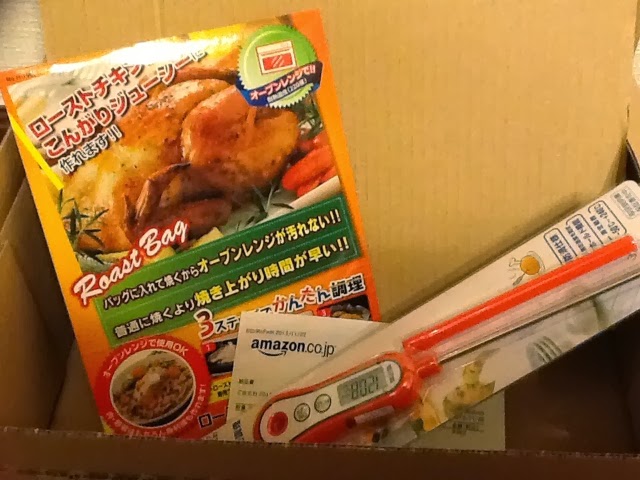 |
| Mircrowave oven roast bag, meat thermometer make up a sample of the necessities to imitate an American style Thanksgiving. |
Therefore, I've learned (sadly through forced training in my early days here of half faking that I understood what people were saying and stumbling my way through conversation) to doctor up what I can and make do. So for that coveted fourth Thursday of November, I create the bird look by baking a rotisserie-look-alike chicken. If I stab a thermometer in it and mount it gently on a hand made doily lined undersized dinner plate, with a good imagination it mimics a cartoon version of a turkey on a platter. This superficial do-it-yourself savvy transfers over to my Easter and Halloween concoctions as well. Why American Easter traditions have not caught on here is a mystery to me. The Japanese love cute and cuddly things (think The Land of Hello Kitty) almost as much as they love giving, receiving and eating upscale chocolates.
She Loves Me, He Loves Me Not
 |
| Made in Japan "White Day," pay-back displays invade department stores for March 14. |
Take Valentine's Day the Japanese way, for example. It's a one way street. Women give men chocolate. Outside of actually giving cocoa fueled gifts to those they like in their lives, they are semi-required to present fancily boxed chocolates to those they work with. I choose "semi-required" lightly since there is actually a word for the custom: giri choko, literally meaning, "obligation chocolate." To reciprocate, they have created a comeback occasion called White Day, a month later in March. On White Day, if you are male recipient of chocolate, you return the chocolate gift favor to the generous giri choko ladies of February 14.
Long Distance Easter Bunny
Even though there are no required duties that surround the customs of Easter baskets or Easter egg hunts, they are packed full of cute chocolate marketing activity potential. A country that has embraced Peter Rabbit and Miffy for all ages really could use the uplifting Easter Bunny in its bank of copy cat (in this case, copy rabbit) traditions. I haven't let a year go by without decorating eggs. Eggs, which luckily don't come from turkeys, are aplenty in Japan, and thanks to the popularity of sushi in Japan, vinegar is easy to come by.
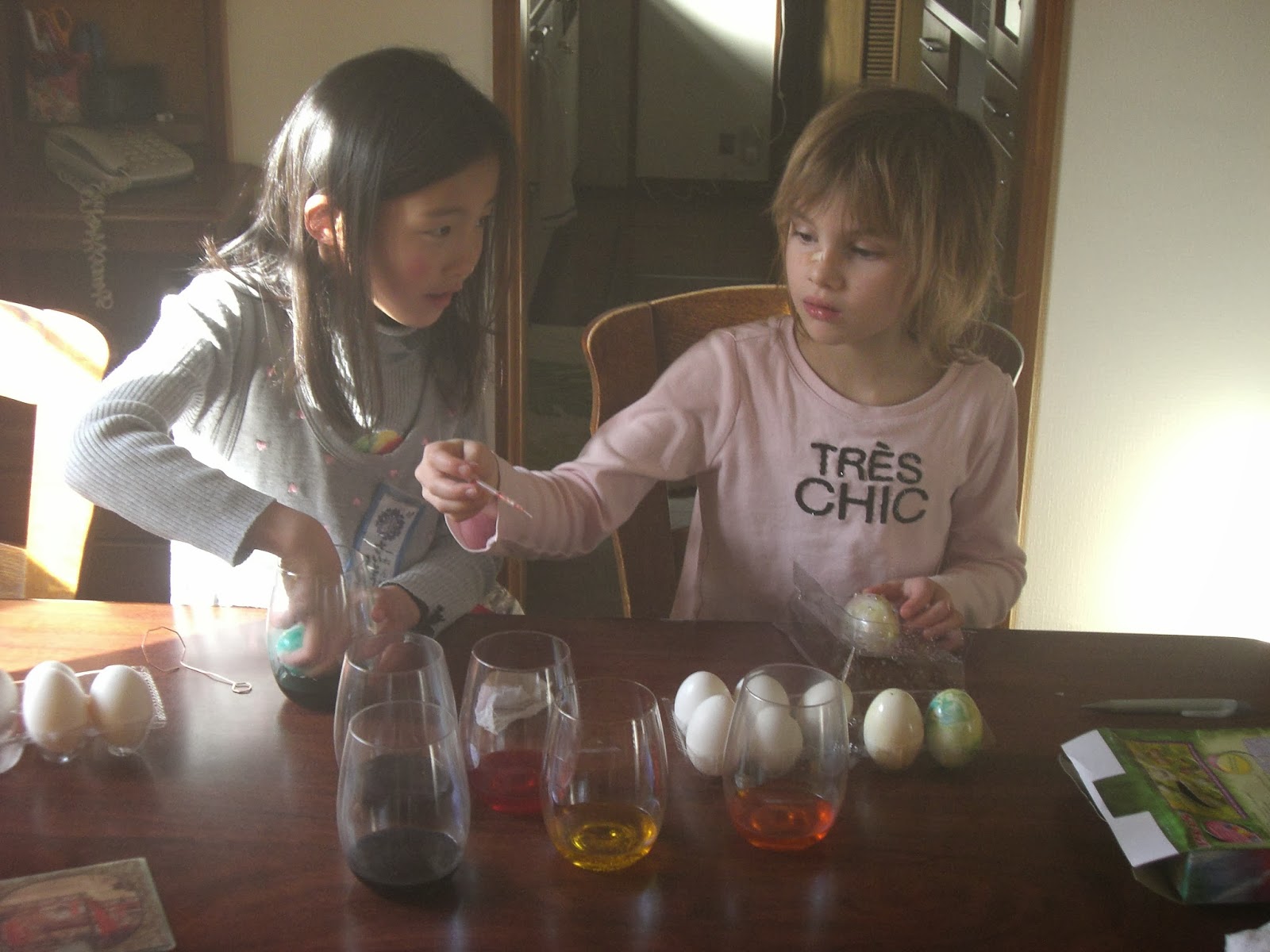 |
| Local eggs, imported Paas dyes; local friend, "imported" American |
It's the Great Green Pumpkin Charlie Brown
Halloween has been catching on more and more. It's finally easy to spot decorations hanging around more than just the standard marketed to foreigner shops in recent years. Even though Beggar's Night is still in the developing country stages, in fall, standard candy sold in any store may have a Halloween themed wrapper. I'm confident (and mostly hopeful) that trick or treating will catch on during my tenure here.
 |
| She is holding a Japanese pumpkin, known to Americans as squash. I was treated for tendonitis one year for carving 6 thick gourds: Green exterior, orange interior. |
 |
| Introducing carmel apple to the neighborhood - skeptical of the sticky mess, but comforted by the chopstick holder. |
When it Comes to Holidays Abroad, Beggar's Night is not Chooser's Night
It takes a true Scrooge not to appreciate a holiday custom, and interestingly, being challenged to adapt to a new way of celebrating, while putting forth great pains to maintain my own custom roots has resulted in doubling the pleasure of celebrations. Accepting and adapting are regular themes that define the pride of the American way. I never imagined that life in Japan would be my greatest teacher of those lessons, nor have I embraced American traditions and holiday more than I do now. And I'm not just saying this because I know Santa is making a list, and checking it twice as I type. He'll show up again this year in his red suit, on his motor bike, and I just bet he'll be delivering an extra large, deep dish supreme. Yes, plenty to share, and even more to be grateful for. It looks like this year, even thousands of miles from "home," I can have my Christmas cake, and eat it too.
 |
| Team "Pizza La" Santa Delivery, at your service! |
Subscribe to:
Posts (Atom)